April 14, 2026 · 6 min
The MECE Mistakes That Sink Strong Candidates
Everyone knows MECE. Far fewer can actually execute it under pressure. Here are the failure modes that interviewers see constantly.
MECE Sounds Simple. It Isn't.
Mutually exclusive, collectively exhaustive. Two requirements, eight syllables, endless ways to fail. Every candidate can define MECE. Very few can consistently execute it when the pressure is on and the problem is unfamiliar.
The gap isn't conceptual—it's practical. Understanding MECE as an idea is trivial. Building MECE structures in real time, with an interviewer watching, for problems you've never seen, is where most candidates struggle.
- Knowing the definition is the easy part
- Execution under pressure is the actual skill being tested
- Most candidates overestimate their MECE ability until they practice rigorously
Mistake 1: The Hidden Overlap
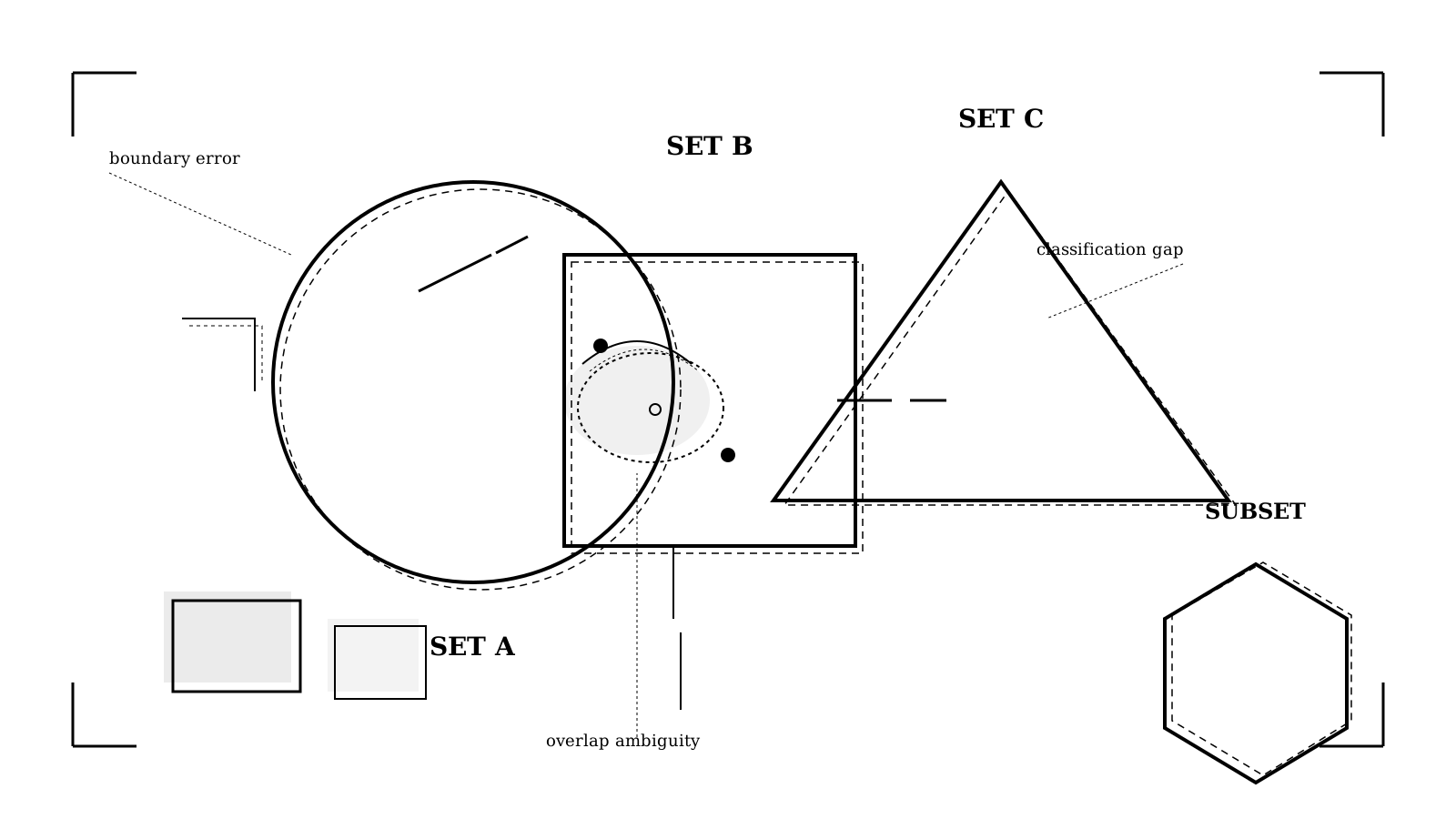
The most common MECE failure is categories that seem distinct but actually overlap. 'Customer acquisition' and 'marketing' overlap. 'Fixed costs' and 'rent' overlap. 'Product issues' and 'quality problems' overlap.
Overlaps create confusion because the same driver can show up in multiple branches. Your interviewer asks which branch a specific issue belongs to, and you can't give a clean answer. This signals fuzzy thinking, exactly what the MECE requirement is designed to reveal.
- Test each pair of categories: Is there anything that could be in both?
- Use the 'where does X go?' test—every data point should have exactly one home
- When in doubt, redefine categories to eliminate ambiguity
Mistake 2: The Invisible Gap
Collective exhaustiveness is harder to verify than mutual exclusivity. Overlaps are visible if you look hard enough. Gaps require you to imagine what you haven't thought of—which is inherently difficult.
The classic gap: forgetting a major category entirely. You decompose revenue into 'existing customers' and 'new customers,' missing that there's a third category—reactivated former customers—that might be exactly where the answer lives.
- Ask: 'Is there anywhere the answer could hide that isn't in my structure?'
- Consider standard business dimensions: geography, customer segment, product line, time period
- Use established frameworks as a checklist against gaps, not as a substitute for thinking
Mistake 3: MECE at the Wrong Level
A structure can be perfectly MECE at one level and completely broken at the next. You might have three clean, non-overlapping top-level categories, but when you decompose them, the sub-categories suddenly overlap or have gaps.
This usually happens when candidates rush to get a structure on paper and only pressure-test the first level. Interviewers will drill into your second and third levels. If those fall apart, your initial structure doesn't save you.
- MECE must hold at every level of decomposition
- Test your structure by drilling one level deeper before presenting it
- Simplify if you can't maintain MECE at lower levels—better to have fewer, cleaner branches
Mistake 4: Framework Force-Fitting
Memorized frameworks are MECE by construction, but they're often not MECE for your specific problem. The 4 P's are great for marketing strategy—they're not always the right decomposition for a pricing case that's really about competitive dynamics.
This mistake stems from learning frameworks as templates rather than as tools. The candidate reaches for a familiar structure instead of building one that fits the problem, and ends up with categories that technically don't overlap but don't actually capture what matters.
- Frameworks are starting points, not destinations
- Adapt framework categories to the specific problem context
- If your framework doesn't fit naturally, build a custom structure
Mistake 5: Premature Granularity
Another failure mode: jumping too quickly to detailed categories without establishing clean higher-level buckets first. The candidate lists eight specific issues without explaining how they group, making it impossible to verify MECE.
Interviewers want to see hierarchical thinking. Start with broad categories, confirm they're MECE, then decompose as needed. Listing granular items without structure suggests you're brainstorming, not analyzing.
- Build structures top-down, not bottom-up
- Establish 3-4 top-level categories before decomposing further
- Each level should be verifiable as MECE before going deeper
Developing Real MECE Intuition
True MECE competence isn't about checking a mental checklist after building your structure. It's about building structures that are MECE from the start—feeling the overlaps and gaps before you commit to categories.
This intuition develops only through repeated practice with feedback. Build structures, have them critiqued, notice your error patterns, and adjust. Over time, the checks become automatic and your first-draft structures improve dramatically.
- Practice structuring the same problem multiple different ways
- Actively seek critique on your structures
- Track your personal error patterns and design practice to address them