April 14, 2026 · 8 min
Profitability Cases: The Framework Most Candidates Use Too Shallowly
Revenue minus cost is only the beginning. Strong profitability analysis goes past the formula and finds the real driver fast.
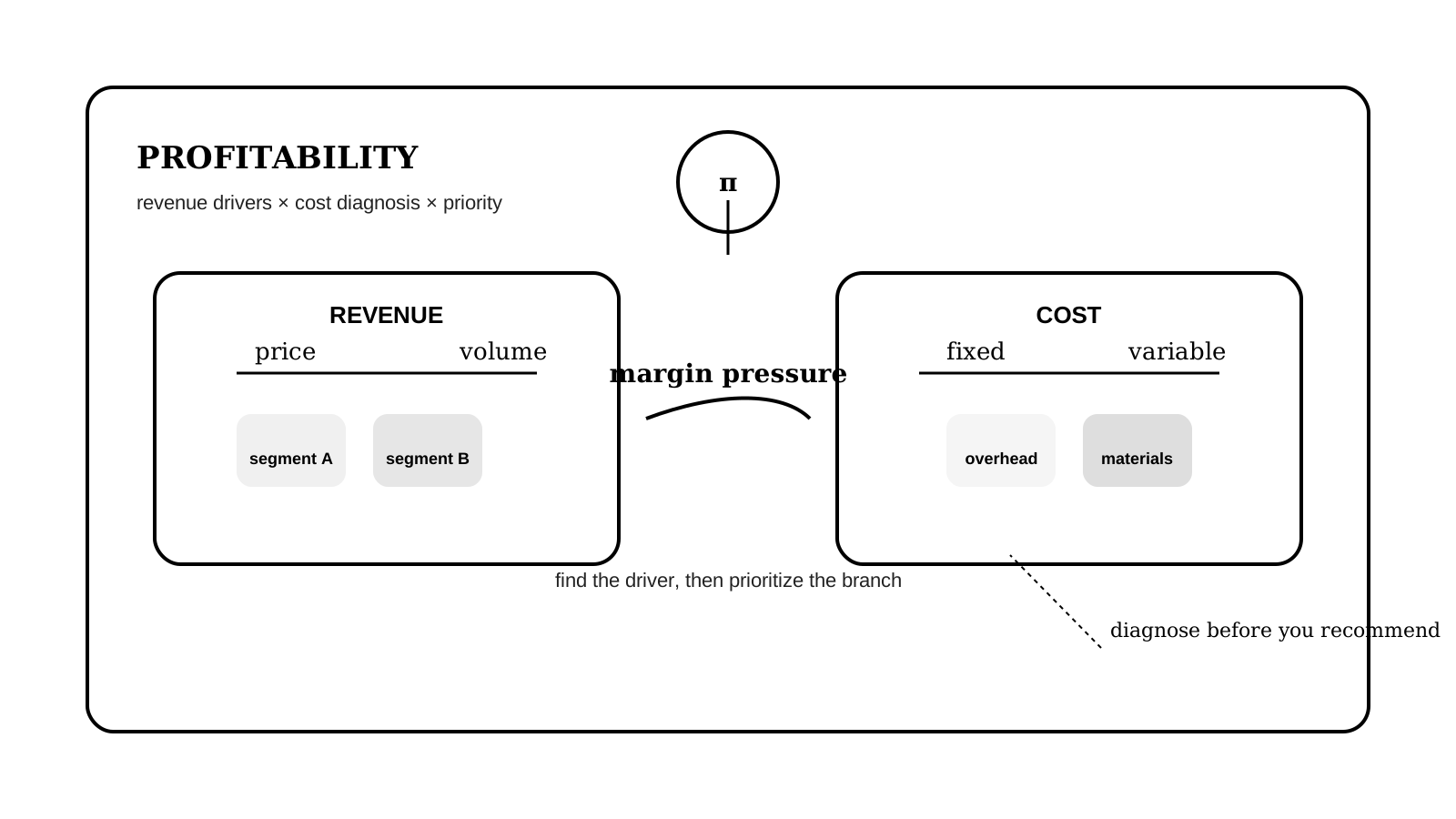
Why 'Revenue Minus Cost' Is Not Enough
Every candidate knows the profitability framework. That is exactly why it stops differentiating people at the surface level. If your only move is to say 'I would look at revenue and costs,' you have stated a formula, not a diagnosis plan.
The real test is whether you can turn that formula into a focused investigation. Interviewers want to see where you would look first, what splits matter most, and how you would avoid getting lost in generic analysis.
- The framework is necessary but not sufficient
- Diagnosis matters more than reciting the formula
- Good candidates move quickly from structure to priority
The Right First Question: Level or Change?
Before decomposing the problem, ask whether the issue is low profitability in absolute terms or declining profitability over time. Those are different questions and often require different structures.
A company that has always had thin margins is a different case from a company whose margins recently collapsed. One is about business economics. The other is about identifying what changed. That distinction can save you several minutes of wandering.
- Low profitability asks: why is the business structurally weak?
- Declining profitability asks: what changed and where?
- Clarifying this upfront improves every branch that follows
Decompose Revenue the Useful Way
Candidates often keep revenue too abstract. A better decomposition is price × volume, then segment further only where needed: product, customer segment, geography, or channel. That gives you a path toward real insight.
The key is choosing the split that is most likely to reveal variation. If one product line is collapsing while others are stable, you want a structure that will expose that immediately.
- Start with price and volume before more exotic branches
- Then segment where variation is likely to exist
- Use business context to choose the most diagnostic split
Decompose Costs With Decision Usefulness in Mind
Fixed versus variable is a good start, but it is not always the best managerial lens. Sometimes the more useful cut is direct versus indirect, controllable versus uncontrollable, or input-specific categories such as labor, materials, logistics, and overhead.
Your cost structure should help you diagnose actionability. If the analysis reveals a margin problem but your categories do not suggest what management can actually do, the structure is too theoretical.
- Choose cost buckets that point toward decisions
- Use the simplest decomposition that preserves actionability
- Do not stop at 'fixed vs variable' if the case needs more specificity
Prioritize Before You Analyze Everything
One of the most common profitability-case mistakes is treating all branches equally. Strong candidates create the full map, then explain where they would investigate first and why.
A good prioritization statement sounds like this: 'I would begin with volume by segment, because the decline seems recent and competitive entry often shows up there first.' That tells the interviewer you are not just structured. You are commercially intelligent.
- Build the tree fully, then prioritize explicitly
- Tie your prioritization to the case facts
- Avoid broad fishing expeditions across every branch
Typical Root Causes Interviewers Want You to Find
Profitability cases frequently boil down to a familiar set of patterns: price pressure, mix shift, demand decline, input cost inflation, utilization problems, or operational inefficiency. Recognizing these patterns helps you move faster without becoming formulaic.
The trick is not to guess the answer early. It is to structure the case so those likely root causes become visible quickly if they are present.
- Price pressure often hides inside customer or channel segments
- Mix shift can hurt margins even if total revenue is flat
- Operational inefficiency usually shows up in cost per unit, not just total cost
How to Close a Profitability Case Well
A strong recommendation does three things: identifies the main driver, states the implication, and recommends action. Too many candidates stop at the diagnosis and never convert it into a management answer.
For example: 'Profitability is down primarily because volume fell in the company’s highest-margin segment after a competitor undercut pricing. I would respond by defending core accounts selectively, simplifying low-margin offerings, and improving retention in the premium tier.' That is a conclusion, not a recap.
- Diagnosis alone is incomplete
- Translate findings into decisions and trade-offs
- Make your recommendation feel implementable, not academic