MethodOctober 22, 20267 min read
First Principles Thinking: How to Break Down Any Business Problem (With Example)
First principles thinking strips a problem to its fundamental truths and rebuilds the answer from scratch. Here's how to apply it—with a worked cost-structure example.
What Is First Principles Thinking?
First principles thinking is a problem-solving method that breaks a question down to its most fundamental truths—facts that cannot be reduced further—then builds a solution upward from those foundations. Instead of accepting conventional assumptions, you identify what is actually true and reason from there.
This approach matters because most business decisions inherit assumptions from how things have always been done. Those assumptions may have been valid once, or they may never have been examined at all. First principles thinking forces you to separate 'this is true' from 'this is how we've always done it.' The result is often a solution that competitors, trapped in conventional thinking, never considered.
The method is not new—Aristotle described it as seeking 'the first basis from which a thing is known'—but it has gained renewed attention because founders like Elon Musk have used it to challenge entrenched industries. The same reasoning applies to everyday business problems: pricing, operations, product design, and strategy.
- First principles are foundational truths that cannot be deduced from other propositions
- The method strips away assumptions and rebuilds from what is demonstrably true
- Useful when conventional approaches have stalled or when entering unfamiliar territory
How Do You Apply First Principles Thinking Step by Step?
Applying first principles thinking follows a structured process: (1) Define the problem clearly. (2) List every assumption embedded in the current approach. (3) Challenge each assumption—ask 'Is this actually true, or is it inherited belief?' (4) Identify the irreducible facts that remain. (5) Rebuild a solution from those facts alone, ignoring precedent.
Step 1: Define the problem. A vague problem yields vague reasoning. Write a clear problem statement that specifies the gap between where you are and where you want to be. 'Our product costs too much' is weak; 'Our unit cost is $85, but the market price ceiling is $60' is strong because it quantifies the gap.
Step 2: Surface assumptions. List everything you believe about the problem and the constraints around it. For a cost problem, assumptions might include: 'We must use supplier X,' 'Assembly requires skilled labor,' 'Units ship individually.' These feel like facts but are often choices made long ago.
Step 3: Challenge each assumption. For every item on your list, ask: Is this a law of physics, a legal requirement, or just the way we've always done it? Most items are the latter. Mark them as challengeable.
Step 4: Find the irreducible facts. What remains after challenging assumptions? For a physical product, irreducible facts might be: the raw materials required by chemistry, the energy needed for transformation, the minimum distance to market. These are your true constraints.
Step 5: Rebuild from fundamentals. Knowing only the irreducible facts, design a new approach. If 'supplier X' was an assumption and not a necessity, what would you do if you sourced differently? If 'skilled labor' was inherited, could automation or redesign change the requirement? Build the solution as if past decisions don't bind you.
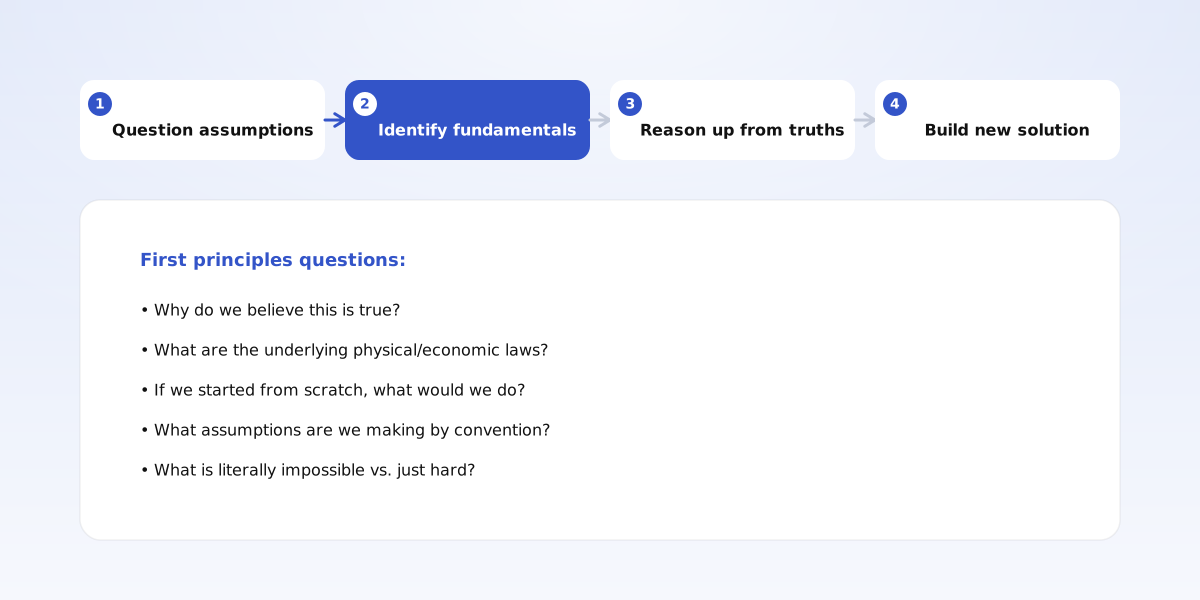
- Step 1: Define the problem with specificity and numbers
- Step 2: Surface all assumptions—write them down explicitly
- Step 3: Challenge each assumption: law of nature or inherited belief?
- Step 4: Identify irreducible facts that survive the challenge
- Step 5: Rebuild the solution using only those fundamentals
First Principles vs Reasoning by Analogy: What's the Difference?
Reasoning by analogy solves problems by pattern-matching to similar situations: 'Company X did this, so we should too' or 'Last time we faced this, we did Y.' Analogical reasoning is efficient—it reuses proven solutions—but it inherits whatever limitations those solutions had.
First principles thinking discards analogies and asks what the situation actually requires. It's slower and more cognitively expensive, but it can reach solutions that analogical reasoning would never surface. The classic example: early electric cars were designed to look like gasoline cars because that's what a 'car' looked like. First principles reasoning asks: given that we're powering with batteries, not engines, what shape should this vehicle actually be?
The two approaches aren't mutually exclusive. Analogy is appropriate when you're operating in well-understood territory and speed matters. First principles is appropriate when you suspect conventional wisdom is wrong, when you're entering new territory, or when the stakes justify deeper analysis. Knowing when to use each is itself a judgment call. For help structuring that decision, a root cause analysis can reveal whether current approaches are failing due to flawed assumptions.
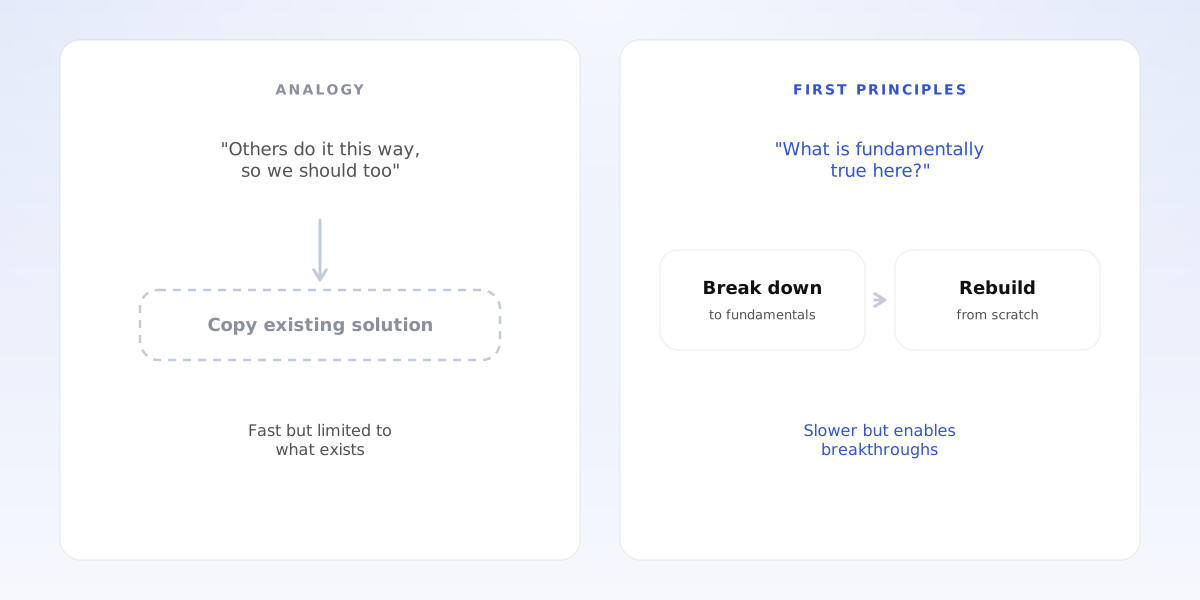
- Analogy: 'Others do X, so we should too'—fast but inherits limitations
- First principles: 'What does this situation actually require?'—slower but can find breakthrough solutions
- Use analogy for routine decisions; use first principles when conventional wisdom fails
Worked Example: Rebuilding Unit Cost From Components
Consider a consumer electronics company whose flagship product has a unit cost of $85. Competitors sell similar products at $55–65. The company's cost position makes profitable competition impossible at market prices. The conventional approach—negotiate harder with suppliers, shave packaging costs—has yielded marginal savings. A first principles analysis looks different.
Step 1: The problem statement is clear: Unit cost is $85; the market ceiling is $60. The gap is $25 per unit, or 29% above the viable price.
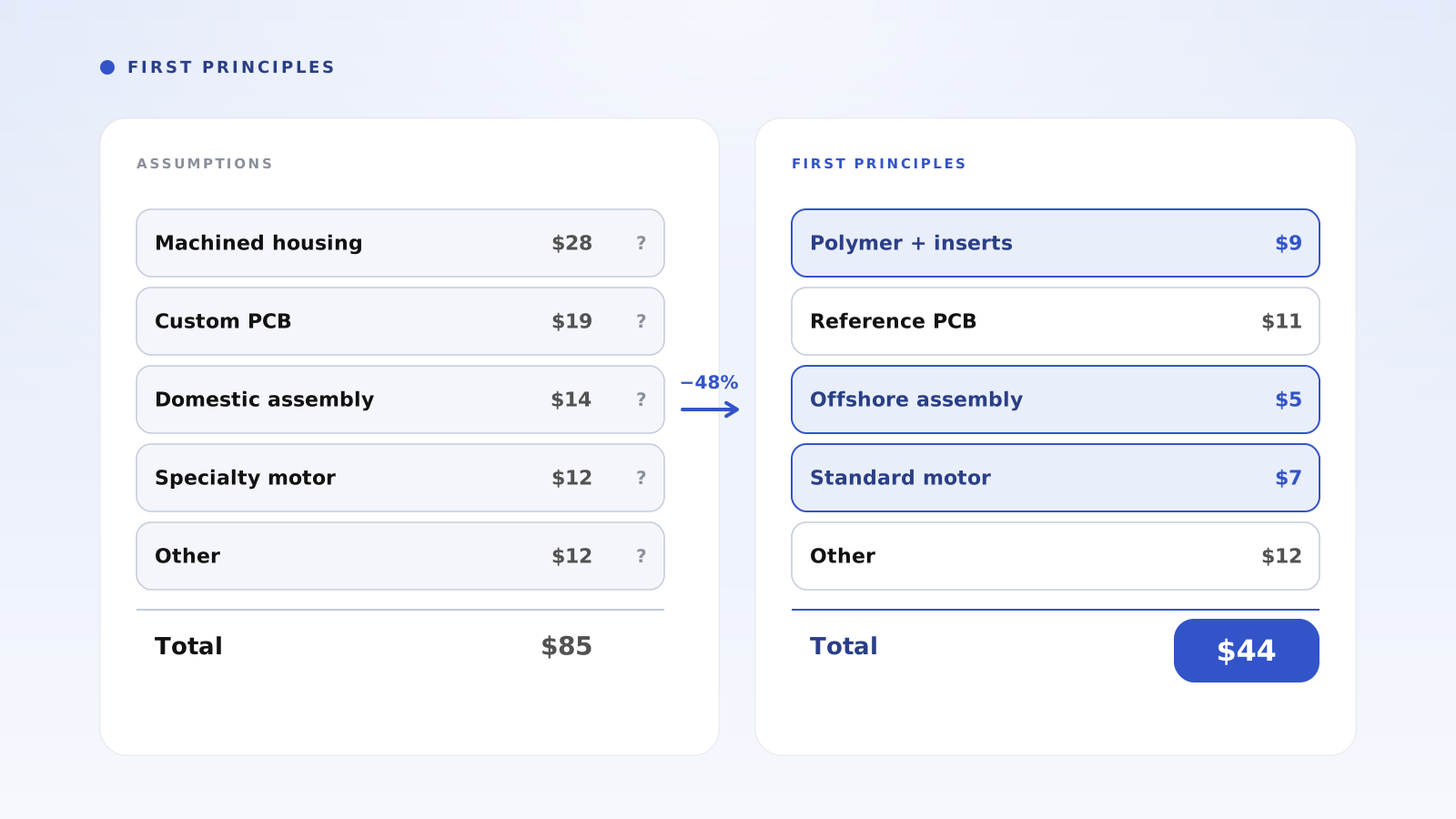
Step 2: Surface assumptions. Current assumptions include: the product requires a machined aluminum housing ($28), the circuit board must be a custom design ($19), assembly is done domestically at $18/hour labor ($14 per unit), the motor is sourced from a specialty supplier ($12), and other components total $12. These sum to $85.
Step 3: Challenge each assumption. Is machined aluminum required? The housing provides rigidity and heat dissipation—but injection-molded polymer with metal inserts could achieve the same function. Is custom PCB required? A reference design with minor modifications might suffice. Is domestic assembly required? The product is not regulated and could be assembled in a lower-cost region. Is the specialty motor required? A standard motor with a different gear ratio might work.
Step 4: Irreducible facts. The product needs: electronic components that perform the core function (cost floor based on commodity pricing: ~$8), a housing that provides structure and heat management, a motor that delivers required torque, and assembly labor (some amount, somewhere). The $85 structure is not irreducible—it's the result of unchallengeable choices.
Step 5: Rebuild. New cost structure: polymer housing with metal inserts ($9, down from $28), reference PCB design ($11, down from $19), offshore assembly at $4/hour equivalent ($5, down from $14), standard motor with gear modification ($7, down from $12), other components remain at $12. New total: $44 per unit. The 29% cost gap becomes a 27% cost advantage.
The first principles analysis didn't find a 5% savings through better negotiation—it found a 48% reduction by questioning the assumptions embedded in every component. This is the power of the method: it reveals that 'constraints' are often decisions in disguise.
- Original cost: $85 (housing $28, PCB $19, assembly $14, motor $12, other $12)
- After first principles: $44 (housing $9, PCB $11, assembly $5, motor $7, other $12)
- Savings: $41 per unit (48% reduction) by challenging assumptions in every component
Frequently Asked Questions
When should I use first principles thinking instead of relying on best practices? Use first principles when best practices aren't working, when you're entering a new domain where precedent doesn't exist, or when you suspect the conventional approach contains unjustified assumptions. For routine optimization in a well-understood area, best practices and hypothesis-driven problem solving are faster.
How do I know if something is a true constraint or just an assumption? Ask: 'What would happen if we violated this?' If the answer is 'physics prevents it' or 'the law forbids it,' it's a true constraint. If the answer is 'we've never tried' or 'it would be unusual,' it's an assumption worth challenging.
Isn't first principles thinking too slow for fast-paced decisions? It's slower than analogy, yes. Use it selectively for high-stakes decisions where the cost of being wrong exceeds the cost of slower analysis. For pricing a new product category, designing a supply chain, or entering a market, the upfront investment pays off. For whether to approve a routine expense, use analogy.
How do I get my team to think in first principles? Start by making assumptions explicit. Before any strategy discussion, ask: 'What are we assuming that we haven't questioned?' Write the list on a whiteboard. Then pick the assumption that would change the answer most if it were wrong, and examine it. This habit, practiced repeatedly, trains first principles instincts. For a structured approach to this decomposition, Razn is a workspace designed for breaking problems into MECE issue trees, testing hypotheses, and writing answer-first documents—exactly the structure first principles analysis requires.
- Use first principles when best practices fail or precedent doesn't exist
- True constraints: physics or law. Assumptions: 'we've never tried'
- Reserve deep analysis for high-stakes decisions; use analogy for routine ones
- Train teams by making assumptions explicit and challenging the highest-impact one
Putting First Principles Thinking Into Practice
First principles thinking is a skill that improves with practice. Start with a decision you're currently facing. Write down the problem, then list every assumption embedded in your current approach. Challenge each one. Identify the irreducible facts. Then—ignoring how you've done it before—design a solution from those facts alone.
The discomfort you feel when discarding familiar approaches is a feature, not a bug. It means you're actually questioning assumptions rather than confirming them. The payoff is solutions that competitors, still reasoning by analogy, will never reach.
Razn is built for exactly this kind of structured work. You can decompose a problem into its components, test which constraints are real, and document your reasoning so it's traceable. When you're facing a problem that conventional wisdom hasn't solved—a pricing decision, a cost structure that doesn't compete, a strategy that needs reinvention—first principles thinking is the method, and Razn is the workspace. It's free during beta.
- Practice by listing assumptions for a current decision and challenging each one
- Discomfort when discarding familiar approaches signals real questioning
- Use Razn to decompose problems, test constraints, and document first-principles reasoning