FrameworksOctober 17, 20268 min read
How to Price a Product: A Decision Framework for Managers
Pricing a product is one of the highest-leverage decisions a business makes. Here's how to move from gut feel to a structured approach using cost, value, and competitive data.
How Do You Price a Product?
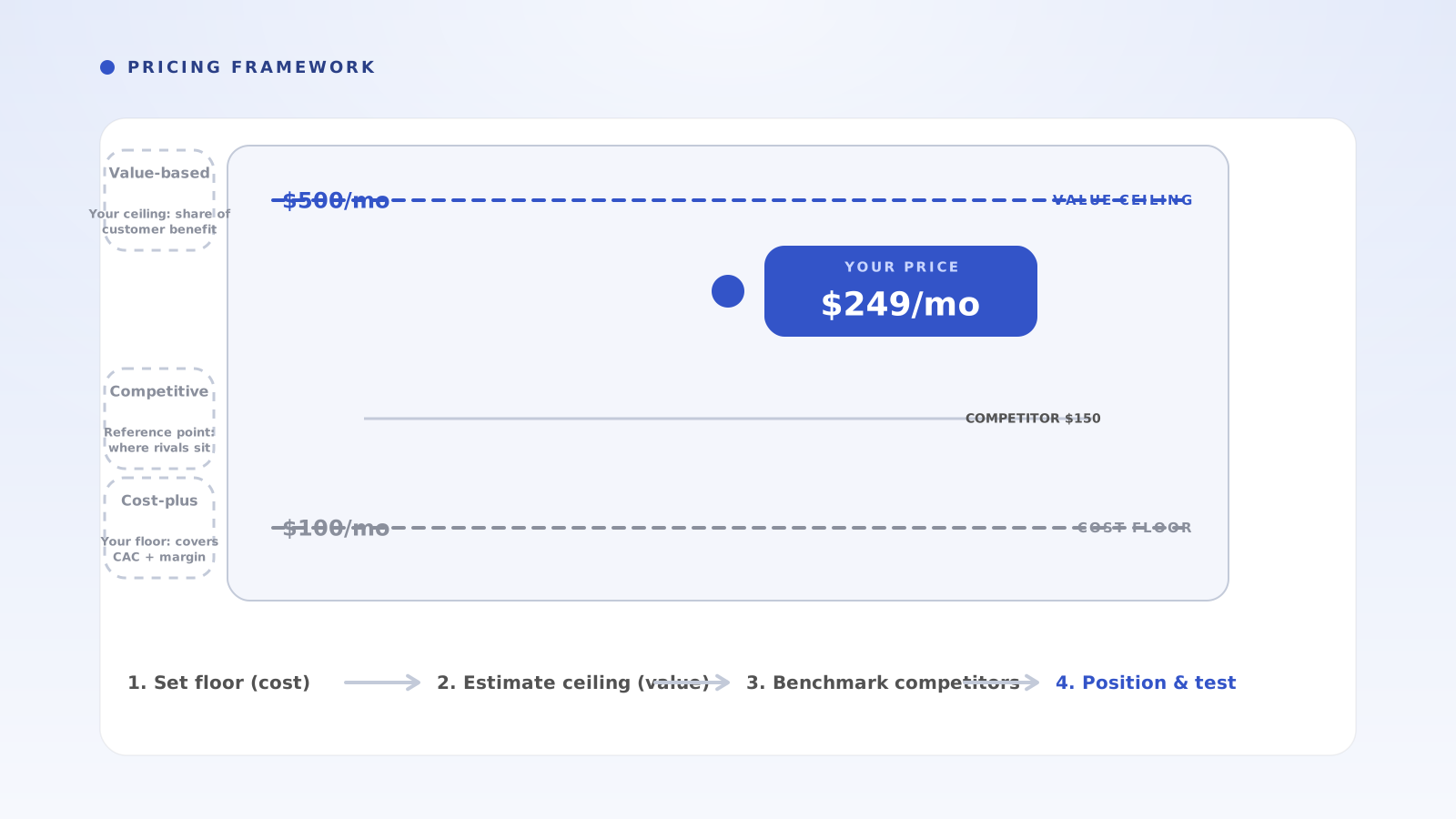
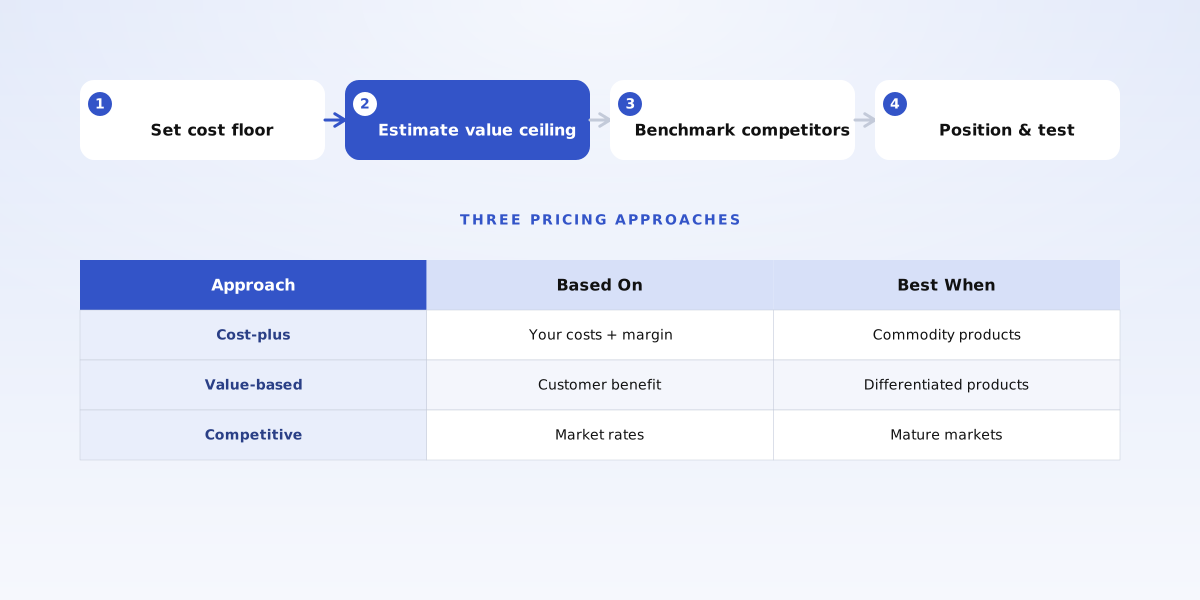
To price a product, calculate your cost floor (the minimum you can charge without losing money), estimate your value ceiling (the maximum a customer would pay given the benefit they receive), and position within that range based on competitive alternatives and your strategic goals. This floor-to-ceiling approach replaces guesswork with a bounded decision space.
Pricing is often treated as a marketing detail, but it's actually one of the most consequential decisions a business makes. A 1% improvement in pricing typically has more impact on profit than a 1% improvement in volume or cost. Yet most teams default to cost-plus or competitor-matching without examining whether those approaches fit their situation.
The framework that follows applies whether you're pricing a SaaS subscription, a physical product, or a professional service. The inputs differ—software has near-zero marginal cost, for instance—but the logic holds: define your floor, estimate your ceiling, and position deliberately within that range.
- Pricing is a high-leverage decision: small changes move profit disproportionately
- Start with a floor (cost-based) and a ceiling (value-based), then position within
- No single pricing method works universally—combine cost, value, and competitive data
What Is Cost-Plus Pricing?
Cost-plus pricing sets your price by adding a markup to your unit cost. If it costs you $50 to make a product and you want a 40% margin, you price it at $83. The appeal is simplicity: you know your costs, you pick a margin, you're done.
The problem is that cost-plus ignores the customer's perspective entirely. If your product delivers $200 of value and you price at $83, you've left money on the table. If it delivers $60 of value, you'll struggle to sell. Cost-plus is useful as a floor—a reality check that prevents pricing below breakeven—but it's rarely the right way to set the actual price.
- Formula: Price = Unit Cost × (1 + Markup %)
- Works best for commodities where competitors use the same method
- Treat it as your price floor, not your final answer
What Is Value-Based Pricing?
Value-based pricing sets your price relative to the benefit the customer receives, not your cost to produce. If your software saves a customer $10,000 per month in labor costs, pricing it at $1,000 per month captures only 10% of the value created. The customer still gets a 10x return, and you capture far more than a cost-plus approach would allow.
The challenge is quantifying value. For B2B products, look for time saved, revenue gained, or costs avoided—these translate directly to dollars. For consumer products, value is fuzzier: it's the willingness to pay, revealed through purchasing behavior and research. Value-based pricing requires you to understand your customer deeply, which is also why it's so powerful when done well.
- Price based on customer benefit, not your cost
- Quantify value in dollars: time saved, revenue gained, costs avoided
- Capture a share of the value you create—the customer keeps the rest as their incentive
What Is Competitive Pricing?
Competitive pricing benchmarks your price against alternatives in the market. If the leading competitor charges $100 and you're positioning as a premium alternative, you might price at $120. If you're positioning on value, you might undercut at $80. The reference point is what the customer could pay elsewhere.
Competitive pricing is necessary but insufficient. Necessary because customers compare—your price never exists in a vacuum. Insufficient because simply matching competitors doesn't account for your cost structure or your differentiated value. Use competitive analysis to set the range, then position within it based on your floor and ceiling.
- Benchmark against the alternatives a customer actually considers
- Premium position: price above the reference to signal quality or exclusivity
- Value position: price below the reference to win on cost-benefit
How Do You Set a Price Floor and Ceiling?
Your price floor is your fully-loaded unit cost: the direct cost of goods, plus an allocation of fixed costs, plus any variable costs that scale with sales. Below this number, you lose money on each unit sold. The floor keeps you honest about what you can sustain.
Your price ceiling is the maximum a customer would pay before walking away—their willingness to pay. In B2B, estimate this by quantifying the economic value of your product relative to the next-best alternative. In B2C, use surveys, A/B tests on landing pages, or analysis of revealed preferences (what similar products sell for). The ceiling represents the upper bound of your positioning.
Your actual price lives somewhere between floor and ceiling. Where you land depends on competitive pressure, your go-to-market strategy, and how much of the value you can credibly capture. A wide gap between floor and ceiling is a sign of a strong business; a narrow gap means pricing power is limited.
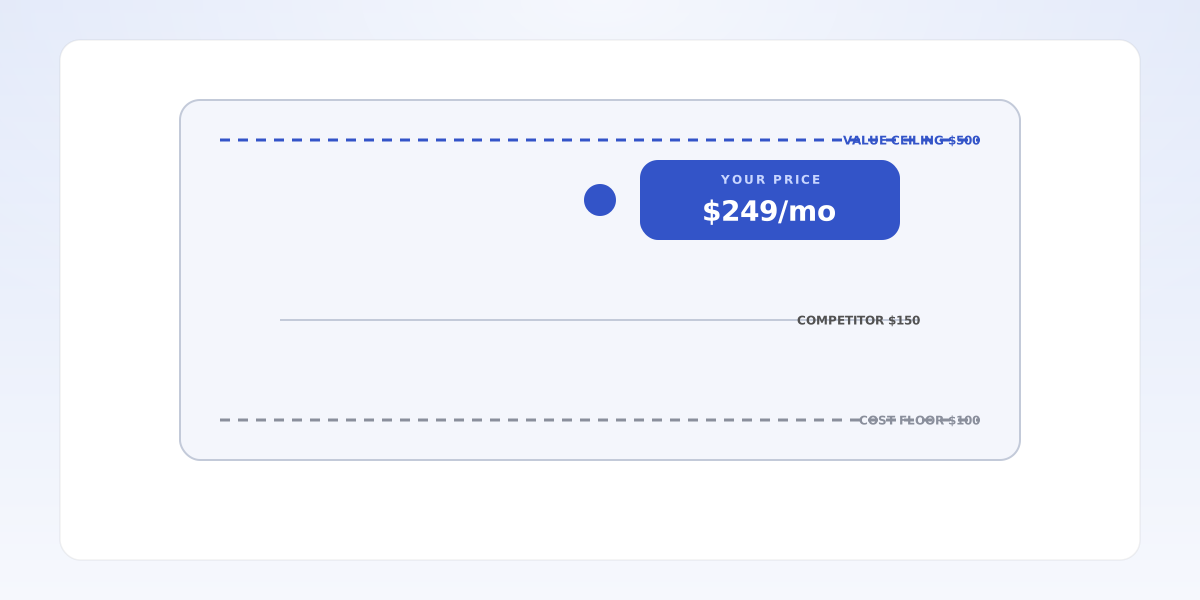
- Floor = fully-loaded unit cost (direct cost + allocated fixed cost + variable costs)
- Ceiling = customer willingness to pay (quantified value or revealed preference)
- Wide floor-to-ceiling gap = high pricing power; narrow gap = constrained margins
A Worked Example: Pricing a B2B SaaS Product
Suppose you're pricing a project management tool for mid-market companies. Your cost structure: the marginal cost to serve one additional customer is near-zero (cloud infrastructure), but your customer acquisition cost (CAC) is $1,200 and payback period target is 12 months. That implies a floor of $100/month ($1,200 CAC ÷ 12 months) to recover acquisition costs on schedule.
Value analysis: customers report saving 8 hours per week of project manager time. At $75/hour fully-loaded, that's $600/week or ~$2,400/month in labor savings. If you price at $200/month, the customer captures $2,200/month in net value—a 12x return. Your ceiling, in theory, extends to $2,400/month, but practical ceilings are lower because value is uncertain and switching costs exist. A realistic ceiling might be $500/month.
Competitive analysis: the main competitor charges $150/month, with fewer features. You've validated stronger outcomes, so a premium is defensible. You choose $249/month—above the competitor (signaling quality), comfortably above your floor (margin), and well below the ceiling (leaving the customer with obvious value). Initial test: 30-day free trial with conversion tracking to validate willingness to pay before full rollout.
- Floor: $100/month (CAC payback in 12 months)
- Ceiling: ~$500/month (share of $2,400/month labor savings)
- Final price: $249/month—premium to competitor, strong margin, clear customer ROI
How Do You Test Willingness to Pay?
Willingness to pay is the ceiling you can't see directly, so you estimate it through research and experimentation. Surveys are fast but hypothetical—people say they'd pay more than they actually do. Pricing page A/B tests are slower but reveal real behavior: show different prices to different cohorts and measure conversion.
Van Westendorp's Price Sensitivity Meter asks four questions: at what price is this product too cheap (quality concern), a bargain, getting expensive, or too expensive? The intersection of these curves identifies an acceptable price range. For high-stakes decisions, conjoint analysis isolates how much each feature contributes to willingness to pay.
The key is to test before you commit. Pricing changes are hard to reverse—customers anchor on the first price they see. Run experiments with limited exposure, then scale the validated price.
- Surveys: fast, directional, but inflated estimates
- A/B tests: slower, but measure real conversion behavior
- Van Westendorp: finds the acceptable range using four price-perception questions
- Test with limited exposure before locking in your price
Frequently Asked Questions
Should I price high and discount, or price low and hold? Generally, start higher. It's easier to lower prices or offer targeted discounts than to raise prices once customers are anchored low. A higher starting price also signals quality and protects margin.
How often should I revisit pricing? At minimum, annually—or whenever your cost structure, competitive landscape, or value proposition changes materially. Many companies under-revisit pricing because it feels uncomfortable; a regular review cadence forces the conversation.
What if my product serves multiple segments with different willingness to pay? Use tiered pricing or versioning. Offer a basic tier at a lower price for price-sensitive segments, and a premium tier with more features or service for segments with higher willingness to pay. This captures value from each segment without leaving money on the table.
How does pricing relate to hypothesis-driven problem solving? Pricing is itself a hypothesis: 'At $X, we will achieve Y conversion and Z margin.' Treat it as testable, not fixed. If the data doesn't support your hypothesis, adjust. The same structured approach applies to pricing as to any business problem.
Can I use a decision matrix to choose a pricing strategy? Yes. If you're debating between cost-plus, value-based, and competitive pricing (or a hybrid), list each option, weight criteria like data availability, margin protection, and market fit, score them, and see which method fits your context. This is especially useful when stakeholders disagree.
- Start higher: easier to discount than to raise prices
- Review pricing annually or when major inputs change
- Use tiered pricing to capture value across segments with different willingness to pay
- Treat pricing as a hypothesis—test it, don't guess it
Putting It Into Practice
To price a product well, you need three numbers: your cost floor, your value ceiling, and the competitive reference point. Gather these, and you've bounded the decision. Then choose where to position within that range based on your strategy—premium, value, or parity—and test your hypothesis before full commitment.
This is the kind of structured work Razn is built for. You can lay out your pricing inputs, model different scenarios, and document your reasoning so the decision is defensible when stakeholders ask 'why this price?' The structure turns a contentious debate into a traceable analysis. If you're facing a pricing decision and want help thinking through it systematically, give Razn a try—it's 80/20 thinking applied to your hardest choices.
- Gather the three inputs: cost floor, value ceiling, competitive reference
- Position deliberately: premium, value, or parity
- Document your reasoning so the decision is traceable and revisable


