FrameworksOctober 16, 20267 min read
Decision Matrix: How to Make Hard Choices With a Weighted Scoring Model
When you have multiple options and conflicting priorities, a decision matrix turns gut feel into a defensible choice. Here's how to build one that actually helps.
What Is a Decision Matrix?
A decision matrix is a tool for comparing multiple options against a set of weighted criteria. When you face a choice where several factors matter—and they matter unequally—the matrix forces you to score each option against each factor, then calculates which option wins overall. The result is a defensible, transparent choice instead of a hunch.
The core insight is simple: hard decisions feel hard because you're holding too many variables in your head at once. A decision matrix externalizes that complexity. You still apply judgment—choosing the criteria, setting the weights, assigning scores—but the structure keeps the comparison honest.
- Compare multiple options against the same criteria simultaneously
- Weight criteria to reflect what actually matters most
- Surface the winner through arithmetic instead of intuition
How Do You Create a Weighted Decision Matrix?
Building a decision matrix takes five steps. First, list your options—these go in the columns. Second, list the criteria you'll judge them on—these go in the rows. Third, assign a weight to each criterion so the weights sum to 100%. Fourth, score each option on each criterion using a consistent scale (1–5 works well). Fifth, multiply each score by its weight, sum across criteria, and compare the totals.
The discipline is in steps two and three. Most people rush to scoring before clarifying what they care about and how much. Spend time here. If two criteria overlap, merge them. If one criterion is really three, split it. The matrix is only as good as the structure you feed it.
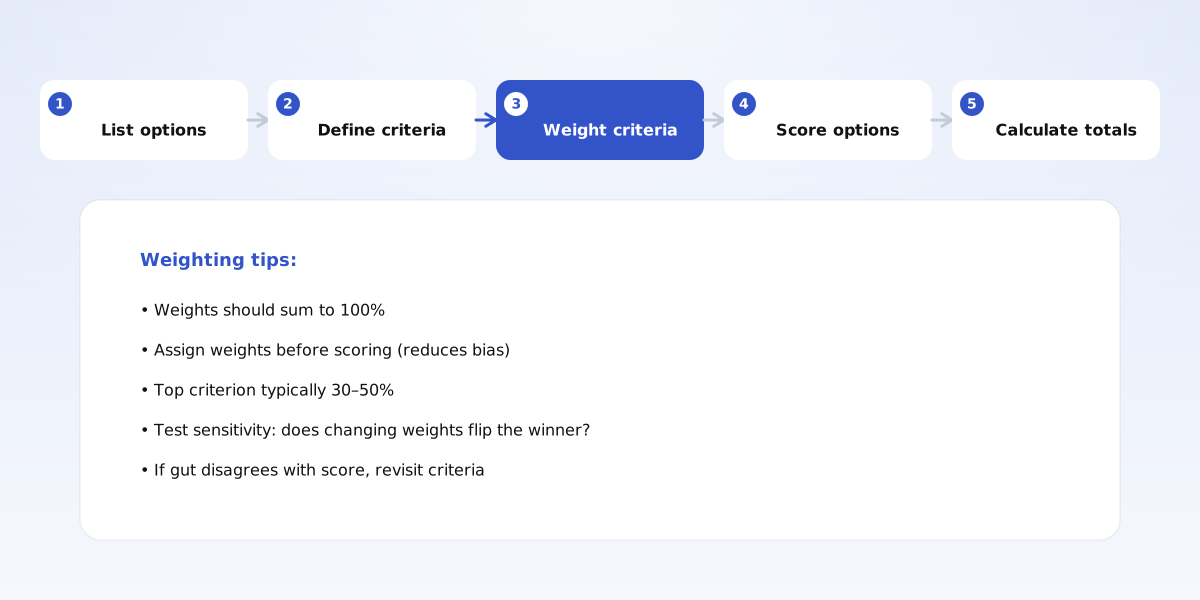
- Step 1: List your options (columns)
- Step 2: List your criteria (rows)
- Step 3: Assign weights to criteria, summing to 100%
- Step 4: Score each option on each criterion (e.g., 1–5)
- Step 5: Multiply scores by weights, sum, and compare
A Worked Example: Choosing Between Three Job Offers
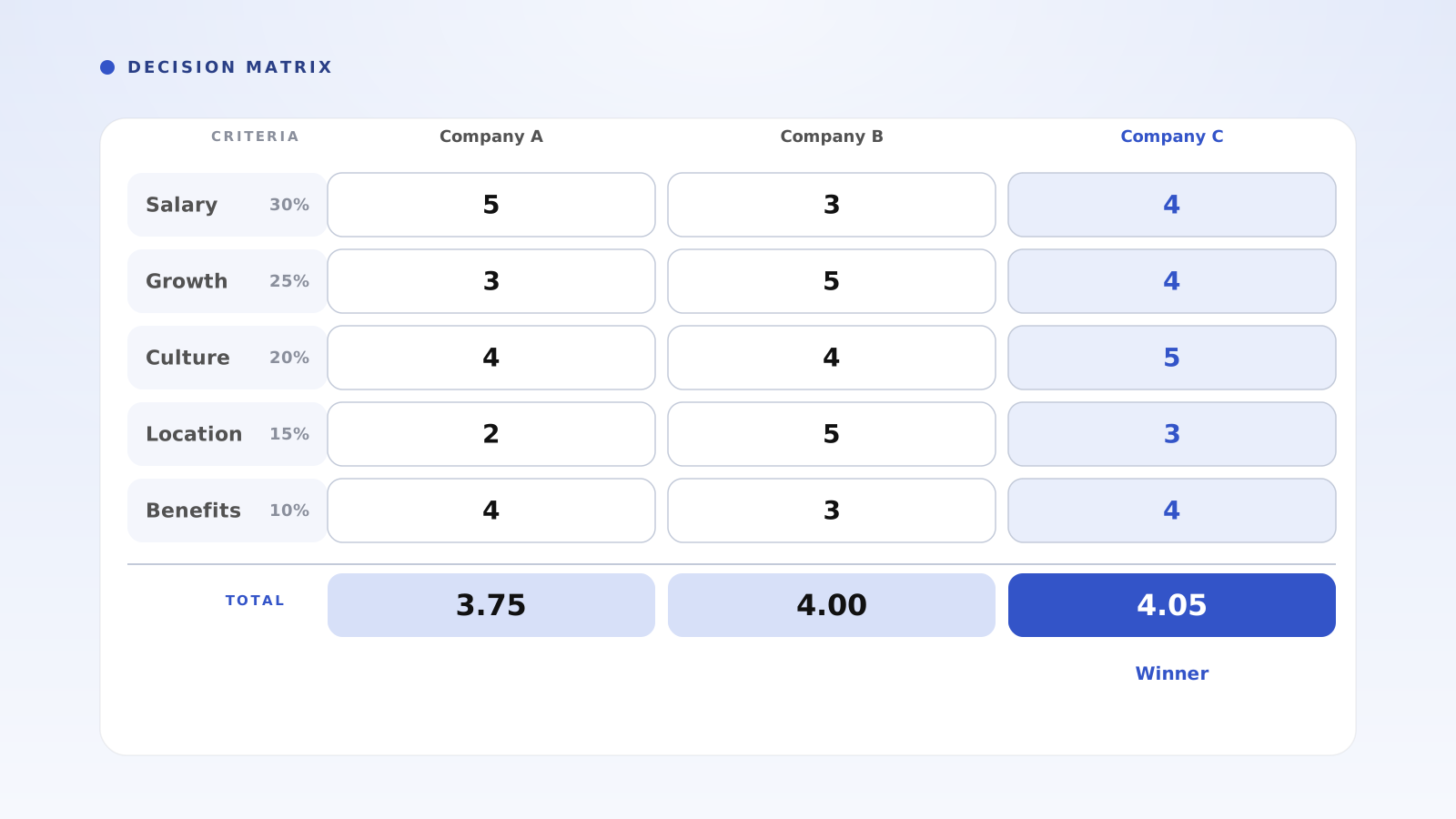
Suppose you have three job offers and need to decide. You identify five criteria that matter: Salary (30% weight), Growth opportunity (25%), Culture (20%), Location (15%), and Benefits (10%). You score each company 1–5 on each criterion. Company A scores 5 on Salary, 3 on Growth, 4 on Culture, 2 on Location, and 4 on Benefits. Company B scores 3, 5, 4, 5, 3. Company C scores 4, 4, 5, 3, 4.
Now calculate. Company A: (0.30×5) + (0.25×3) + (0.20×4) + (0.15×2) + (0.10×4) = 1.50 + 0.75 + 0.80 + 0.30 + 0.40 = 3.75. Company B: (0.30×3) + (0.25×5) + (0.20×4) + (0.15×5) + (0.10×3) = 0.90 + 1.25 + 0.80 + 0.75 + 0.30 = 4.00. Company C: (0.30×4) + (0.25×4) + (0.20×5) + (0.15×3) + (0.10×4) = 1.20 + 1.00 + 1.00 + 0.45 + 0.40 = 4.05.
Company C wins with 4.05, just edging out Company B at 4.00. Company A, despite the highest salary, comes in last at 3.75 because it underperforms on growth and location. The matrix revealed that your stated priorities—weighting salary at only 30%—favored a more balanced option.
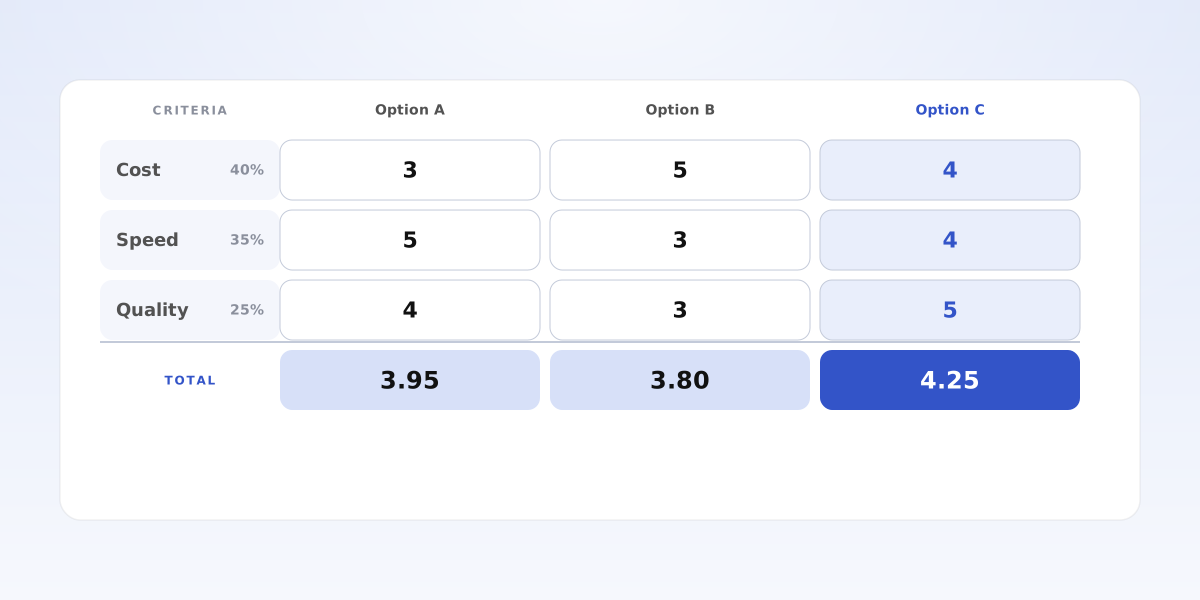
- Weights reflect priorities: Salary matters, but not as much as Growth + Culture combined
- Scores are judgment calls, but they're visible and debatable
- The arithmetic is simple—the value is in making trade-offs explicit
When Should You Use a Decision Matrix?
A decision matrix earns its keep when you have at least three options and at least three criteria that matter. Fewer than that, and the overhead isn't worth it. The matrix also works best when the criteria are somewhat independent—if two criteria always move together, you're double-counting.
Classic use cases: hiring (comparing candidates), purchasing (comparing vendors), strategy (comparing market entry modes), and prioritization (comparing projects for a limited budget). Any time you catch yourself saying 'it depends' repeatedly, a matrix can clarify what it depends on.
- Three or more options with three or more criteria
- Criteria should be reasonably independent
- Especially useful for hiring, vendor selection, and project prioritization
When Should You Not Use a Decision Matrix?
Don't use a matrix when one criterion is genuinely non-negotiable. If any score below 3 on 'regulatory compliance' is disqualifying, filter those options out first—don't let the matrix average away a fatal flaw. Similarly, skip the matrix if the decision is already obvious. Over-engineering a clear choice wastes time and invites second-guessing.
Watch out for false precision. A matrix gives you a number, but that number is only as reliable as your inputs. If you're guessing at half the scores, the ranking can flip on small changes. Run a quick sensitivity check: if tweaking one uncertain score by a point changes the winner, the matrix is telling you to gather more information, not to trust the current output.
- Filter out options that fail non-negotiable criteria before scoring
- Skip the matrix if the answer is already obvious
- Test sensitivity: does the winner change with plausible score adjustments?
Common Mistakes and How to Avoid Them
The first mistake is weights that don't reflect reality. People claim criteria are equally important, then balk at the result because it contradicts what they actually wanted. If you don't like the output, revisit the weights—your revealed preferences may differ from your stated ones.
The second mistake is inconsistent scoring. If you score optimistically on one option and conservatively on another, you've rigged the result. Score one criterion across all options before moving to the next, so you're making like-for-like comparisons.
The third mistake is treating the matrix output as final. A decision matrix is a decision input. It clarifies trade-offs and surfaces your priorities; it doesn't absolve you of judgment. If the winner feels wrong, that's information—interrogate why.
- Weights should match actual priorities—test by checking if you'd accept the result
- Score one criterion at a time across all options to stay consistent
- Use the output to inform judgment, not replace it
Frequently Asked Questions
What scale should I use for scoring? A 1–5 scale is usually enough granularity. Wider scales (1–10) introduce false precision without adding real information. Whatever scale you pick, define the endpoints: 1 means 'fails to meet the need,' 5 means 'fully meets the need.'
How do I set the weights? Start by rank-ordering your criteria from most to least important, then distribute 100 points across them. The gap between adjacent criteria should reflect how much more the higher one matters. If you can't decide, try multiple weightings and see if the winner changes.
Can I use a decision matrix for personal decisions? Yes. The method works for apartments, job offers, graduate programs, or any choice where you have options, criteria, and trade-offs. The act of writing down your criteria and weights often clarifies what you actually want.
What if two options tie? If the scores are within a few percent, they're effectively tied given the uncertainty in your inputs. Look for a tiebreaker criterion you didn't include, or accept that either choice is defensible and pick.
How does a decision matrix relate to hypothesis-driven thinking? A hypothesis is your best current guess about the answer. A decision matrix is a tool for testing that guess: you lay out the options, weight the criteria, and see if the data confirms your initial leaning. If it doesn't, you've learned something.
- 1–5 scale, with endpoints clearly defined
- Weights: rank-order criteria, then distribute 100 points
- Works for both professional and personal decisions
- Near-ties mean either option is defensible
- The matrix tests your hypothesis about which option is best
Putting It Into Practice
The best way to learn is to build one. Pick a decision you're currently facing—or a recent one you can reconstruct—and run it through the five steps. Set a ten-minute timebox. The first matrix is never perfect, and it doesn't need to be; the value is in the structure, not the polish.
Razn is built for exactly this kind of structured work. You can define the options, set the criteria, adjust the weights, and see the weighted totals update as you refine your inputs. When you need to explain the choice to someone else—or to your future self—the matrix is already documented and shareable.
- Build a matrix for a real decision in ten minutes
- Start rough; refine as you learn what matters
- Document the matrix so you can revisit the reasoning later


