MethodOctober 23, 20267 min read
Second-Order Thinking: How to Make Better Business Decisions
Second-order thinking asks 'and then what?' to reveal consequences that first-order analysis misses. Here's how to apply it—with a worked pricing example.
What Is Second-Order Thinking?
Second-order thinking is a decision-making method that looks beyond immediate consequences to examine what happens next—and what happens after that. While first-order thinking asks 'What is the direct result of this action?', second-order thinking asks 'And then what?' The method reveals hidden costs, unintended effects, and feedback loops that simple analysis misses.
Most bad business decisions aren't wrong at the first-order level. A price cut increases volume. A hiring freeze reduces costs. An aggressive growth target energizes the team. These first-order effects are real and often positive. The problems emerge at the second order: the price cut triggers a competitor response that erodes everyone's margins; the hiring freeze burns out the remaining staff, increasing attrition costs; the aggressive target leads to shortcuts that damage quality and reputation.
Second-order thinking matters because consequences compound. A decision that looks good today may create problems that dwarf the original benefit. The discipline of asking 'then what?' surfaces these downstream effects before they become sunk costs. For high-stakes, irreversible decisions, this analysis is essential.
- First-order: the direct, immediate consequence of an action
- Second-order: what happens as a result of that first consequence
- Most decision failures come from ignoring second-order effects, not from getting the first order wrong
How Do You Apply Second-Order Thinking Step by Step?
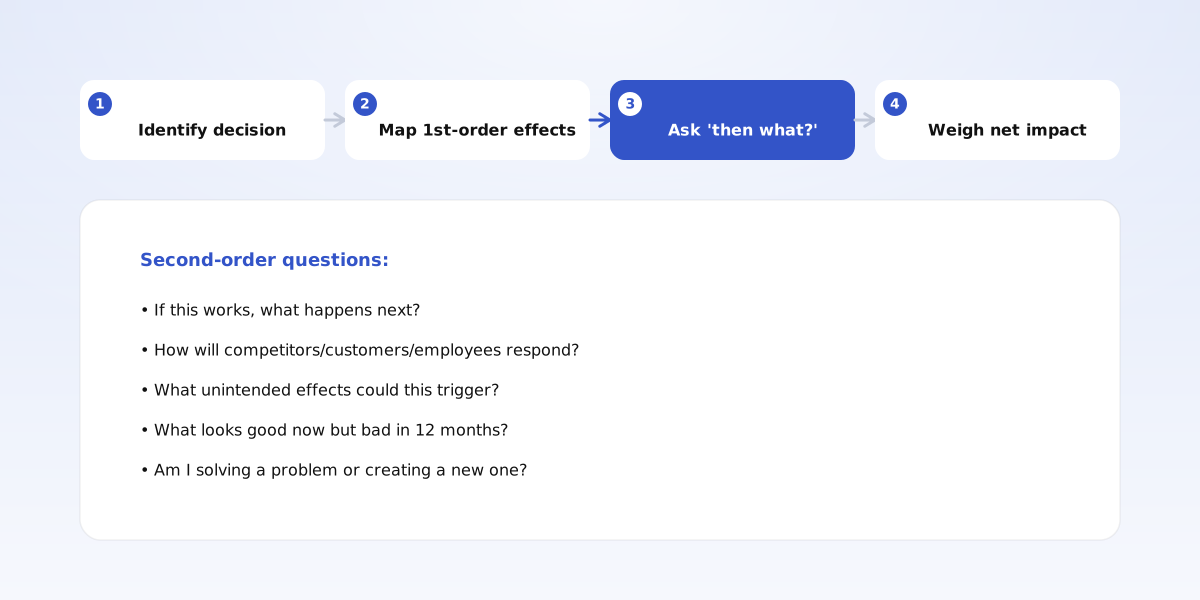
Applying second-order thinking follows a structured process: (1) Identify the decision and its intended first-order effect. (2) For each first-order effect, ask 'then what?' to surface second-order consequences. (3) Continue to third order where relevant. (4) Weigh the net impact across all orders. (5) Decide whether the total outcome justifies the action.
Step 1: State the decision clearly. Write down what you're considering and the immediate result you expect. 'Cut prices 15% to increase volume' or 'Delay the product launch to add features.' Be specific about the first-order effect you're counting on.
Step 2: Map second-order effects. For each first-order result, ask: What happens next? How do customers, competitors, employees, and partners respond to this new state? What behaviors does this outcome encourage or discourage? Write each consequence down—you'll often surface effects you hadn't consciously considered.
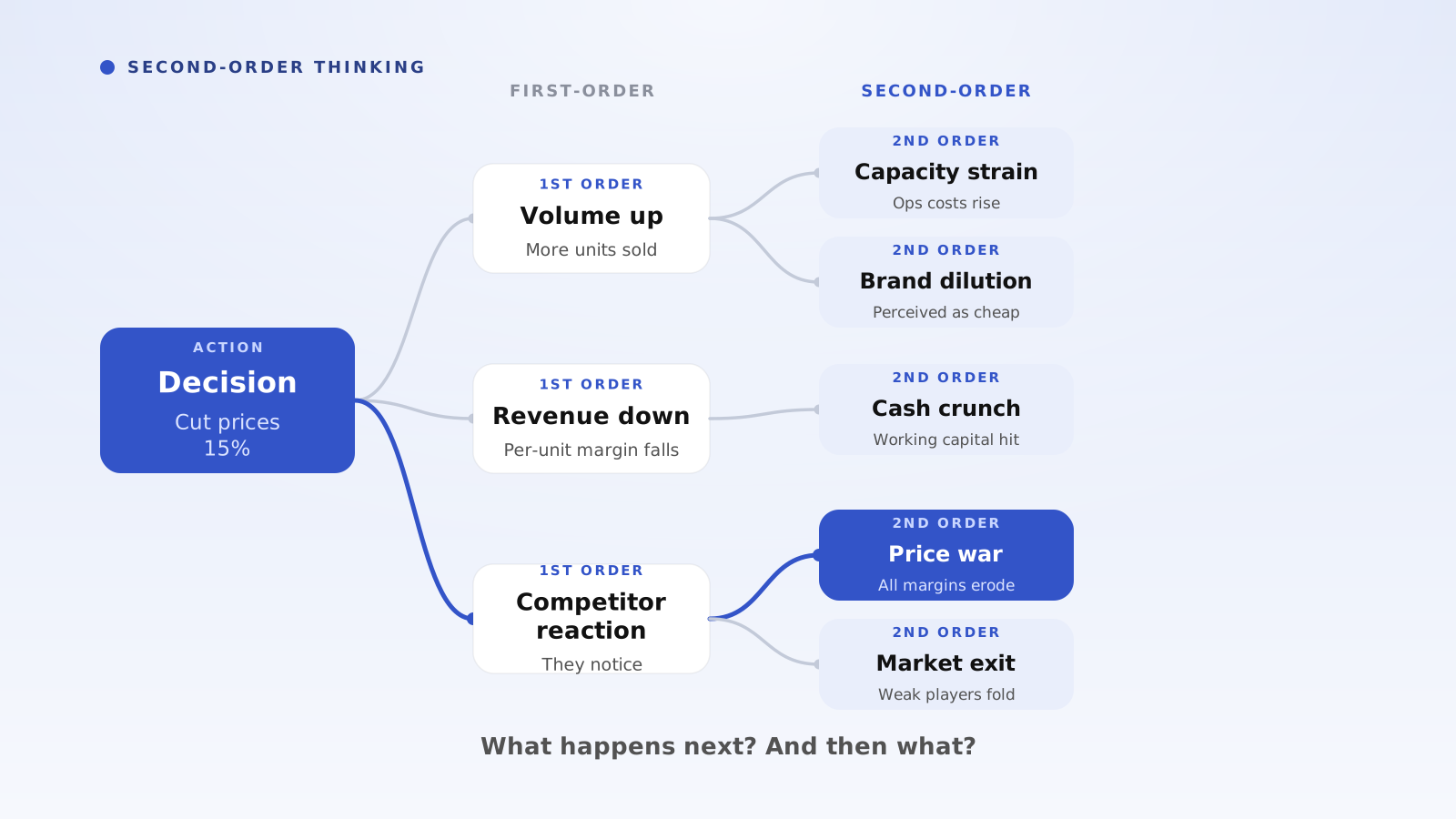
Step 3: Extend to third order where stakes are high. For major decisions, push one level deeper. If the price cut triggers a competitor response (second order), what does that response cause (third order)? A price war, margin collapse, or weaker players exiting? This chain matters for pre-mortem analysis.
Step 4: Weigh the net impact. Sum the effects across all orders. Some second-order consequences may be positive—a competitor's exit increases your market share. Others may be negative—ops costs spike. The decision is good if the total is positive, not just if the first order looks attractive.
Step 5: Decide with full visibility. Now you're deciding with eyes open. The price cut might still be the right call, but you know the second-order costs and can plan for them. Or the second-order analysis reveals the decision destroys more value than it creates, and you avoid a costly mistake.
- Step 1: State the decision and its intended first-order effect
- Step 2: For each first-order effect, ask 'then what?' to find second-order consequences
- Step 3: Push to third order for high-stakes decisions
- Step 4: Sum the net impact across all orders
- Step 5: Decide based on total outcome, not just immediate result
What Is the Difference Between First-Order and Second-Order Thinking?
First-order thinking stops at the immediate consequence. It's fast, intuitive, and often wrong for complex decisions. Second-order thinking traces the chain of effects further. It's slower, requires deliberate effort, and catches problems that first-order analysis misses.
Consider a simple example: a company struggling with cash flow decides to delay paying suppliers by 30 days. First-order effect: improved cash position this quarter. Second-order effects: suppliers tighten credit terms, prioritize other customers, or raise prices to compensate for their own cash strain. Third-order: the company's cost of goods rises and delivery reliability falls, eroding the competitive position that generated the revenue in the first place.
The difference matters because the world reacts to your decisions. Customers adjust behavior. Competitors respond. Employees recalibrate effort. These reactions are second-order effects, and they often dominate the first-order gains. Ignoring them is the source of most 'unintended consequences'—they were predictable, just not predicted.
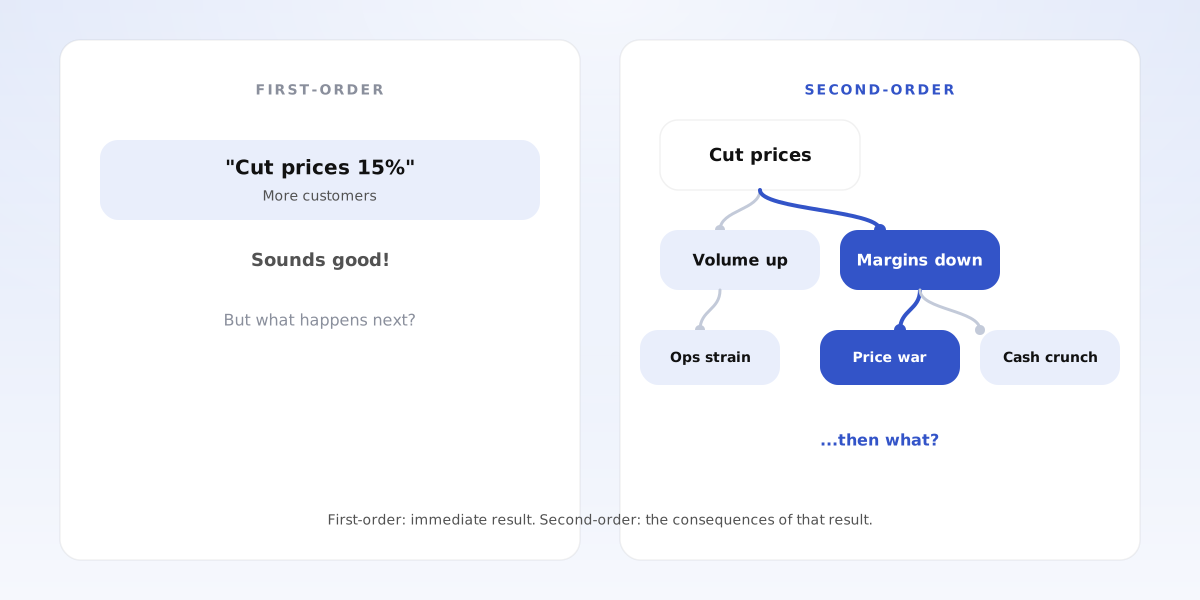
- First-order: 'What is the immediate result?'—fast but incomplete
- Second-order: 'And then what happens?'—slower but catches downstream effects
- Most unintended consequences are second-order effects that were predictable but not predicted
Worked Example: Second-Order Analysis of a Price Cut
A B2B software company is losing deals to a lower-priced competitor. The sales team proposes cutting prices by 15% to match. First-order analysis: volume increases 25%, revenue per customer falls 15%, net revenue rises 6%. The proposal looks attractive.
Second-order analysis reveals more. Effect 1: Volume up 25% strains operations—onboarding capacity, support tickets, infrastructure costs. Ops costs rise 18%, absorbing most of the revenue gain. Effect 2: The competitor, seeing volume shift, matches the new price. Prices fall industry-wide, but volume returns to baseline. Effect 3: Existing customers demand the new price at renewal. Margin on the installed base falls 15%, a far larger impact than new customer gains.
Effect 4: Lower prices signal 'commodity' positioning. Enterprise buyers, who valued the premium product, reconsider. The brand dilution takes years to reverse. Effect 5: Reduced margins constrain R&D investment. The product advantage that justified premium pricing erodes over time, validating the price cut in a self-fulfilling way.
The net result: a decision that looked like +6% revenue at first order becomes negative when second-order effects are included. The company avoids the price cut and instead invests in differentiation, solving the competitive problem without triggering the cascade. This kind of analysis benefits from a structured root cause breakdown to ensure no consequence is missed.
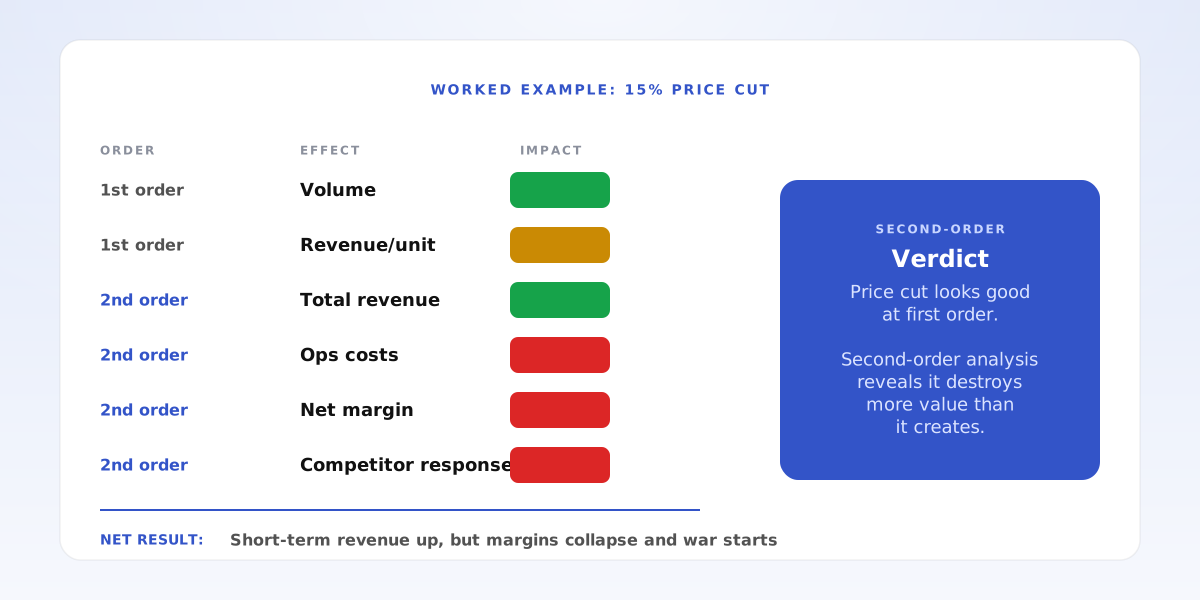
- First-order: Volume +25%, Revenue +6%—looks positive
- Second-order: Ops costs +18%, competitor response, margin erosion on installed base
- Net result: Decision destroys more value than it creates when second-order effects are included
Frequently Asked Questions
When should I use second-order thinking instead of just deciding quickly? Use it for decisions with significant consequences, long time horizons, or where others will respond to your action. A reversible decision with low stakes—what vendor to use for a small pilot—doesn't need deep second-order analysis. A pricing change, market entry, or organizational restructure does.
How do I know when to stop? Three orders is usually sufficient. Beyond that, effects become too speculative to inform the decision. Focus effort on consequences that are likely (not just possible) and material (not just real). A decision matrix can help weigh effects once you've surfaced them.
What if I can't predict second-order effects? You won't predict them perfectly—but you'll predict them better than by not trying. The exercise often surfaces 'obvious in hindsight' risks that were simply never articulated. Even uncertain second-order effects inform risk awareness: you may proceed but build contingency for the downside.
How do I train my team to think this way? Make 'then what?' a standard meeting question. When someone proposes an initiative, ask them to walk through second-order consequences before approving. Razn supports this discipline—it's a workspace for structuring problems into issue trees, testing hypotheses, and writing answer-first documents, exactly the structure second-order analysis requires. Use it to map consequences visually before committing to a decision.
- Use second-order thinking for high-stakes, irreversible, or reactive-environment decisions
- Stop at three orders—beyond that, predictions become too speculative
- Uncertain second-order effects still inform risk planning
- Train teams by making 'then what?' a standard question in decision meetings
Applying Second-Order Thinking to Your Decisions
Start with a decision you're currently facing. Write the first-order effect you expect. Then ask: 'If this happens, then what?' Write every second-order consequence you can identify. For each of those, ask again. Now look at the full picture—does the decision still make sense?
The discomfort of discovering negative second-order effects is the point. It's better to find them now, on paper, than to experience them later, in revenue and reputation. Second-order thinking doesn't make decisions slower for their own sake—it makes decisions better by seeing what first-order analysis hides.
Razn is built for this kind of structured reasoning. You can map a decision into an issue tree, trace each branch to its consequences, and document the logic so it's visible to your team. When you're facing a decision where the first-order answer looks obvious but the stakes are high—pricing strategy, competitive response, resource allocation—second-order thinking is the method, and Razn is the workspace. It's free during beta.
- Practice by mapping 'then what?' for any significant decision you're facing
- The discomfort of finding negative second-order effects is valuable—it's cheaper than experiencing them
- Use Razn to map decisions, trace consequences, and document second-order reasoning visibly