FrameworksOctober 21, 20267 min read
Reversible vs Irreversible Decisions: The One-Way Door Framework
Not all decisions deserve the same process. Understanding whether you're facing a two-way door or a one-way door changes how much time, analysis, and consensus you need before acting.
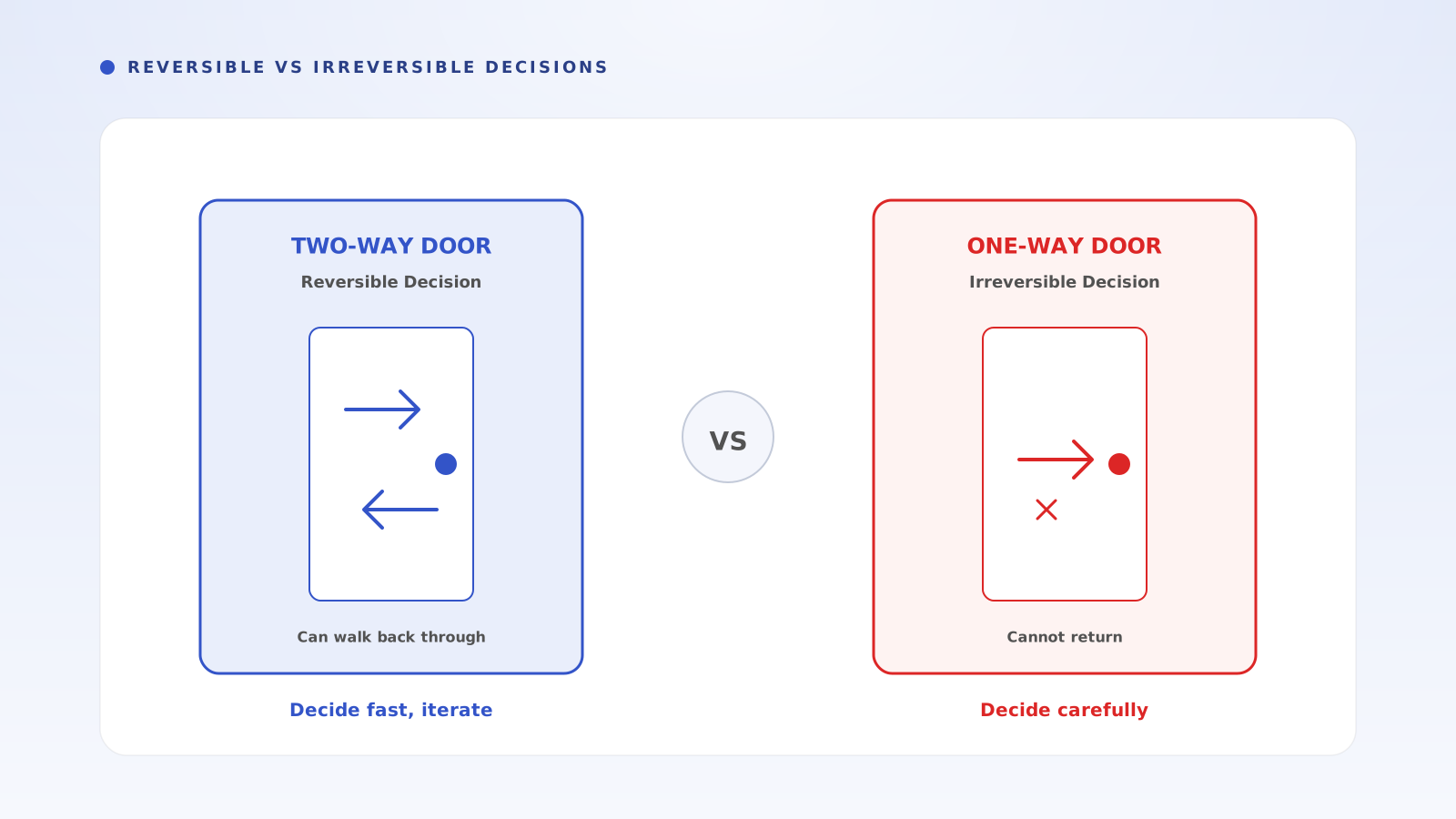
What Are Reversible vs Irreversible Decisions?
Reversible vs irreversible decisions differ in one critical dimension: whether you can undo them. A reversible decision can be changed, rolled back, or corrected after you see the results. An irreversible decision, once made, locks you into a path with no practical way to return to the starting point. This distinction—popularized by Jeff Bezos as the 'one-way door vs two-way door' framework—should drive how much time, analysis, and consensus you invest before acting.
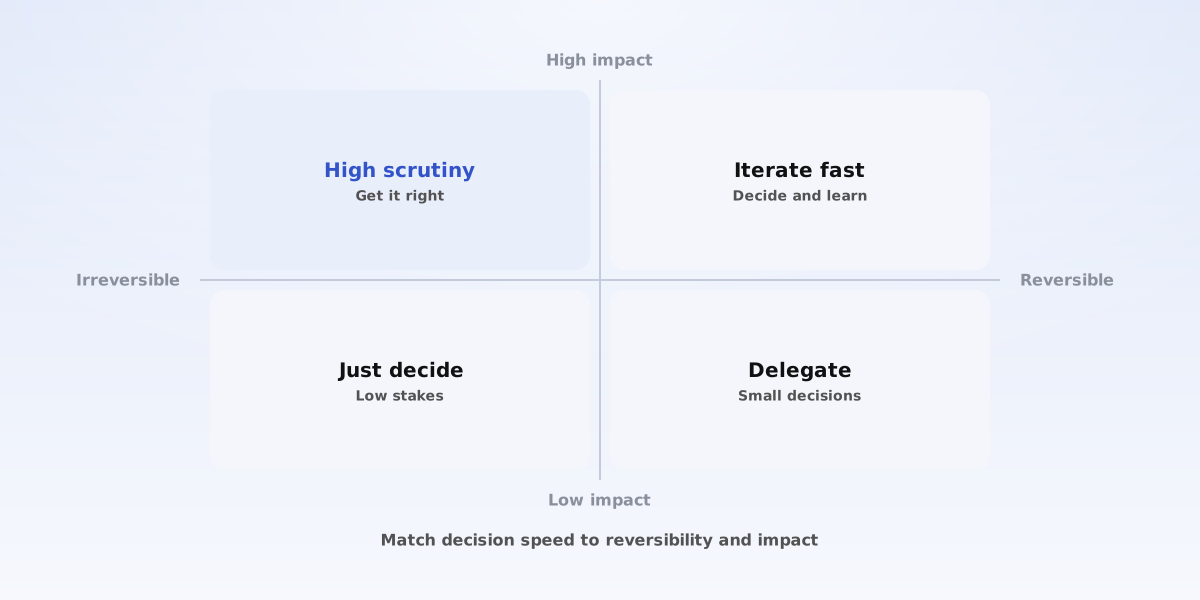
The core insight is simple: most decisions are reversible, yet organizations treat them as if they were irreversible. Teams spend weeks analyzing choices they could test in days. Committees form around decisions a single person could make and adjust. The result is slow organizations that lose to faster competitors—not because they decided wrong, but because they decided late.
Understanding whether you face a two-way door (reversible) or a one-way door (irreversible) is the first step in any decision process. Get this classification right, and you'll know immediately whether to move fast or slow down.
- Reversible (two-way door): can be undone or adjusted after seeing results
- Irreversible (one-way door): commits you permanently with no practical way back
- Most decisions are reversible—treat them that way to move faster
How Do You Identify a One-Way Door vs Two-Way Door Decision?
To classify a decision, ask three questions. First: Can I reverse this within a reasonable timeframe and cost? If changing course takes months or costs more than the original decision, it's closer to one-way. Second: What gets destroyed if I'm wrong? If the downside is embarrassment or wasted effort, it's two-way. If the downside is losing a key customer, a lawsuit, or a damaged reputation that takes years to rebuild, it's one-way. Third: Does this decision foreclose other options? Some choices eliminate future paths—signing an exclusive contract, selling a business unit, or making a public commitment.
Here's a practical test: imagine you make this decision and it turns out badly. What happens next? If the answer is 'we adjust and try something else,' you're facing a two-way door. If the answer is 'we're stuck with the consequences for years,' you're facing a one-way door.
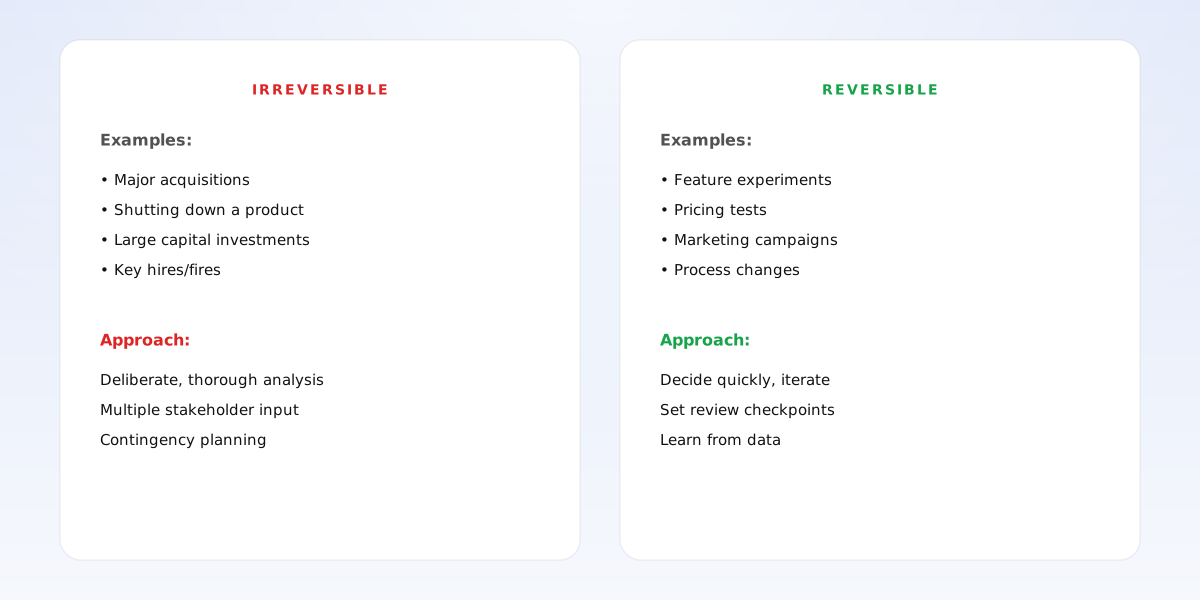
A useful heuristic: decisions about people (hiring, firing, promoting) and decisions about structure (org changes, major contracts, public commitments) tend toward irreversible. Decisions about tactics (pricing experiments, marketing channels, product features) tend toward reversible. But always test against your specific context—a pricing change might be trivially reversible for one business and catastrophic for another.
- Ask: Can I reverse this within reasonable time and cost?
- Ask: What gets destroyed if I'm wrong—effort, or something harder to rebuild?
- Ask: Does this decision foreclose other options I might want later?
- Test: If it fails, do we adjust and retry, or live with it for years?
How Should You Handle Two-Way Door Decisions?
For reversible decisions, the goal is speed, not perfection. You want to reach 70% confidence and act—because the remaining 30% is learned faster through execution than analysis. Waiting for certainty on a two-way door decision means you're optimizing for comfort, not outcomes.
The process for two-way doors should be lightweight: 1) Frame the decision and success criteria in one sentence. 2) List 2–3 options—don't enumerate exhaustively. 3) Pick the option that looks best given current information. 4) Set a review date to assess and adjust. The total time should be hours or days, not weeks.
Delegate two-way door decisions to the lowest level with adequate context. Bezos calls these 'Type 2' decisions and insists they should be made by individuals or small groups, not committees. The cost of a wrong call on a reversible decision is usually lower than the cost of slow decision-making. If someone makes a bad two-way door call, they learn and correct—that's valuable organizational learning, not a failure of governance. For a structured way to compare options quickly, see how to use a decision matrix.
- Aim for 70% confidence, then act
- Lightweight process: frame, list options, pick, set review date
- Delegate to the lowest level with adequate context
- The cost of slowness often exceeds the cost of a wrong call
How Should You Handle One-Way Door Decisions?
For irreversible decisions, slow down and invest in getting it right. These deserve the heavyweight process: broad input, senior review, explicit risk assessment, and clear accountability. The goal isn't consensus for its own sake—it's ensuring you've seen the decision from multiple angles before committing.
A good process for one-way doors: 1) Write a clear problem statement defining what you're deciding and why it matters. 2) Enumerate genuine alternatives—if there's only one option, you're not deciding, you're rationalizing. 3) Identify what could go wrong with each path using a pre-mortem. 4) Get input from people with relevant expertise or who will live with the consequences. 5) Make the call with explicit ownership. 6) Document the reasoning so future you (or your successor) understands why.
Even on one-way doors, avoid analysis paralysis. The point isn't to eliminate risk—that's impossible. The point is to understand the risk you're taking. Set a decision deadline, gather the input you can within that window, and commit. Postponing a one-way decision indefinitely is itself a decision, often a bad one.
- Slow down—these deserve heavyweight process
- Write a problem statement and enumerate real alternatives
- Use a pre-mortem to surface what could go wrong
- Get input from those with expertise or who bear consequences
- Set a decision deadline—postponing indefinitely is also a choice
A Worked Example: Deciding Whether to Raise Prices
Consider a B2B SaaS company deciding whether to raise prices by 20% for new customers. Is this a one-way or two-way door? Let's apply the test.
Can it be reversed? Yes—if the price increase tanks conversion, the company can lower prices again. The cost is some lost deals during the test period, but nothing permanent. What gets destroyed if wrong? Some potential revenue, but no customer relationships (existing customers keep their old price) and no reputation damage (B2B pricing isn't public). Does it foreclose options? No—lowering prices later is always possible.
Verdict: this is a two-way door. The right process is lightweight: set the new price, monitor conversion rates for 60 days, and decide whether to keep, adjust, or revert. Total deliberation time before testing: one meeting. Compare this to the alternative—six weeks of pricing committee meetings, endless spreadsheet modeling, and surveys asking customers what they'd hypothetically pay. The fast approach gets you real data; the slow approach gets you delayed guesses.
Now imagine the same company considering a 20% price increase for existing customers on their current contracts. Different calculation: existing customers may churn, damaged relationships are hard to rebuild, and public backlash is possible. This version is closer to a one-way door and warrants more deliberation—customer interviews, grandfathering analysis, and communication planning before acting.
- New customer pricing: reversible → test it quickly with a 60-day review
- Existing customer pricing: less reversible → invest in research and communication
- Same topic, different reversibility → different processes
- The test: what gets destroyed if you're wrong?
Common Mistakes When Applying This Framework
The first mistake is treating two-way doors as one-way. Organizations default to heavyweight process because it feels safer. Everyone gets input, no one is blamed if it fails. But this safety is an illusion—slow decisions have real costs that just aren't attributed to the decision process. If your team debates reversible decisions for weeks, you're losing to competitors who test and learn.
The second mistake is treating one-way doors as two-way because you're impatient. Some decisions feel reversible in the moment but aren't. Hiring someone is technically reversible (you can fire them), but the real costs—onboarding time, team disruption, severance, reputation—make it functionally one-way. Launching a product publicly is reversible (you can kill it), but customer expectations and market positioning make reversal costly. Be honest about whether 'we can always change it later' is actually true.
The third mistake is misclassifying based on decision size rather than reversibility. A $10M investment might be more reversible than a $10K commitment if the investment can be unwound and the commitment is contractual. A major strategic shift might be more reversible than a minor public statement if the shift happens internally and the statement creates external expectations. Size and reversibility are different dimensions—judge reversibility directly.
- Don't apply heavyweight process to two-way doors—speed matters
- Don't pretend one-way doors are reversible because you're impatient
- Don't confuse decision size with reversibility—they're different dimensions
Frequently Asked Questions
What if I'm unsure whether a decision is reversible? Default to treating it as more reversible than your instinct suggests. Organizations systematically overweight irreversibility because caution feels responsible. If genuinely uncertain, ask: 'What would have to be true for us to reverse this in 90 days?' If you can construct a plausible scenario, it's probably two-way.
How does this relate to 'disagree and commit'? They're complementary. Once a decision is made—whether through fast individual judgment on a two-way door or deliberate group process on a one-way door—everyone commits to execution. The framework tells you how much process before the decision; disagree and commit tells you what happens after.
Can a two-way door become a one-way door over time? Yes. A reversible experiment becomes less reversible as you build on top of it. A test pricing tier becomes harder to kill once customers are on it. Review your two-way decisions periodically—if you haven't reversed or adjusted them, ask whether you're now locked in. A hypothesis-driven approach helps you define what success looks like so you know when to commit or pivot.
Should I always move fast on two-way doors? Almost always. The exception is when the learning from deliberation exceeds the learning from action. If thinking through the decision teaches you something important, that time isn't wasted. But be honest: are you learning, or are you stalling?
- When uncertain, default to treating decisions as more reversible
- Disagree and commit applies after the framework tells you how much process before
- Two-way doors can become one-way over time—review periodically
- Move fast unless deliberation generates more learning than action
Putting the One-Way Door Framework Into Practice
Start by auditing your current decision pipeline. List the decisions your team has pending or recently made. For each, ask: Is this actually irreversible, or did we treat it as irreversible by default? Most teams find that 70–80% of their 'big decisions' are actually two-way doors in disguise. Those decisions should take hours, not weeks.
Build the classification into your process. Before any decision discussion, spend 60 seconds explicitly naming whether this is one-way or two-way. If it's two-way, set a bias toward action: 'We decide today, review in 30 days.' If it's one-way, set a bias toward completeness: 'We decide by Friday, after getting input from X, Y, and Z.'
Razn is a workspace for structuring decisions with issue trees, answer-first documents, and decision support. When you face a genuine one-way door, Razn helps you define the problem clearly, enumerate alternatives, and document your reasoning. When you face a two-way door, Razn helps you move fast by keeping the structure lightweight and the focus on action. Use the one-way/two-way framework to decide how much structure you need, then use Razn to execute that structure efficiently.
- Audit your decision pipeline—most 'big decisions' are actually reversible
- Classify explicitly at the start: one-way or two-way?
- Two-way: bias toward action with a review date
- One-way: bias toward completeness with a decision deadline
- Use Razn to structure decisions at the right level of depth for their reversibility


