MethodOctober 24, 20267 min read
Build vs Buy Decision: A Step-by-Step Framework (With a Worked Example)
The build vs buy decision determines whether to develop a capability in-house or purchase it externally. Here's a structured framework with a real cost comparison.
What Is a Build vs Buy Decision?
A build vs buy decision is the strategic choice between developing a capability internally (build) or acquiring it from an external vendor (buy). This decision shapes how companies allocate resources, manage risk, and maintain competitive advantage. Getting it wrong can mean wasted investment, missed market windows, or long-term dependency on solutions that don't fit.
The build vs buy decision appears across every function: software systems, manufacturing processes, service capabilities, and operational infrastructure. A company might build a custom CRM to match its unique sales process, or buy Salesforce and adapt its process to the tool. Either path can succeed—the question is which fits the specific context.
Most build vs buy decisions are not binary. Options include building from scratch, buying off-the-shelf, customizing a platform, partnering, or outsourcing. The framework below helps you evaluate these options systematically rather than defaulting to whatever the loudest voice in the room prefers.
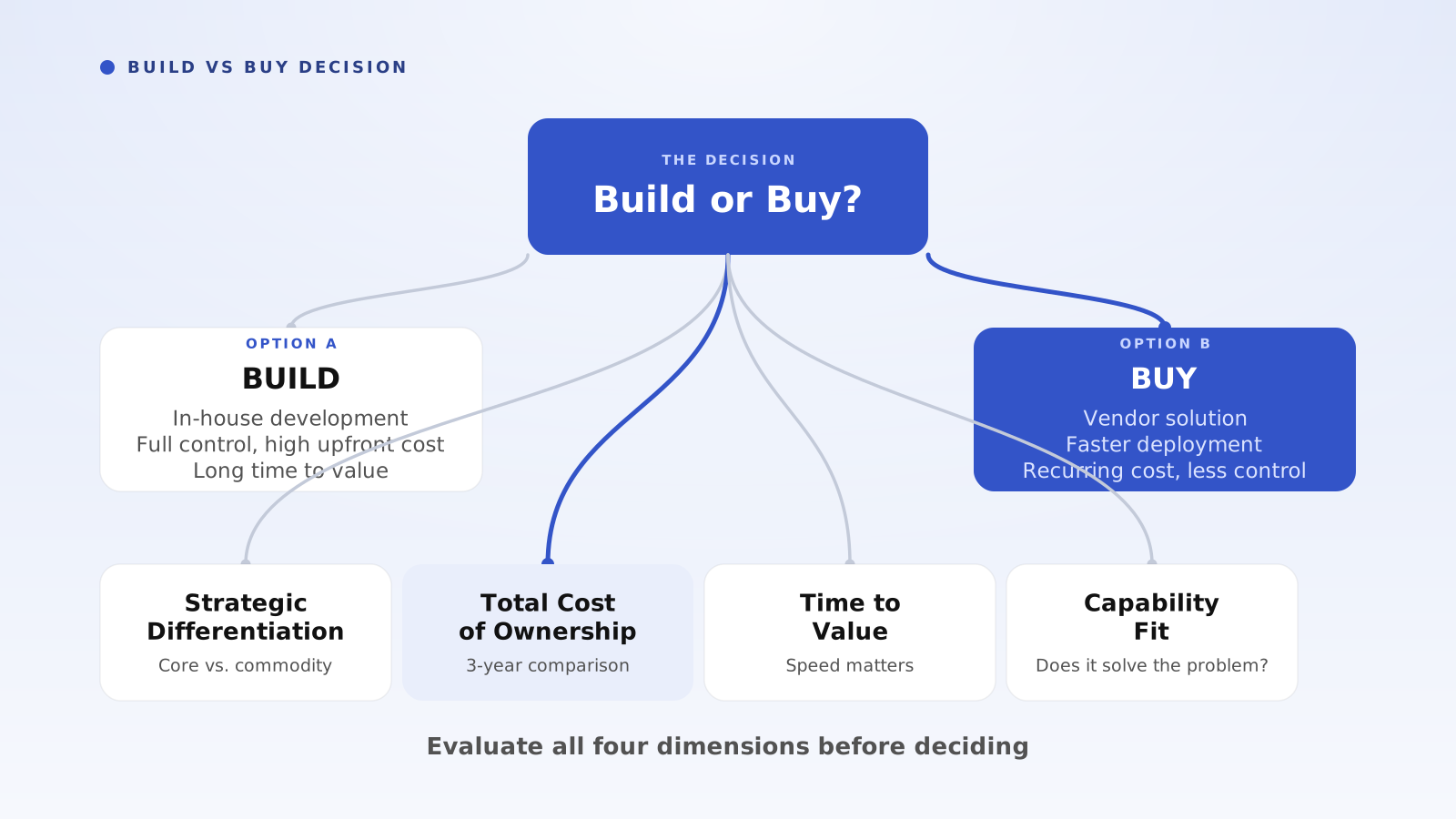
- Build: develop internally with full control and customization, but higher upfront cost and longer timeline
- Buy: acquire externally for faster deployment and lower initial investment, but less control and recurring costs
- The right answer depends on strategic importance, total cost, time constraints, and internal capabilities
How Do You Evaluate a Build vs Buy Decision?
A structured build vs buy decision evaluates four dimensions: (1) strategic differentiation—is this capability a core competency that drives competitive advantage? (2) total cost of ownership—what are the true 3-5 year costs of each path? (3) time to value—how fast do you need the capability? (4) capability fit—do you have the skills to build it, and does the vendor solution actually solve the problem?
Start with strategic differentiation. If the capability is core to your business model and a source of competitive advantage, the default leans toward build. If it's a commodity function that every competitor handles the same way, the default leans toward buy. A logistics company might build proprietary route optimization (strategic) but buy standard accounting software (commodity).
Next, calculate total cost of ownership honestly. Building looks cheaper when you only count development costs. But add ongoing maintenance, infrastructure, opportunity cost of engineering time, and the cost of getting it wrong. Buying looks cheaper when you only count the license fee. But add implementation, customization, training, integration, and the switching cost if you outgrow the vendor. The comparison changes when you include everything.
Then assess time to value. Building takes longer—often 6-18 months for significant systems. If speed to market matters, that delay has a quantifiable cost. If a vendor solution gets you to market in 8 weeks instead of 12 months, the opportunity cost of building may outweigh the control benefits.
Finally, evaluate capability fit from both sides. Do you have engineers who can build this well, or would you be stretching a team beyond its expertise? Does the vendor solution actually solve your problem, or would you spend months customizing it to fit?
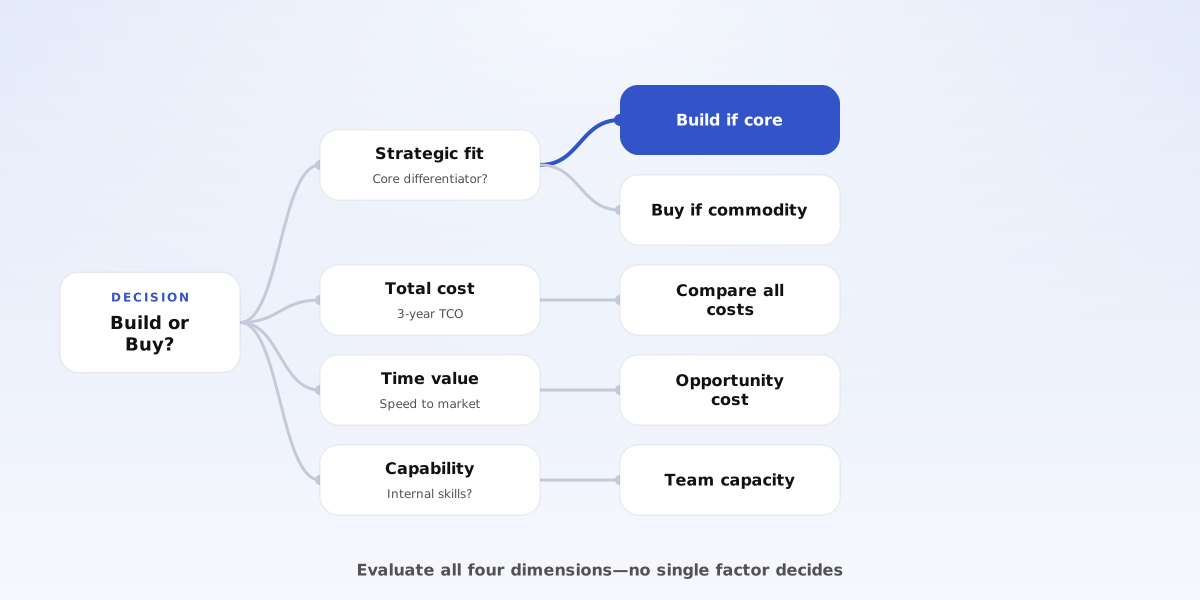
- Strategic differentiation: Build if it's a core competency; buy if it's commodity
- Total cost of ownership: Include maintenance, opportunity cost, and switching costs over 3-5 years
- Time to value: Calculate the cost of delay if building takes longer
- Capability fit: Assess both internal skills to build and vendor solution's actual fit to your needs
When Should You Build Instead of Buy?
Build when the capability is strategically differentiating and you have the internal skills to execute. If your competitive advantage depends on a unique approach that no vendor offers, building preserves that advantage. If buying would mean adapting your strategy to fit a vendor's assumptions, you're commoditizing your differentiation.
Build when vendor solutions don't fit and customization costs exceed building costs. Sometimes the closest vendor solution requires so much modification that you end up paying twice: once for the license and again for the customization. At that point, purpose-built often delivers more value.
Build when long-term flexibility matters more than short-term speed. Owning the codebase means you control the roadmap. You're not waiting for a vendor to prioritize your feature request or forced to accept breaking changes in their next release. For capabilities you'll evolve continuously, ownership reduces friction over time.
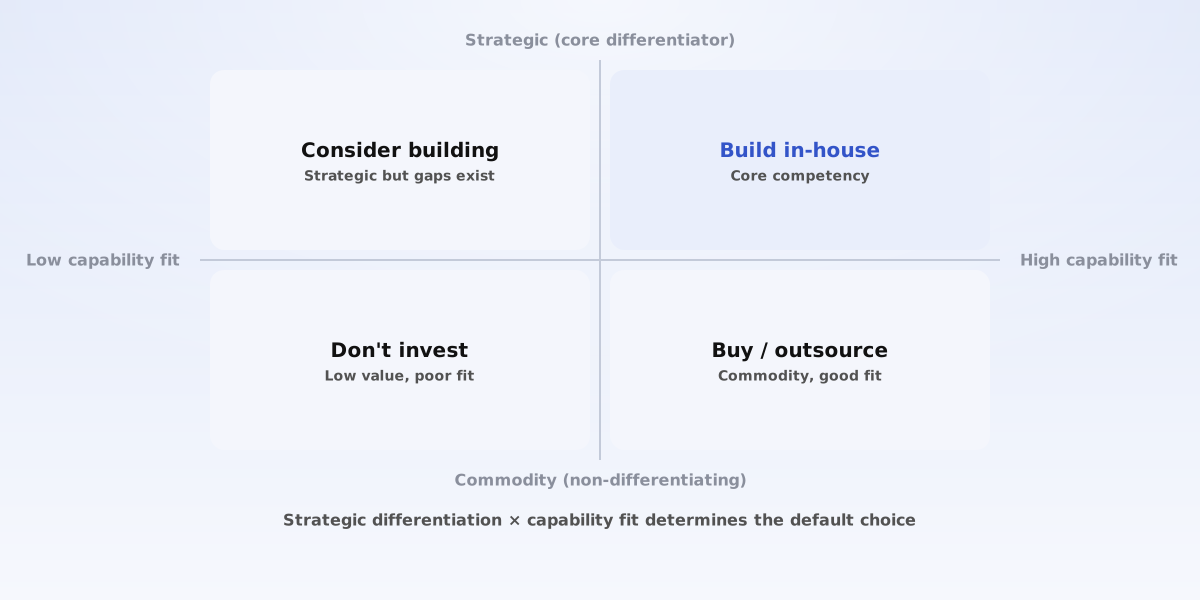
- Build when the capability is a core differentiator that drives competitive advantage
- Build when vendor solutions require extensive customization that erodes their cost advantage
- Build when you need long-term control over the roadmap and don't want vendor dependency
How Do You Calculate the Total Cost of Building vs Buying?
Total cost of ownership (TCO) compares all costs over a defined period—typically 3-5 years. For building, include: development costs (salaries, contractors, tools), infrastructure (hosting, licenses, security), ongoing maintenance (bug fixes, updates, on-call), opportunity cost (what else could those engineers build?), and risk cost (probability of failure × cost of failure).
For buying, include: licensing or subscription fees, implementation and integration costs, training and change management, customization (if needed), ongoing vendor management, and switching cost (what it costs to leave if the solution doesn't work out). Don't forget the hidden costs: time spent managing the vendor relationship, workarounds for missing features, and productivity loss during implementation.
A common mistake is comparing build costs (upfront investment) to buy costs (annual subscription) without normalizing the time horizon. A $400K build that lasts 5 years with $80K annual maintenance costs $800K over 5 years. A $100K/year subscription costs $500K over 5 years—but only if you don't grow. Factor in volume scaling: build costs stay flat while many vendor fees scale with usage.
- Build TCO: development + infrastructure + maintenance + opportunity cost + risk cost
- Buy TCO: license + implementation + training + customization + vendor management + switching cost
- Use a 3-5 year horizon and include all costs—visible and hidden—for accurate comparison
Worked Example: CRM System Build vs Buy
A mid-size B2B company needs a CRM system. Option A: build a custom CRM tailored to their complex sales process. Option B: buy Salesforce and adapt workflows to fit. Here's the 3-year TCO comparison.
Build costs: $400K upfront development (6 engineers × 6 months), $80K annual maintenance and hosting, $150K annual internal support and iteration, $200K opportunity cost (those engineers delayed the product roadmap by 6 months). 3-year total: $400K + (3 × $80K) + (3 × $150K) + $200K = $1.29M.
Buy costs: $50K implementation and training, $120K annual Salesforce licenses (50 seats), $30K annual admin and customization. 3-year total: $50K + (3 × $120K) + (3 × $30K) = $500K. Even adding an $80K estimated switching cost if they later outgrow Salesforce, the buy path totals $580K.
The buy option saves $710K over 3 years. But the decision isn't purely financial. If the company's unique sales process is a competitive advantage that Salesforce would flatten, the strategic cost of buying may outweigh the financial savings. Conversely, if the sales process is standard, spending $710K extra to preserve it is waste. This is where first-principles thinking helps: question whether the 'unique process' is truly differentiating or just legacy habit.
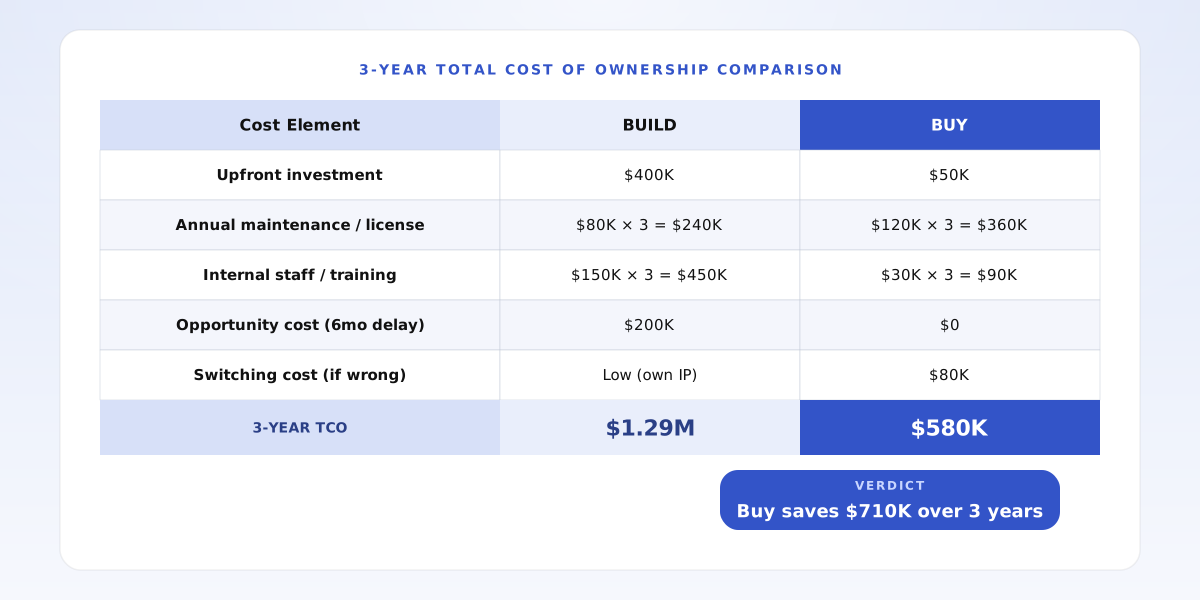
- Build: $1.29M over 3 years—higher cost but full control and customization
- Buy: $580K over 3 years—lower cost but workflows adapt to the vendor
- Financial TCO favors buy, but strategic differentiation may justify the premium to build
Frequently Asked Questions
What if we can't decide between build and buy? If the decision is genuinely close, consider a phased approach. Buy now to get speed to market, then evaluate building a replacement after you've learned more about your actual requirements. The switching cost you estimated becomes real data after 18 months.
How do we handle the 'build' bias from engineering teams? Engineers often prefer building—it's more interesting than configuring vendor software. Counter this by requiring full TCO analysis including their time, and by asking: 'If we had $800K cash, would we spend it on a custom CRM or on product features that drive revenue?' The opportunity cost of engineering time is real.
Should we weight strategic factors more than cost? Yes, but quantify them. If a capability is truly strategic, estimate the revenue impact of differentiation. If building preserves a 10% price premium on $20M revenue, that's $2M/year—which justifies a higher TCO. If you can't quantify the strategic value, question whether it's actually strategic.
What about hybrid approaches? Hybrid (buy a platform, build custom modules on top) often combines the worst of both: vendor lock-in plus internal maintenance burden. It can work for extensible platforms with good APIs, but model the hybrid TCO separately—don't assume it's automatically the middle ground on cost.
- If the decision is close, buy first for speed, then re-evaluate after learning more
- Counter build bias by requiring full TCO analysis including engineering opportunity cost
- Quantify strategic value—if you can't put a number on differentiation, question whether it's real
- Hybrid approaches often combine the downsides of both; model them separately
Applying the Build vs Buy Framework
Start by clearly defining what capability you need and why. Use a problem statement to articulate the gap you're filling. Then score the four dimensions: strategic differentiation (1-5), total cost of ownership (calculate actual numbers), time to value (weeks/months for each option), and capability fit (internal and vendor). Build a decision matrix to weight and compare options.
Involve stakeholders from engineering, finance, and the business function that will use the capability. Engineering understands build complexity and maintenance burden. Finance validates TCO assumptions. The business user knows whether the vendor solution actually solves their problem or forces awkward workarounds.
Razn is an AI workspace that helps you structure decisions like build vs buy into issue trees, test assumptions with data, and write an answer-first recommendation your leadership can act on. The framework above becomes a living document: you map the decision, score each dimension, run the TCO comparison, and document the rationale so it's auditable when someone asks 'why did we build/buy this?' in two years. Razn is free during beta—try it on your next build vs buy decision.
- Define the capability need clearly before evaluating options
- Score all four dimensions: strategic fit, TCO, time to value, capability fit
- Use Razn to structure the decision, compare options, and document the rationale for future reference