MethodNovember 10, 20266 min read
Unit Economics: How to Calculate Them and Use Them to Make a Decision (Worked Example)
Unit economics show whether one customer earns more than it costs to win and serve. Here's how to calculate contribution margin, CAC, LTV and payback period, with a worked example of a subscription business.
What Are Unit Economics?
Unit economics are the revenue and costs tied to one unit of your business, usually one customer or one sale. They show whether each unit earns more than it costs to win and serve, which decides whether growth creates profit or uses up cash. The core numbers are contribution margin per unit, customer acquisition cost (CAC), customer lifetime value (LTV) and payback period.
The unit depends on the business model. A subscription company uses one customer, a retailer uses one order and a manufacturer uses one item. Choose the unit you sell and pay to acquire, and keep it the same in every calculation.
What Do Contribution Margin, CAC, LTV and Payback Period Mean?
Four definitions do most of the work. Each one builds on the one before it.
Fixed costs such as salaries and rent are left out on purpose. Unit economics ask whether one more customer is worth winning. A break-even analysis then asks how many customers you need to cover the fixed costs.
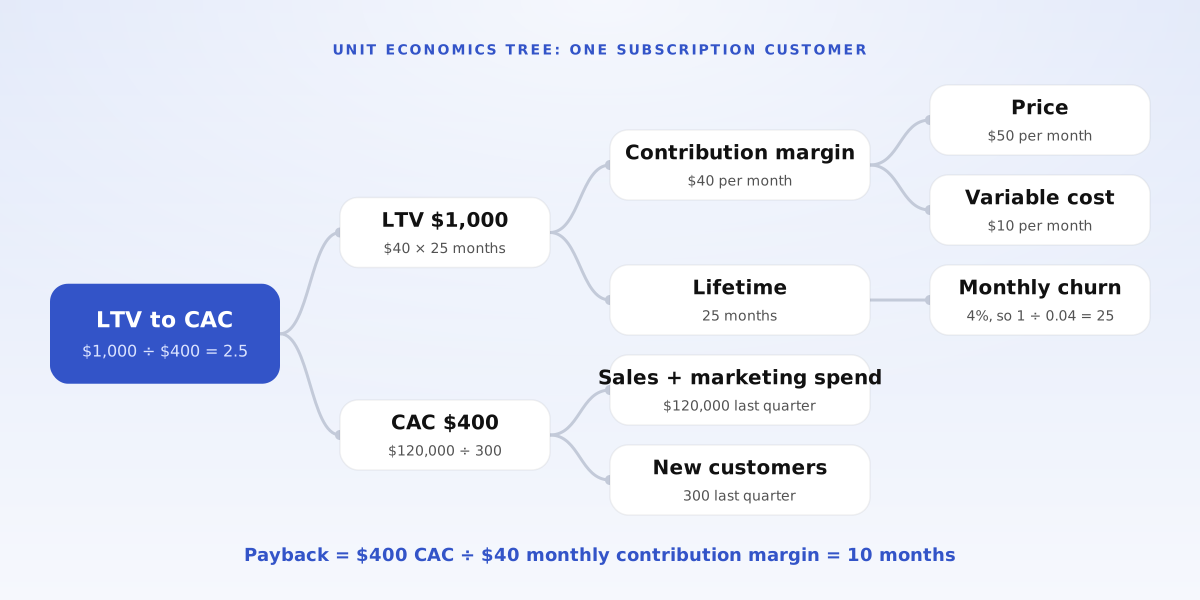
- Contribution margin per unit: price minus the variable costs of serving one unit, such as payment fees, hosting, shipping and support
- CAC (customer acquisition cost): total sales and marketing spend in a period divided by the new customers won in that period
- LTV (customer lifetime value): the contribution margin one customer generates over their whole lifetime. For a subscription, it is monthly contribution margin × lifetime in months, where lifetime = 1 ÷ monthly churn
- Payback period: CAC ÷ monthly contribution margin, which is the number of months it takes to earn back the cost of winning the customer
Related: why CAC is rising
How Do You Calculate Unit Economics?
1. Define the unit and the period. Pick one customer, order or item, and one time window for all the data, such as the last quarter.
2. Calculate contribution margin per unit. Subtract every cost that rises with each extra unit from the price.
3. Estimate the lifetime. For a subscription, divide 1 by the monthly churn rate. For repeat purchases, use the average number of orders per customer.
4. Calculate LTV. Multiply contribution margin per period by the lifetime. Use margin here, not revenue.
5. Calculate CAC by channel. Divide each channel's full sales and marketing spend, including salaries and tools, by the customers it brought in.
6. Compare and decide. Divide LTV by CAC, divide CAC by monthly contribution margin to get payback, and check both against your targets before you spend more.
Worked Example: Should a Subscription Business Double Its Ad Budget?
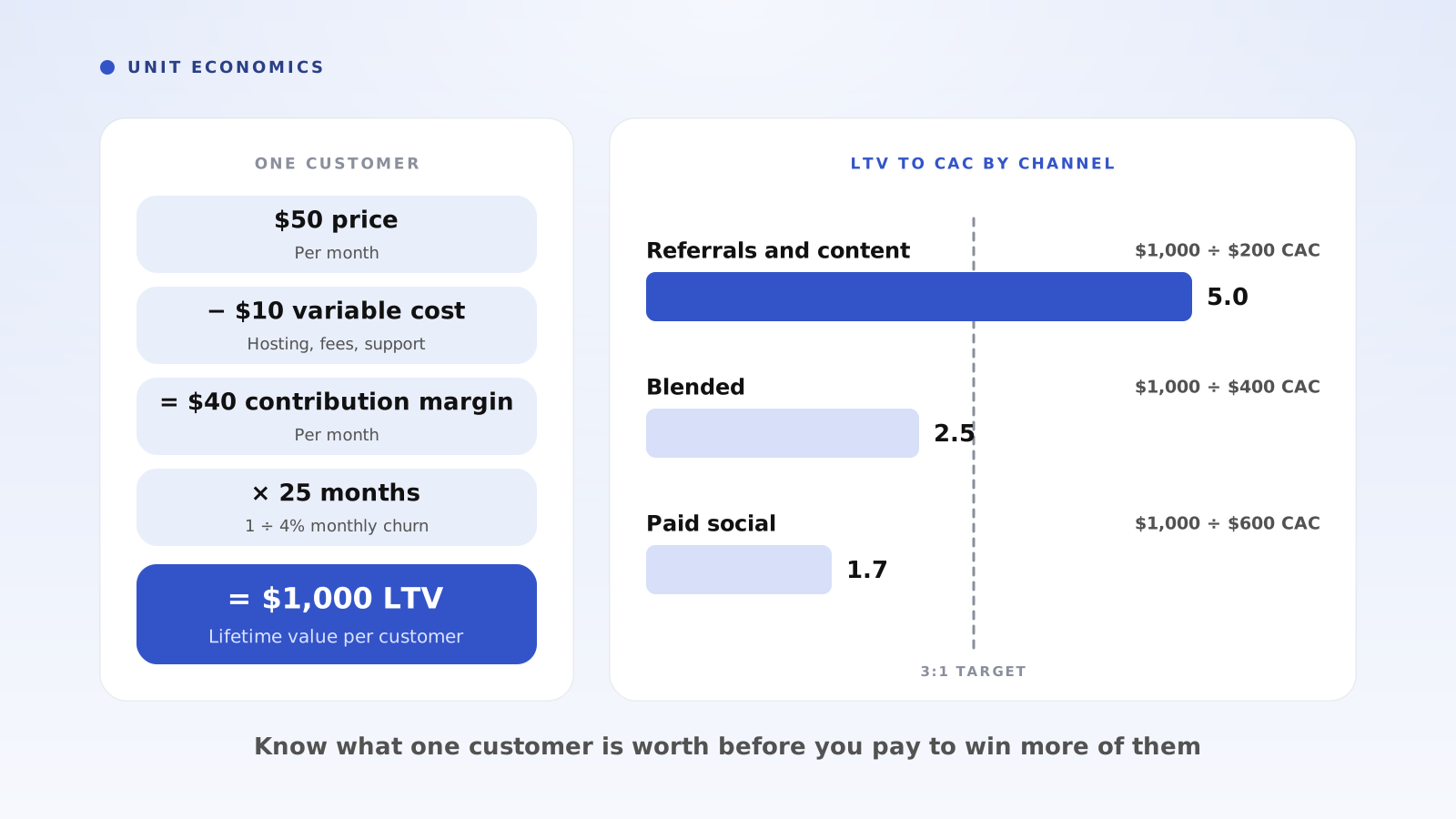
A subscription software company charges $50 a month. Serving a customer costs $10 a month in hosting, payment fees and support, so the contribution margin is $40 a month, or 80% of the price. Monthly churn is 4%, so the average customer stays 1 ÷ 0.04 = 25 months. LTV is $40 × 25 = $1,000.
Last quarter the company spent $120,000 on sales and marketing and won 300 customers, so blended CAC is $400. LTV to CAC is $1,000 ÷ $400 = 2.5, and payback is $400 ÷ $40 = 10 months. The team proposes doubling the paid social budget to grow faster.
The blended number hides two very different channels. Referrals and content cost $30,000 and brought in 150 customers. That is a CAC of $200, a ratio of 5.0 and a 5-month payback. Paid social cost $90,000 and also brought in 150 customers. That is a CAC of $600, a ratio of 1.7 and a 15-month payback.
The decision is not to double paid social. A ratio of 1.7 leaves too little to cover fixed costs and forecast error, and each new customer ties up cash for 15 months. To reach a 3:1 ratio, paid social CAC must fall to $1,000 ÷ 3 = $333. The company holds the channel at its current budget, sets $333 as the target and funds a separate $30,000 referral test.
Two other levers would change the picture. Cutting churn from 4% to 3% lifts the lifetime to about 33 months and LTV to about $1,333. Raising the price to $55 lifts the margin to $45 and LTV to $1,125 if churn holds, which is a question for how to price a product. Checking how far the answer moves when one input changes is a sensitivity analysis.
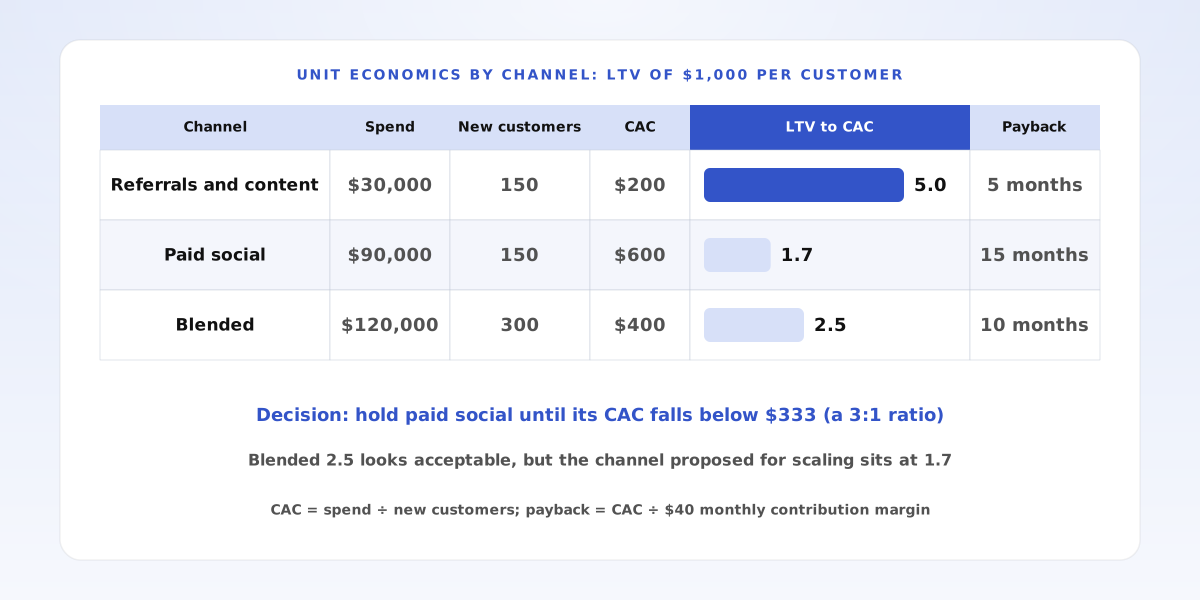
- Per customer: $40 monthly contribution margin, 25-month lifetime, $1,000 LTV
- Blended: CAC $400, LTV to CAC 2.5, payback 10 months
- Referrals and content: CAC $200, LTV to CAC 5.0, payback 5 months
- Paid social: CAC $600, LTV to CAC 1.7, payback 15 months
- Decision: hold paid social until its CAC is below $333
What Is a Good LTV to CAC Ratio?
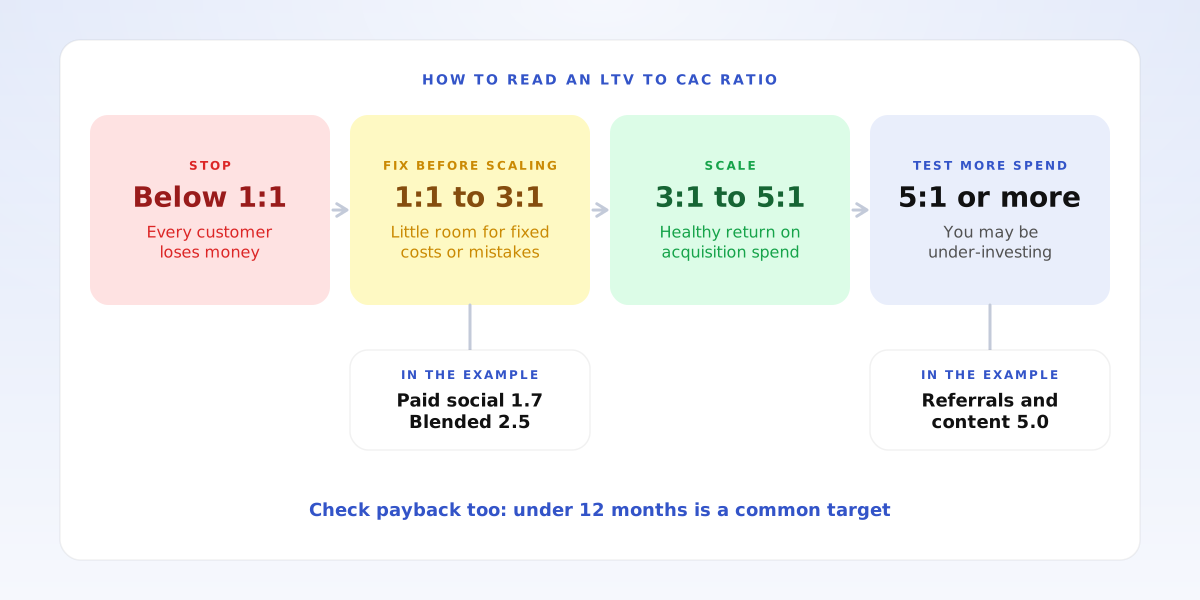
A common rule of thumb is an LTV to CAC ratio of at least 3:1, with payback inside 12 months. Below 1:1, you lose money on every customer and growth makes it worse. Between 1:1 and 3:1, the unit works on paper but leaves little room for fixed costs or mistakes. At 5:1 or above, you can often grow faster by spending more on acquisition.
These are guides, not laws. A business with little cash should weigh payback more heavily than the ratio, because payback decides how much cash growth consumes. A business with long contracts and low churn can accept a longer payback.
Related: why customer churn is rising
What Are Common Unit Economics Mistakes?
Using revenue instead of contribution margin. In the example, LTV based on revenue would be $50 × 25 = $1,250, which overstates what a customer is worth by 25%.
Relying on blended CAC. An average across channels can look acceptable while the channel you plan to scale is the weak one. Calculate CAC for each channel.
Leaving costs out of CAC. Count salaries, agency fees, tools, discounts and free trials, not just ad spend.
Trusting a lifetime you have not observed. A 4% churn rate implies 25 months, but a company with eight months of data has not seen it yet. Check the estimate against how older groups of customers actually behaved.
Forgetting fixed costs. Good unit economics do not guarantee a profit. With $60,000 of monthly fixed costs and a $40 margin, the company needs 1,500 active customers to break even.
Frequently Asked Questions
What is the difference between unit economics and profitability? Unit economics measure one customer or sale and leave out fixed costs. Profitability covers the whole business after all costs.
Do unit economics apply outside subscriptions? Yes. For a store or a product business, the unit is one order or one item. Use price minus variable cost per order, multiplied by the number of orders per customer.
What is the formula for LTV? For a subscription, LTV = monthly contribution margin ÷ monthly churn. In the example, $40 ÷ 0.04 = $1,000.
How often should you recalculate unit economics? Every month or quarter, by channel, and whenever price, costs or churn change.
How Does Razn Help With Unit Economics?
Razn is an AI workspace that structures a business problem into a MECE issue tree, hypotheses and an answer-first document or deck. Use it when the numbers show a problem but not its cause. For example, break "why is paid social CAC $600?" into its drivers, test the strongest hypotheses and write up the recommendation. If the fix needs investment, weigh it with a cost-benefit analysis. Razn is free during beta.
- Define the unit and calculate its contribution margin
- Calculate LTV from margin and lifetime, and CAC by channel
- Check LTV to CAC and payback against your targets
- Scale the channels that pass, and fix or cap the ones that do not