MethodOctober 25, 20267 min read
How to Write a Decision Memo: A One-Page Framework for Clear Decisions
A decision memo is a one-page document that frames a decision, presents options, and recommends action. Here's how to write one that gets alignment fast.
What Is a Decision Memo?
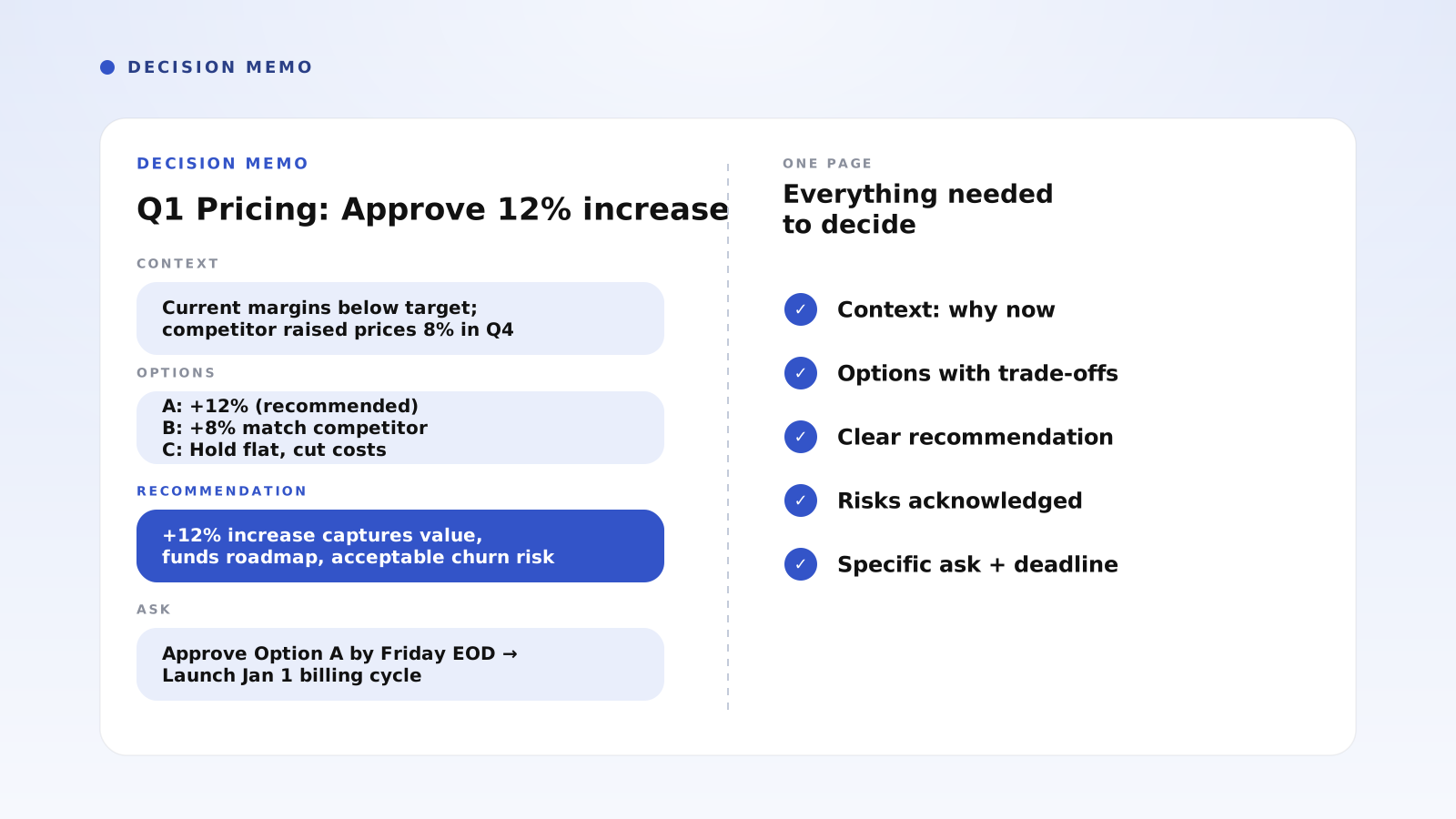
A decision memo is a concise document—typically one page—that frames a decision, presents options with their trade-offs, makes a clear recommendation, and asks the reader to approve or choose. Unlike lengthy reports that bury the ask in appendices, a decision memo leads with the decision needed and provides just enough context to make it. The format forces clarity: if you can't fit it on one page, you haven't thought it through.
The decision memo is the workhorse document of effective organizations. Amazon uses six-page narratives for complex strategy but one-page decision docs for operational choices. Consulting firms train associates to write decision memos before client meetings. Startups use them to get alignment from investors and boards without scheduling another meeting. The pattern works because it respects the reader's time while giving them everything needed to decide.
A well-written decision memo does three things: it clarifies thinking for the writer (you can't write a crisp recommendation without understanding the trade-offs), it enables fast decisions from the reader (they get context, options, and a recommendation in minutes), and it creates a record (when someone later asks 'why did we do this?', the memo documents the rationale). For deeper analysis of decision processes, see reversible vs irreversible decisions.
- A one-page document that frames a decision, presents options, recommends action, and asks for approval
- Forces clarity: if it doesn't fit on one page, you haven't distilled the thinking
- Creates a record of what was decided and why for future reference
How Do You Structure a Decision Memo?
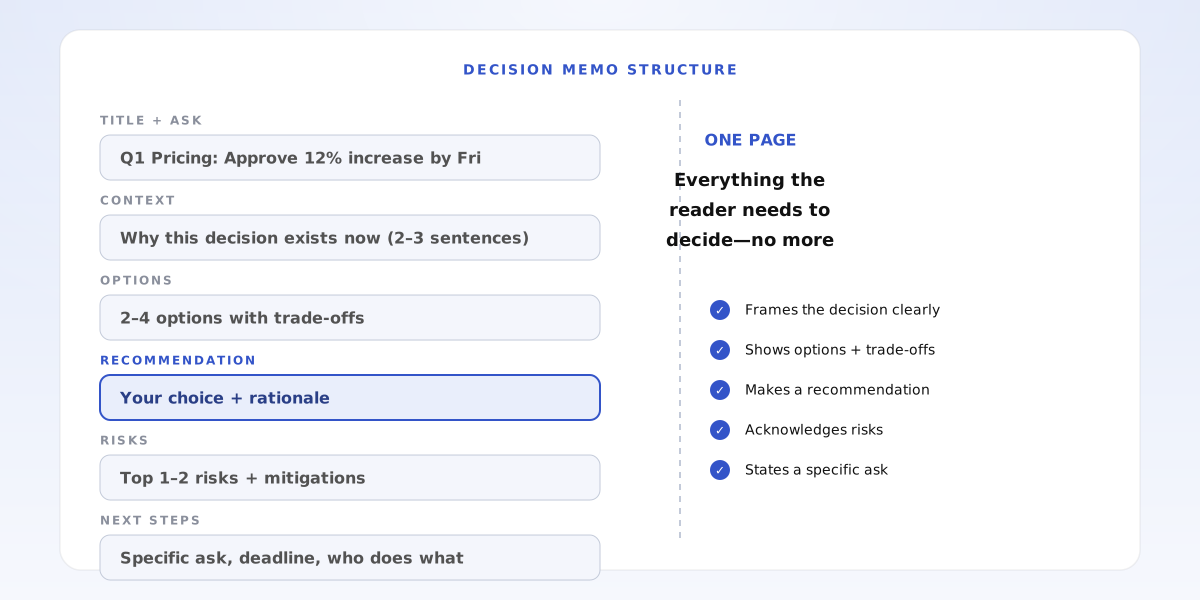
A decision memo has six core sections that fit on one page. Each section earns its space by answering a question the decision-maker needs answered. Skip a section and they'll ask; pad a section and they'll skim. The structure is: (1) Title and decision needed, (2) Context, (3) Options, (4) Recommendation, (5) Risks and mitigations, (6) Next steps and ask.
Title and decision needed: Start with a descriptive title and a one-sentence statement of the decision required. Example: 'Q1 Pricing Strategy: Approve 12% price increase for Enterprise tier.' The reader knows immediately what they're being asked to decide.
Context: In 2–3 sentences, explain why this decision exists now. What changed? What's the goal? What's the deadline? Don't explain the whole history—just enough so the reader understands why this decision matters. Link to background documents if they need more detail.
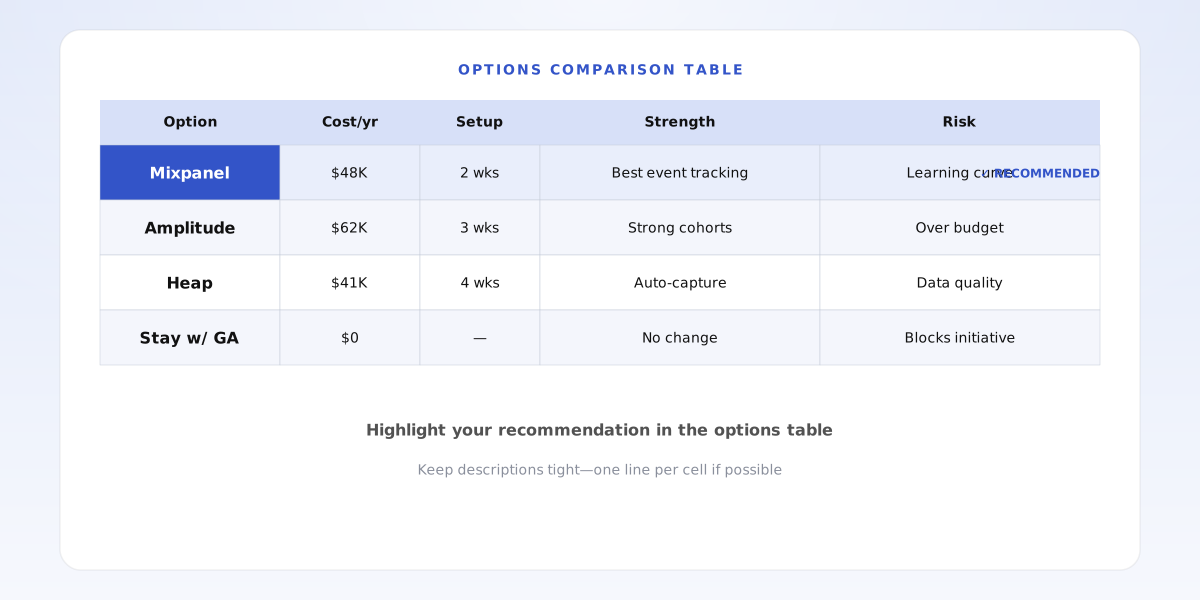
Options: Present 2–4 options with their key trade-offs. More than four options signals you haven't narrowed the field. Use a comparison table if helpful: rows are options, columns are criteria that matter. Each option should include projected outcome, cost/effort, and the main risk. Keep descriptions tight—one line per option if possible.
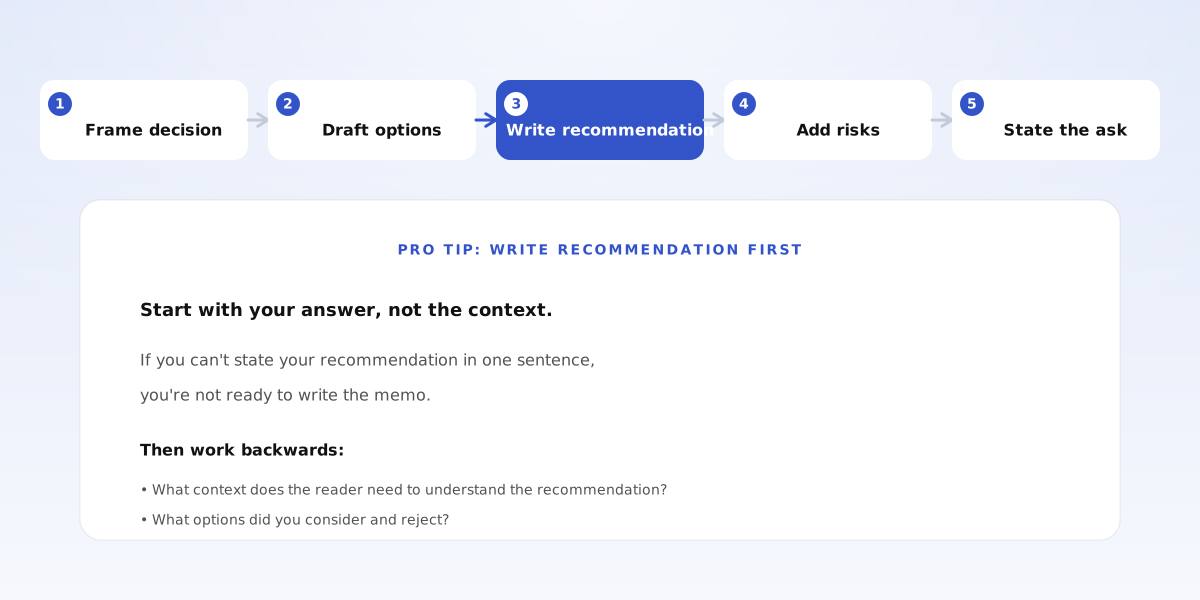
Recommendation: State your recommended option clearly and explain why in 2–3 sentences. The recommendation section is not a hedge; it's a commitment. If you're not ready to recommend, the memo isn't ready. Use answer-first writing here: lead with the choice, then the reasoning.
Risks and mitigations: Name the 1–2 biggest risks of your recommendation and how you'll address them. This shows you've thought about what could go wrong and aren't selling a fantasy. If the decision-maker is worried about something, it's probably here.
Next steps and ask: End with the specific action you need. 'Please approve Option B by Friday EOD so we can begin implementation Monday.' Include who does what if approved. The ask should be unambiguous—yes/no, not 'thoughts?'
- Title + decision needed: one sentence stating exactly what approval is required
- Context: 2–3 sentences on why this decision exists now
- Options: 2–4 options with trade-offs, costs, and risks (table format works well)
- Recommendation: clear choice with 2–3 sentences of reasoning
- Risks: 1–2 biggest risks of the recommendation and how you'll mitigate
- Next steps: specific ask with deadline and who does what
Worked Example: Vendor Selection Decision Memo
Consider a product team choosing between analytics vendors. Here's how the decision memo would read:
Title: Analytics Platform Selection—Approve Mixpanel contract by Nov 1. Context: Current analytics tool (Google Analytics) lacks product event tracking needed for the retention initiative. Evaluated three platforms over two weeks. Contract signature required by Nov 1 for Q4 implementation. Budget approved in Q3 planning ($48K/year).
Options: Option A—Mixpanel: $48K/year, best event tracking, 2-week setup, risk is learning curve for team. Option B—Amplitude: $62K/year, strongest cohort analysis, 3-week setup, risk is over budget by $14K. Option C—Heap: $41K/year, auto-capture reduces instrumentation, 4-week setup, risk is data quality concerns from auto-capture. Option D—Stay with GA: $0, limited to pageviews, no setup, risk is retention initiative blocked.
Recommendation: Approve Mixpanel (Option A). Rationale: Fits approved budget, has the event tracking depth we need for retention analysis, and fastest to implement. Amplitude is stronger on cohorts but $14K over budget and we can build cohort views in Mixpanel. Heap's auto-capture trades data quality for convenience—wrong trade-off for a retention initiative where precision matters.
Risks: (1) Team learning curve on Mixpanel—mitigated by scheduling vendor training in Week 1 and assigning two analysts as internal experts. (2) Migration of historical data limited—mitigated by running GA in parallel for 90 days.
Ask: Please approve Mixpanel contract ($48K/year, 2-year term) by Nov 1. Upon approval: Legal reviews contract (Nov 1–3), signature (Nov 4), kickoff with vendor (Nov 7), training complete by Nov 21. The memo is 247 words—under a page, everything needed to decide.
- 247 words covers context, four options, recommendation with rationale, risks, and ask
- Comparison table makes trade-offs visible at a glance
- Clear ask with deadline: 'Approve by Nov 1' leaves no ambiguity
When Should You Write a Decision Memo?
Write a decision memo when you need approval from someone who isn't in the details. If you and the decision-maker have been collaborating closely, you might not need a memo—a conversation suffices. But when you're asking a busy executive, a board, or a cross-functional stakeholder to weigh in on something they haven't been tracking, a memo respects their time and increases your chances of a fast yes.
Decision memos are especially useful for: vendor selections (as above), budget requests, project go/no-go decisions, process changes that affect other teams, and any choice where you want a documented record of the decision and reasoning. They're less useful for: exploratory discussions where you're not yet ready to recommend, highly technical decisions better suited to a design doc, or decisions the reader expects you to make yourself.
A good rule: if the decision is irreversible and involves others' resources or approval, write a memo. If it's reversible and within your authority, decide and move. Don't write memos to cover yourself—write them to enable good decisions. For decisions that need deeper analysis before writing the memo, start with an issue tree or problem statement.
- Write a memo when you need approval from someone not in the day-to-day details
- Best for: vendor selections, budget requests, go/no-go decisions, cross-functional changes
- Skip the memo when you're still exploring or when the decision is yours to make
Common Decision Memo Mistakes
The most common mistake is burying the recommendation. Some writers present options 'neutrally' and leave the choice to the reader. This abdicates your job. You've done the analysis; you know the trade-offs; make a recommendation. The reader can override you, but they shouldn't have to do your thinking for you.
The second mistake is including too many options. If you have six options, you haven't narrowed the field. Do the work to eliminate implausible options before the memo. Presenting everything you considered signals thoroughness to you but overwhelms the reader. Two to four options is the sweet spot.
The third mistake is vague asks. 'Let me know your thoughts' is not an ask. 'Approve Option B by Friday' is an ask. If you don't know what you need, the reader won't either. State the action, the deadline, and what happens next.
Finally, many memos fail by being too long. If your memo is two pages, cut it. The constraint of one page forces prioritization—which is exactly the value you're providing. Use appendices for supporting data, but the core memo should stand alone. If the decision-maker needs to read an appendix to understand the recommendation, the memo isn't doing its job.
- Don't bury the recommendation—make a clear choice, don't present options 'neutrally'
- Don't include too many options—narrow to 2–4 before writing
- Don't use vague asks—specify action, deadline, and what happens next
- Don't exceed one page—use appendices for supporting data
Frequently Asked Questions
What if I'm not sure which option to recommend? Then you're not ready to write the decision memo. Do more analysis, talk to more people, or run a quick decision matrix to clarify your thinking. The memo is the output of your analysis, not a substitute for it.
How do I handle a decision-maker who always asks for more information? Anticipate their questions in the memo. If they always ask about cost, make sure cost is prominent in your options table. If they worry about risk, make your risks section thorough. Over time, your memos will train them to trust your recommendations because they see you've already considered their concerns.
What if the decision-maker disagrees with my recommendation? That's fine—the memo did its job. They have context, options, and your reasoning. If they choose differently, ask why so you learn what you missed. The goal isn't to win; it's to enable a good decision with clear documentation.
How is a decision memo different from a proposal or business case? A decision memo is shorter and more focused. A proposal might run 10 pages selling an idea. A business case might include financial models and sensitivity analysis. A decision memo assumes the audience is ready to decide and just needs the essential information. Use longer formats when you need to persuade or when the stakes justify more detail.
Should I circulate the memo before the decision meeting? Yes, send it at least 24 hours ahead. This lets the decision-maker read and think before the meeting. The meeting then becomes a Q&A and decision session, not a presentation. If they need to read the memo for the first time in the meeting, you've wasted everyone's synchronous time.
- Not sure what to recommend? Do more analysis first—the memo is the output, not the process
- Anticipate the decision-maker's recurring questions in your memo structure
- If they disagree, ask why and learn—the goal is a good decision, not winning
- Send the memo 24 hours before the meeting so the meeting is for Q&A, not reading
Writing Your First Decision Memo
A decision memo earns its place in your toolkit because it compresses decision-making time. Instead of multiple meetings circling around a choice, you send a memo, the reader digests it asynchronously, and the meeting becomes a 10-minute approval or a focused discussion on the one point of disagreement. That's hours saved per decision, compounding across an organization.
To write your first decision memo, pick a real decision you're facing. Draft the recommendation first—even before the context. If you can't state your recommendation in one sentence, you're not ready to write. Then work backwards: what context does the reader need? What options did you consider? What risks should they know about? What exactly are you asking them to do?
Razn is an AI workspace that helps you structure decisions into issue trees, compare options with a decision matrix, and write answer-first documents like decision memos. When you need to analyze a complex decision before writing the memo—mapping the trade-offs, running the numbers, stress-testing your recommendation—Razn structures that thinking so your memo is backed by rigorous analysis. Razn is free during beta.
- A good decision memo compresses multiple meetings into one focused conversation
- Start with the recommendation, then work backwards through context and options
- Use Razn to structure the analysis behind your decision memo