MethodNovember 20, 20267 min read
Net Present Value (NPV): How to Calculate It and Use It to Make an Investment Decision (Worked Example)
Net present value tells you how much an investment is worth today after paying for the money it ties up. Here's what NPV is, how to calculate it step by step, which discount rate to use, how it compares with ROI and IRR, and a worked example of a $120,000 automation project.
What Is Net Present Value (NPV)?
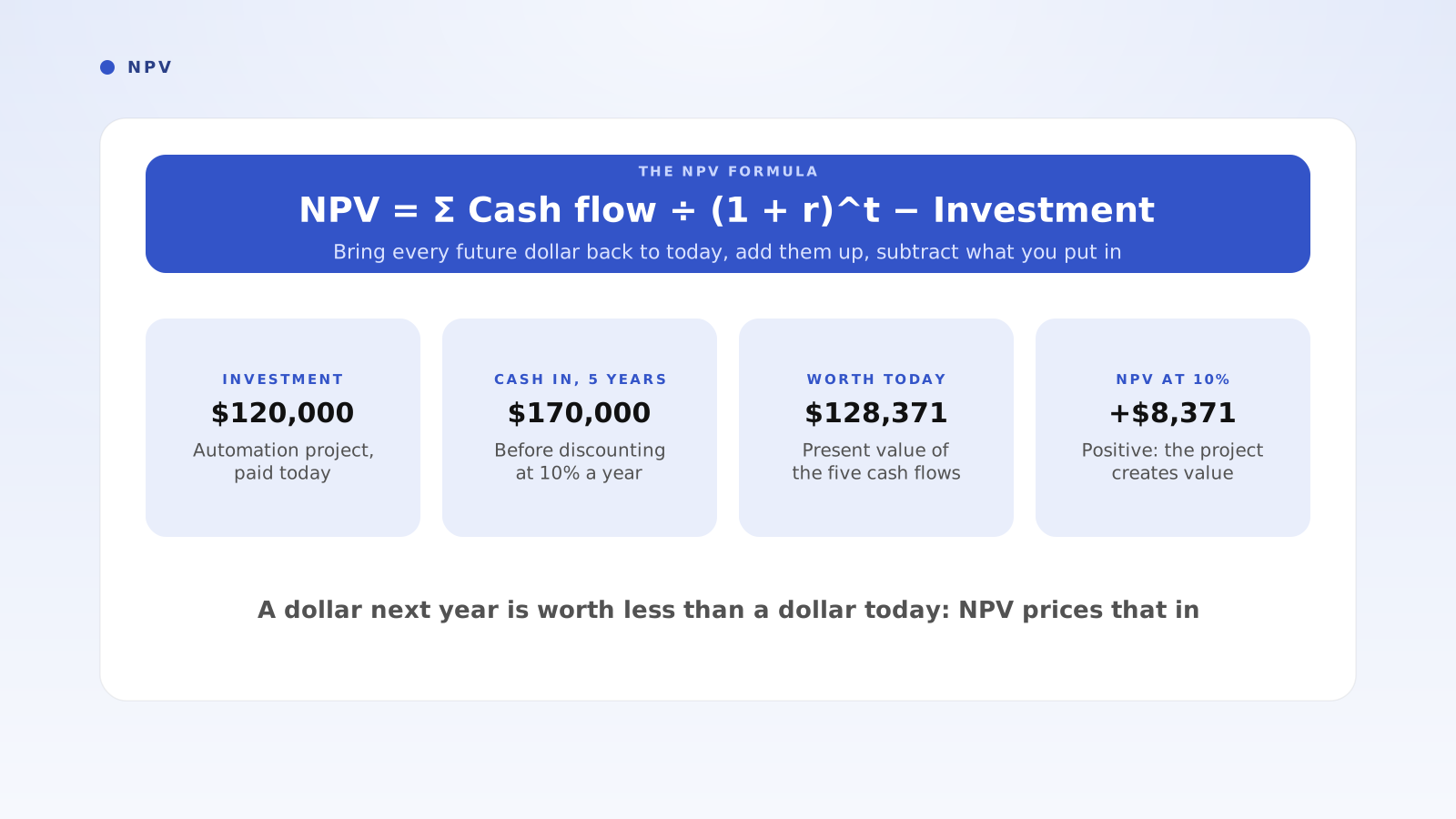
Net present value (NPV) is what an investment is worth in today's money: the present value of all the cash it will bring in, minus what it costs. If NPV is positive, the investment earns more than your required return and creates value; if it is negative, you would do better putting the money elsewhere. To calculate it, you discount each future cash flow back to today at a chosen rate, add them up and subtract the upfront cost.
NPV is the standard test for whether a project, a machine, a hire or an acquisition is worth funding, because it is the one common metric that accounts for both the size of a return and when it arrives. This guide defines the terms, walks through the calculation, and works a full example with real numbers.
What Do Cash Flow, Present Value and Discount Rate Mean?
Cash flow is the net money that moves in a period because of the investment: extra revenue or savings, minus the extra costs of running it. The upfront spend is a negative cash flow in year 0.
Present value is what a future amount is worth today. $1,000 a year from now is worth less than $1,000 now, because money you hold today can be invested, and future money carries risk. The present value of a cash flow in year t is the cash flow ÷ (1 + r)^t.
The discount rate (r) is the yearly return you require to tie up money in this investment instead of the next-best use. It is the rate that does the converting from future dollars to today's dollars.
Put together: NPV = sum of [cash flow in year t ÷ (1 + r)^t] − initial investment.
How Do You Calculate NPV?
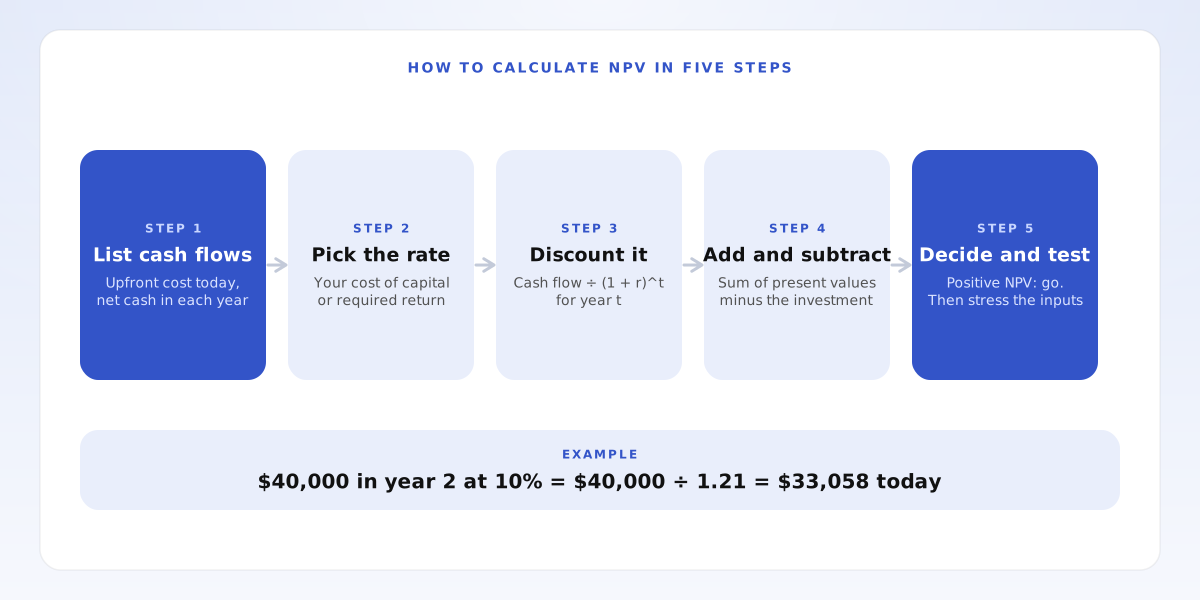
1. List the cash flows. Write the upfront cost in year 0 and the net cash in or out for each year of the project's life. Use cash, not accounting profit, and only cash that changes because of this decision.
2. Choose the discount rate. Use your cost of capital or the minimum return you require for this level of risk (more on this below).
3. Discount each year. Divide each year's cash flow by (1 + r)^t. At 10%, year 1 is divided by 1.10, year 2 by 1.21, year 3 by 1.331, and so on.
4. Add and subtract. Sum the present values and subtract the upfront investment. The result is the NPV.
5. Decide and test. A positive NPV means invest, a negative one means don't, and among options that exclude each other, the higher NPV wins. Then check how much the answer depends on your assumptions.
NPV Example: Should You Invest $120,000 in Automation?
A company is deciding whether to spend $120,000 today on automating its order processing. It expects net savings of $25,000 in year 1 while the team adapts, $40,000 in years 2 and 3, then $35,000 in year 4 and $30,000 in year 5 as the system ages. After five years it will need replacing. The company's discount rate is 10%.
Before discounting, the project returns $170,000 on $120,000, a simple ROI of 41.7%. That overstates its value, because most of the money arrives years from now. Discounting each year at 10%:
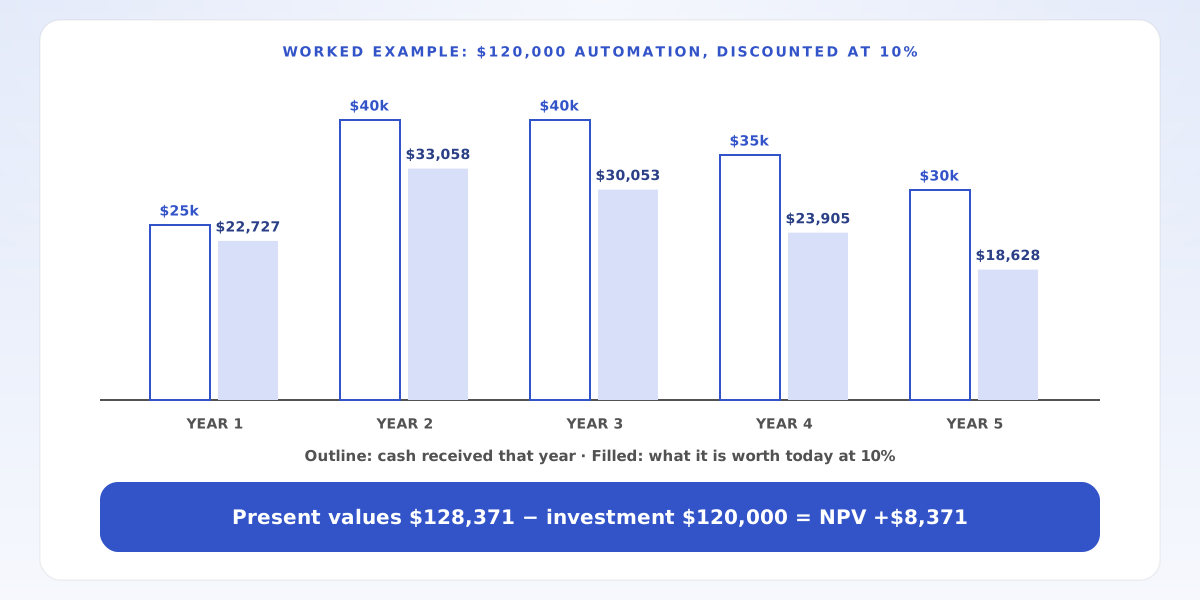
- Year 1: $25,000 ÷ 1.10 = $22,727
- Year 2: $40,000 ÷ 1.21 = $33,058
- Year 3: $40,000 ÷ 1.331 = $30,053
- Year 4: $35,000 ÷ 1.4641 = $23,905
- Year 5: $30,000 ÷ 1.61051 = $18,628
- Sum of present values: $128,371. NPV = $128,371 − $120,000 = +$8,371
Is a Positive NPV Enough to Invest?
The NPV is positive, so the project clears the 10% bar and adds about $8,400 of value in today's money. To check the result, recompute at 12%: NPV falls to +$1,946. At 13% it turns negative (−$1,079). So the project's internal rate of return sits around 12.6%, only a few points above the required 10%.
That narrow margin is the real finding. If year 2 and 3 savings come in 10% lower ($36,000 instead of $40,000), the present value drops by about $6,300 and most of the NPV disappears. Before approving, the company should test how confident it is in those two years with a sensitivity analysis, and compare the project with the other uses of the same $120,000, which is its opportunity cost.
What Discount Rate Should You Use?
Use the return you could reasonably get elsewhere for similar risk. For most companies that starts with the weighted average cost of capital (WACC): the blended cost of its debt and equity. Many businesses set a hurdle rate a few points above WACC to cover forecast optimism.
Adjust for risk. A cost-saving project on proven technology deserves a lower rate than a new product in an untested market. If you have no finance team, a practical range for an established small business is roughly 8% to 15%; pick a rate, state it and show how NPV changes at a few points around it. Never lower the rate just to make a project pass.
NPV vs ROI vs IRR: Which Should You Use?
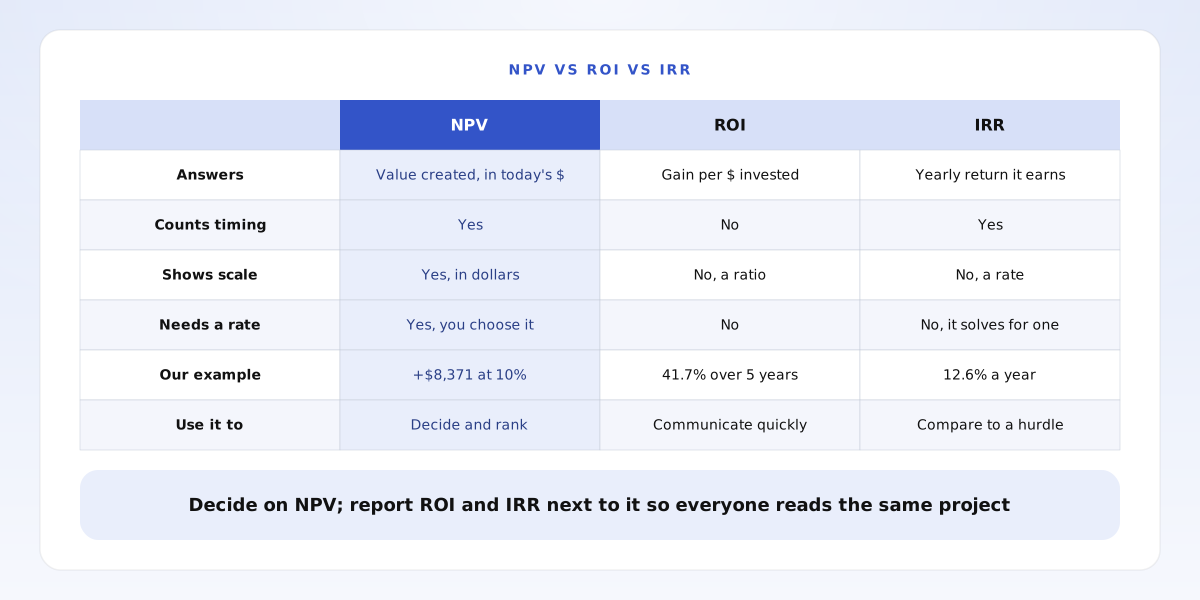
Decide on NPV and report the others next to it. ROI tells you how much you get back per dollar invested but ignores timing; our guide on how to calculate ROI covers when it misleads. IRR is the discount rate at which NPV equals zero, so it shows the project's yearly return as a single rate, but it hides scale and can mislead when cash flows change sign more than once. NPV is in dollars, counts timing and adds up across projects, which is why it is the best guide when you must choose.
Frequently Asked Questions
What does a negative NPV mean? The investment returns less than your discount rate. It may still make money in total, but you would create more value by using the cash elsewhere.
Can I calculate NPV in Excel or Google Sheets? Yes. Use =NPV(rate, year 1 to year N cash flows) and then subtract the year 0 investment separately, because the function assumes the first value arrives one year from now.
Should I include inflation? Be consistent: if your cash flows include price increases, use a nominal discount rate; if they are in today's prices, use a real rate.
How is NPV different from cost-benefit analysis? NPV is the calculation at the core of a cost-benefit analysis; the analysis also covers which costs and benefits to count and how to value them.
How Does Razn Help You Make Investment Decisions With NPV?
Razn is an AI workspace that helps you structure problems, build issue trees and reach answer-first recommendations. Use it when an investment decision depends on more than one number: Razn helps you break the cash flows into the drivers behind them, test the assumptions that move NPV the most, compare the investment with its alternatives and write up the recommendation with the reasoning attached. It is free during beta.
- NPV = sum of discounted cash flows − initial investment
- Discount at your cost of capital, adjusted for risk
- Positive NPV creates value; the higher NPV wins between exclusive options
- Check how thin the margin is before you approve


