MethodNovember 19, 20267 min read
How to Calculate ROI: Formula, Annualized ROI and Payback (Worked Example)
ROI tells you how much you get back for every dollar you put in. Here's how to calculate ROI step by step, how annualized ROI and payback add the missing time dimension, when ROI misleads compared with NPV, and a worked example that compares two projects.
How Do You Calculate ROI?
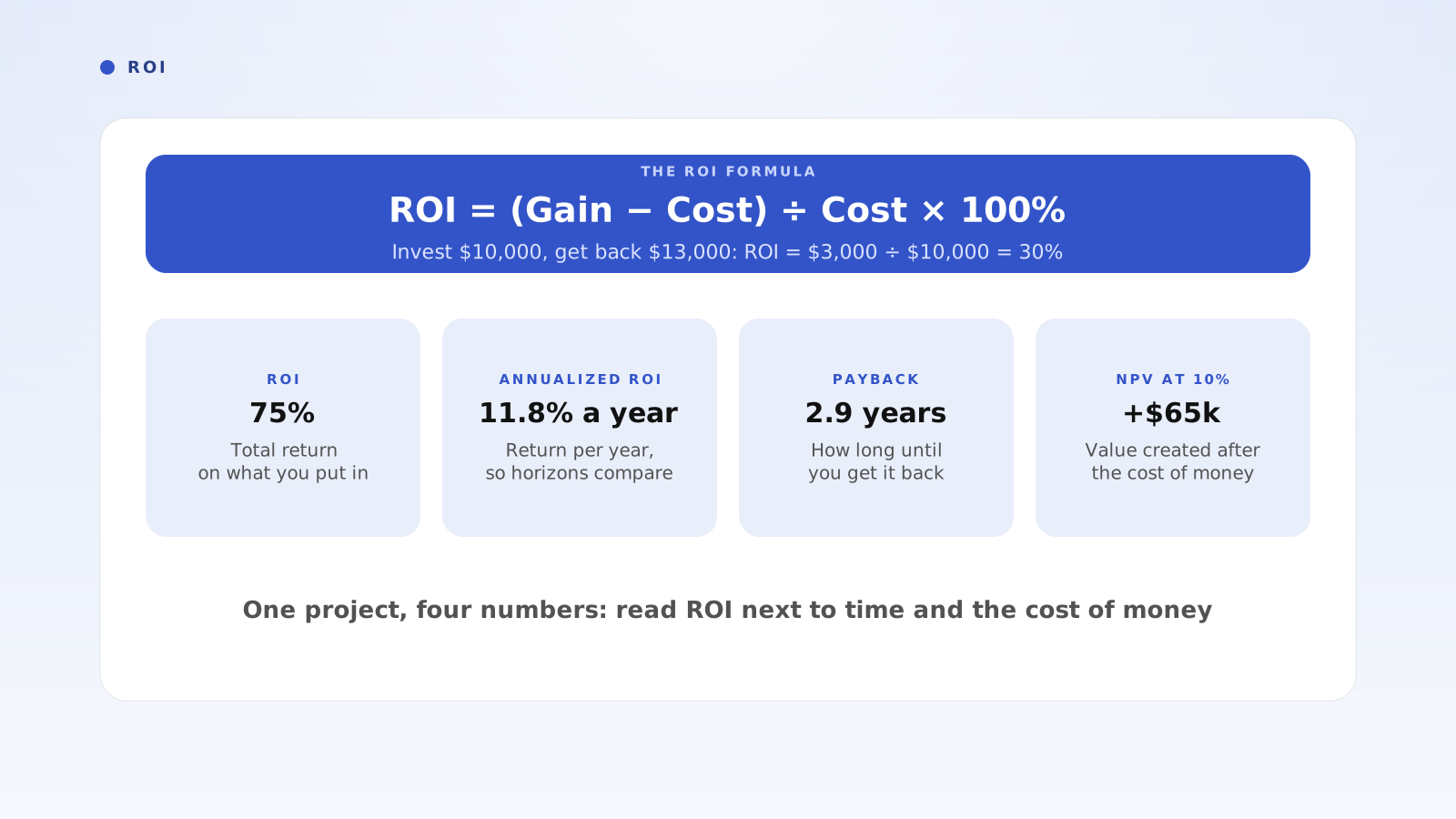
To calculate ROI (return on investment), subtract the cost of an investment from what it returns, divide the result by the cost and multiply by 100. If you spend $10,000 and get back $13,000, your ROI is $3,000 divided by $10,000, or 30%. That is the whole formula; the hard part is deciding what counts as cost and gain, and over what period.
ROI is the most common way to answer "is this worth it?" for a project, a hire, a tool or a campaign. It is also easy to misuse, because a single percentage hides how long the return takes and how big the project is. This guide covers the formula, the variants that fix those gaps, and how to use them to choose between projects.
What Is the ROI Formula?
ROI = (Gain − Cost) ÷ Cost × 100%. Gain is everything the investment brings in or saves over the period you measure. Cost is everything you spend on it over the same period, including running costs, not just the upfront price. Gain minus cost is the net gain.
An ROI of 0% means you got your money back and nothing more. A negative ROI means you lost money. An ROI of 100% means you doubled it. Because the result is a ratio, it lets you compare investments of different sizes on the same scale, which is both its strength and, as we will see, its main weakness.
How Do You Calculate ROI Step by Step?
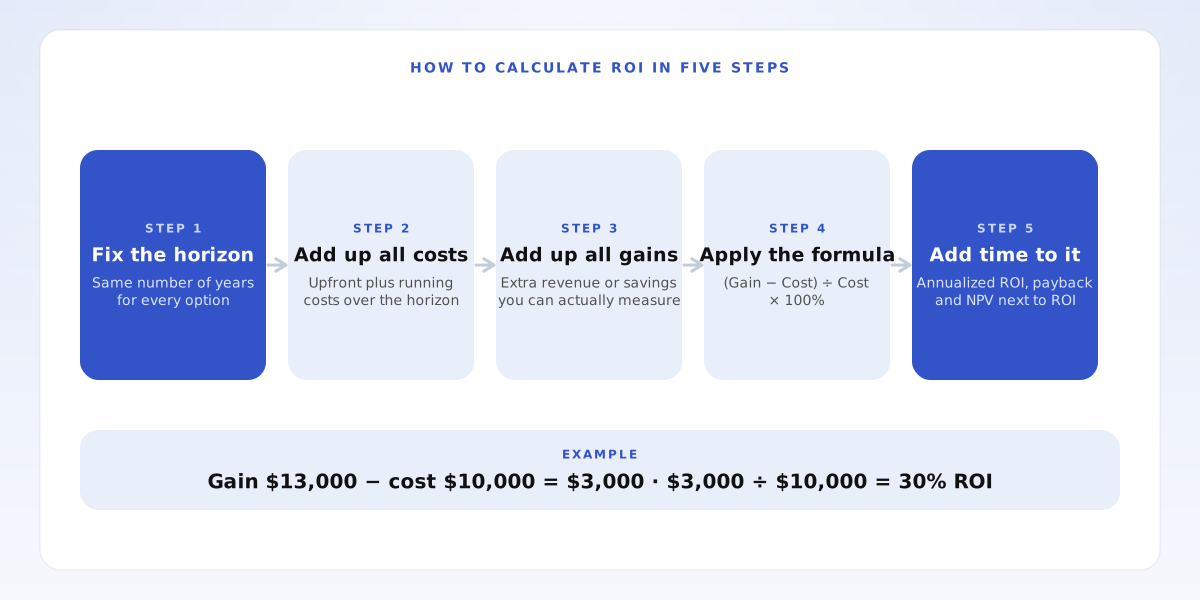
1. Fix the time horizon. Decide how many years you will measure, and use the same horizon for every option you compare. ROI over one year and ROI over five years are different numbers.
2. Add up all the costs. Include the upfront spend, setup, training and every year of running costs inside the horizon. Leaving out running costs is the most common way to inflate ROI.
3. Add up all the gains. Count extra revenue or cost savings you can measure and attribute to this investment. Use margin, not revenue, when the gain comes from sales, because selling more also costs more. Our guide to unit economics shows how to get from revenue to contribution.
4. Apply the formula. Net gain divided by total cost, times 100.
5. Add time to it. Calculate annualized ROI and the payback period, and NPV if the money is large or the horizon long. Then read the numbers together.
What Is Annualized ROI and Payback Period?
Annualized ROI converts a total ROI into a yearly rate, so investments with different horizons can be compared. The formula is ((1 + ROI) ^ (1 ÷ years)) − 1. A 75% ROI over five years is 1.75 to the power of 0.2, minus 1, which is 11.8% a year. A 44% ROI over two years is 20% a year. This version treats the whole return as if it arrives at the end; when cash comes in every year, the internal rate of return (IRR) is the precise version of the same idea.
The payback period is how long it takes to earn back the upfront cost. With an even yearly net benefit, payback = upfront cost ÷ net annual benefit. It ignores everything after the payback date, but it is a good measure of risk and of how long your cash is tied up.
Net present value (NPV) discounts every future cash flow back to today at your cost of capital and subtracts the cost. A positive NPV means the investment creates value after paying for the money it uses. Our guide to cost-benefit analysis walks through discounting in detail.
ROI Example: Which of Two Projects Should You Fund?
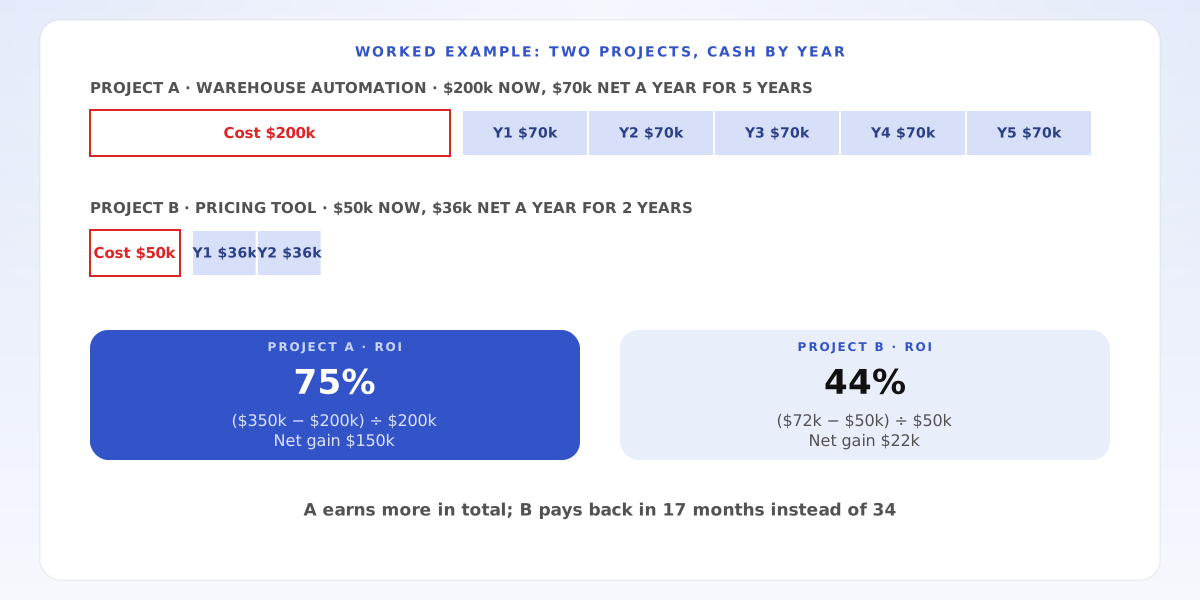
A company has two proposals. Project A is warehouse automation: $200,000 upfront and $70,000 a year in net savings for five years. Project B is a pricing tool: $50,000 upfront and $36,000 a year in extra margin for two years, after which the tool needs replacing. The cost of capital is 10%.
Project A: total gains are 5 × $70,000 = $350,000. Net gain is $350,000 − $200,000 = $150,000, so ROI is $150,000 ÷ $200,000 = 75%. Annualized ROI is 1.75 ^ 0.2 − 1 = 11.8% a year. Payback is $200,000 ÷ $70,000 = 2.9 years, or about 34 months. At 10%, five years of $70,000 are worth $265,400 today, so NPV is +$65,400.
Project B: total gains are 2 × $36,000 = $72,000. Net gain is $22,000, so ROI is $22,000 ÷ $50,000 = 44%. Annualized ROI is 1.44 ^ 0.5 − 1 = 20% a year. Payback is $50,000 ÷ $36,000 = 1.4 years, or about 17 months. Two years of $36,000 are worth $62,500 today, so NPV is +$12,500.
Simple ROI and NPV favor A. Annualized ROI and payback favor B. Both projects create value, so if the budget covers both, fund both. If you can only fund one and capital is not the constraint, choose A: it creates $52,900 more value in today's money. If cash is tight or the next two years are uncertain, B returns your money twice as fast and frees $150,000 for other uses.
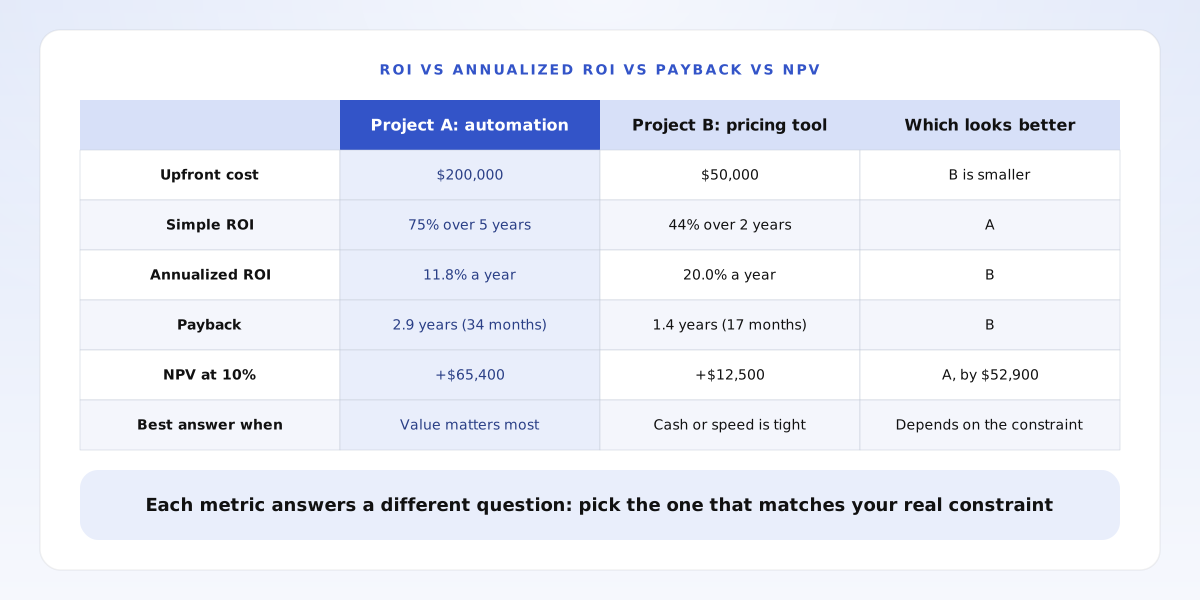
- Project A: ROI 75%, 11.8% a year, payback 34 months, NPV +$65,400
- Project B: ROI 44%, 20% a year, payback 17 months, NPV +$12,500
- Choose on NPV when value matters most, on payback when cash is the constraint
When Is ROI Misleading?
ROI ignores time. A 50% ROI over one year and a 50% ROI over ten years look identical. Always state the horizon, and use annualized ROI or NPV when horizons differ.
ROI ignores scale. A 200% ROI on $5,000 creates $10,000 of value; a 40% ROI on $1,000,000 creates $400,000. When you can only pick one, NPV tells you which creates more.
ROI ignores risk. A projected 80% ROI that depends on a doubtful sales forecast is not better than a near-certain 30%. Test the assumptions that drive the gain with a sensitivity analysis, and if outcomes split into distinct scenarios, weigh them with a decision tree.
ROI is easy to game. Leaving out running costs, counting revenue instead of margin or stretching the horizon all raise the number. Agree on the definitions before anyone calculates it.
How Do You Use ROI to Choose Between Projects?
Use ROI as a first screen and NPV as the decider. Put every option, including doing nothing, on the same horizon and calculate ROI, annualized ROI, payback and NPV for each. Discard anything with a negative NPV. Among the rest, rank by NPV unless a real constraint, such as cash, a deadline or risk tolerance, makes payback or annualized ROI more important.
Then check how fragile the ranking is. Ask how far the key assumption would have to move for the winner to lose, and how many units or customers you need just to recover the cost, which is a break-even analysis. When you present the decision, a business case puts the numbers, the risks and the recommendation on one page.
Frequently Asked Questions
What is a good ROI? It depends on the risk and the horizon. As a rule, a project should beat your cost of capital on an annualized basis, and riskier projects should clear a higher bar.
What is the difference between ROI and ROAS? ROAS (return on ad spend) divides revenue by ad spend. ROI divides net gain by total cost. A campaign can have a high ROAS and a negative ROI once product costs are counted.
Is ROI the same as profit margin? No. Margin is profit as a share of revenue. ROI is net gain as a share of what you invested.
Should I use ROI or NPV? Use both. ROI is quick and easy to communicate; NPV is what tells you which option creates the most value.
How Does Razn Help You Decide With ROI?
Razn is an AI workspace that helps you structure problems, build issue trees and reach answer-first recommendations. Use it when you are choosing between projects and need more than a single ROI figure: Razn helps you lay out the options, break the costs and gains into drivers you can check, test the assumptions that move the result and write up the recommendation with the reasoning attached. It is free during beta.
- ROI = (Gain − Cost) ÷ Cost × 100%
- Use the same horizon and include running costs
- Add annualized ROI, payback and NPV before deciding
- Rank by NPV unless cash or risk is the real constraint