MethodOctober 26, 20268 min read
Opportunity Cost: How to Use It to Make Better Business Decisions (With Examples)
Opportunity cost is the value of the best alternative you give up when making a decision. Here's how to calculate it and use it to make smarter business choices.
What Is Opportunity Cost?
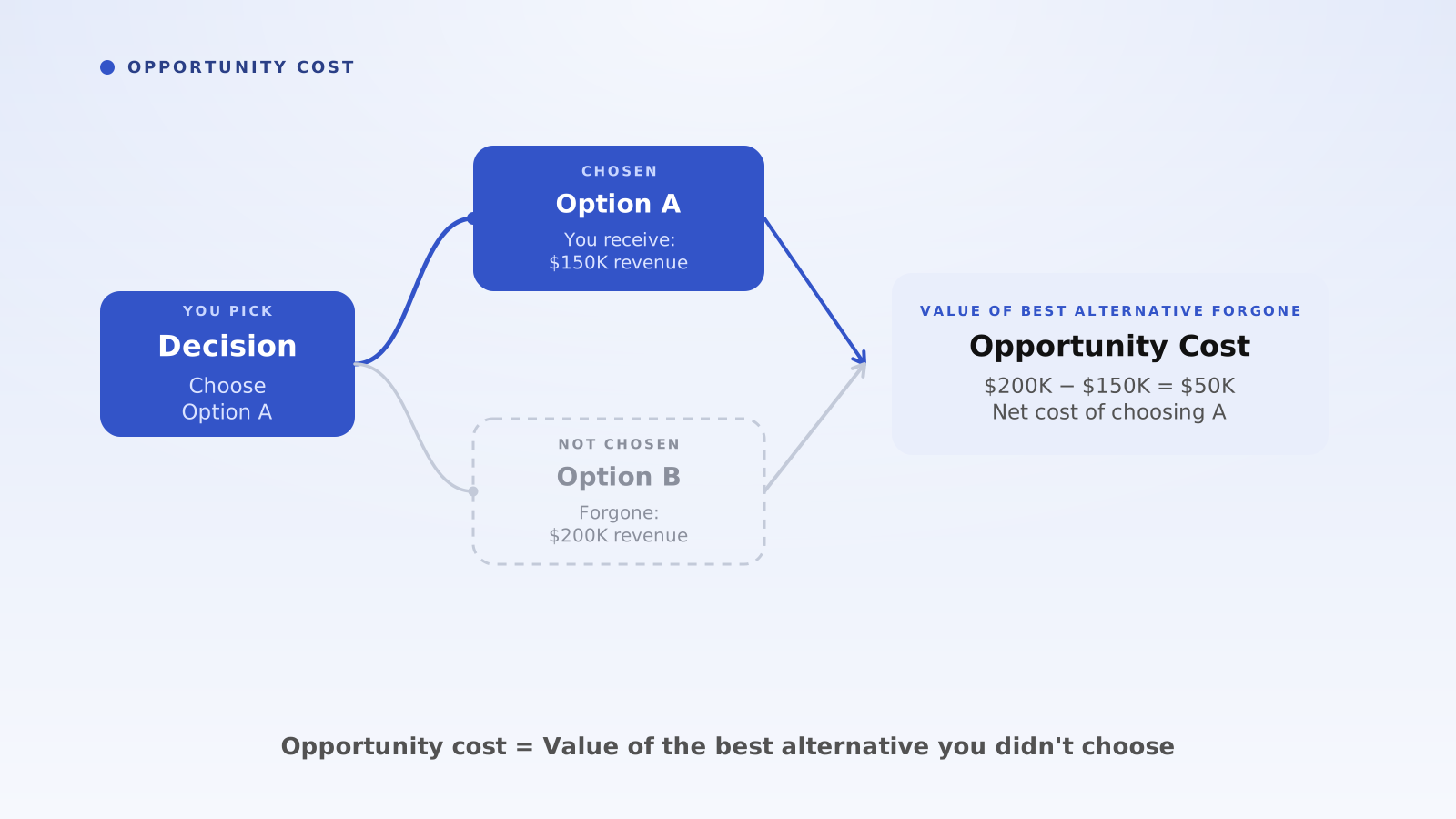
Opportunity cost is the value of the best alternative you give up when you make a decision. Every time you choose one option, you're implicitly rejecting others—and the opportunity cost is what you would have gained from the next-best choice. This concept matters because decisions aren't free: even when no money changes hands, choosing A means not choosing B, and that trade-off has real value.
Consider a simple example: you have $100,000 to invest and two options—a bond yielding 5% annually or a stock expected to return 12%. If you choose the bond, your opportunity cost is 12% − 5% = 7%, or $7,000 per year. You didn't lose $7,000 in cash, but you gave up $7,000 in potential gains. That's the hidden cost of your choice.
Opportunity cost applies to every constrained resource: capital, time, attention, engineering hours, warehouse space. When you assign two engineers to Project A, the opportunity cost is what those engineers would have delivered on Project B. When you spend an hour in a meeting, the opportunity cost is the work you didn't do. Making this trade-off explicit—rather than ignoring it—leads to better decisions.
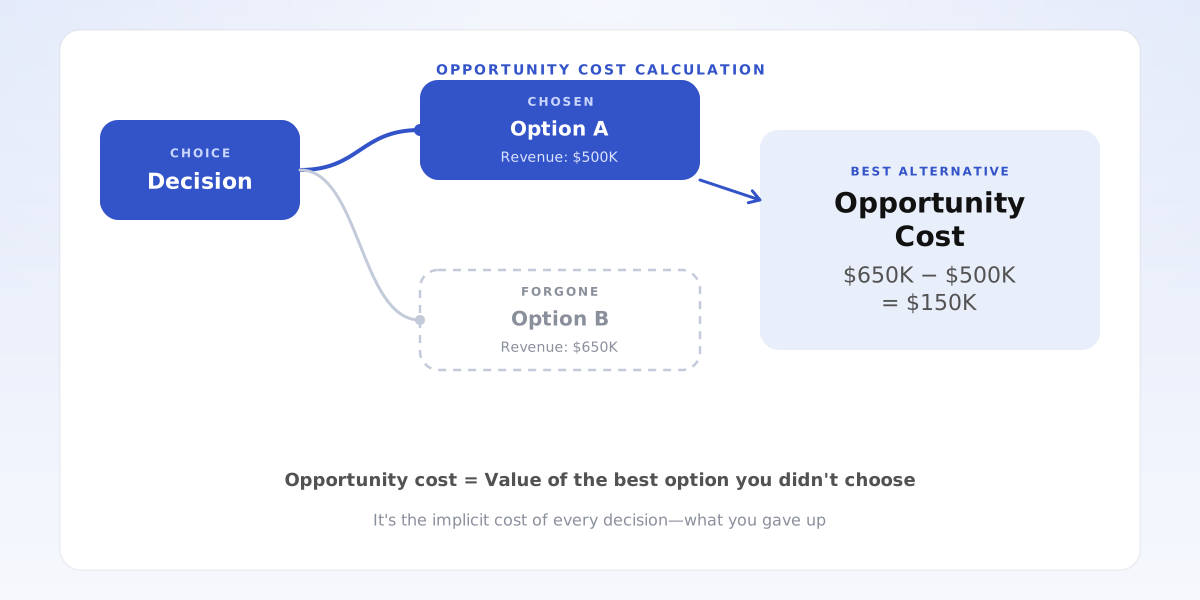
- Opportunity cost is the value of the best alternative you give up when making a decision
- It applies to every constrained resource: money, time, attention, talent, space
- Making opportunity cost explicit helps you see the true cost of every choice
How Do You Calculate Opportunity Cost?
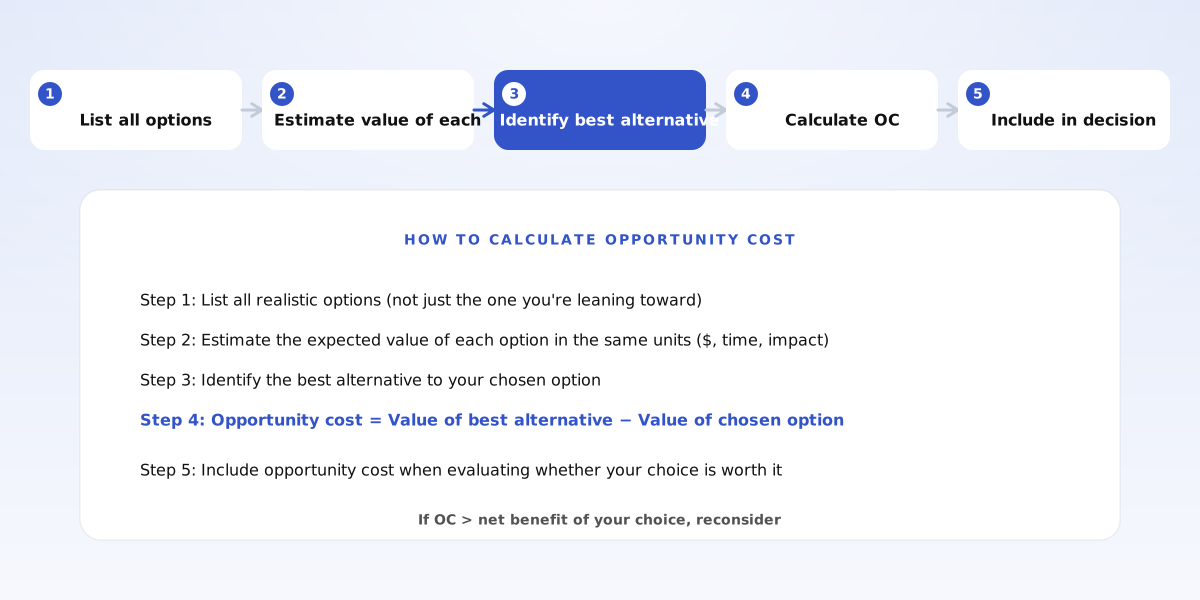
Calculating opportunity cost follows a five-step process: (1) List all realistic options. (2) Estimate the expected value of each option in comparable units. (3) Identify the best alternative to your chosen option. (4) Calculate: Opportunity cost = Value of best alternative − Value of chosen option. (5) Include opportunity cost when deciding whether your choice is worth it.
Step 1: List all realistic options. Don't just compare your preferred choice to 'do nothing.' Identify the actual alternatives—including options you might dismiss too quickly. If you're deciding whether to hire a contractor, the alternatives might include hiring a full-time employee, automating the work, outsourcing to an agency, or delaying the project.
Step 2: Estimate the expected value of each option in the same units. Use dollars, revenue impact, time saved, or whatever metric matters for this decision. Be honest about uncertainty—a range is better than false precision. If one option could yield $200K–$400K and another $150K with high certainty, note that variance.
Step 3: Identify the best alternative to your chosen option. This is the option you'd pick if your current choice wasn't available. It's not the worst alternative or the average of alternatives—it's the single best one you're giving up.
Step 4: Calculate the opportunity cost. If you're choosing Option A ($300K value) over Option B ($350K value), your opportunity cost is $350K − $300K = $50K. This doesn't mean Option A is wrong—it means you need $50K of other value (strategic fit, risk reduction, learning) to justify the choice.
Step 5: Include opportunity cost in your decision. The true cost of Option A isn't just its direct cost—it's the direct cost plus the $50K you're forgoing. If the benefits of A exceed this total cost, proceed. If not, reconsider. This is where a decision matrix helps you weigh factors systematically.
- Step 1: List all realistic options, not just your preferred choice
- Step 2: Estimate value of each option in comparable units (dollars, time, impact)
- Step 3: Identify the best alternative—the one you'd choose if your current pick wasn't available
- Step 4: Opportunity cost = Value of best alternative − Value of chosen option
- Step 5: Include opportunity cost when deciding whether the choice is worth it
Worked Example: Where Should We Assign Our Engineers?
A product team has two engineers available for the next quarter. Three projects compete for their time: Project Alpha (build a new feature expected to add $300K ARR), Project Beta (reduce tech debt, saving $180K in future maintenance costs), and Project Gamma (support sales demos, potentially accelerating $100K in pipeline). Which project should get the engineers?
First, estimate the value of each option. Alpha: $300K ARR (recurring, high confidence). Beta: $180K savings (one-time, high confidence). Gamma: $100K pipeline acceleration (less certain—depends on close rates). Alpha has the highest expected value.
Next, calculate the opportunity cost of each choice. If you choose Alpha ($300K), you give up Beta ($180K, the next-best). Opportunity cost: $0—you're already picking the highest-value option. If you choose Beta ($180K), you give up Alpha ($300K). Opportunity cost: $300K − $180K = $120K. If you choose Gamma ($100K), you give up Alpha ($300K). Opportunity cost: $300K − $100K = $200K.
The decision becomes clear: choosing anything other than Alpha means giving up $120K–$200K in value. Unless there's a compelling strategic reason (Beta unblocks a critical migration, Gamma closes a must-win account), Alpha is the right call. The opportunity cost analysis made explicit what 'prioritization' really means—it's not just about picking the best; it's about quantifying what you lose when you don't.
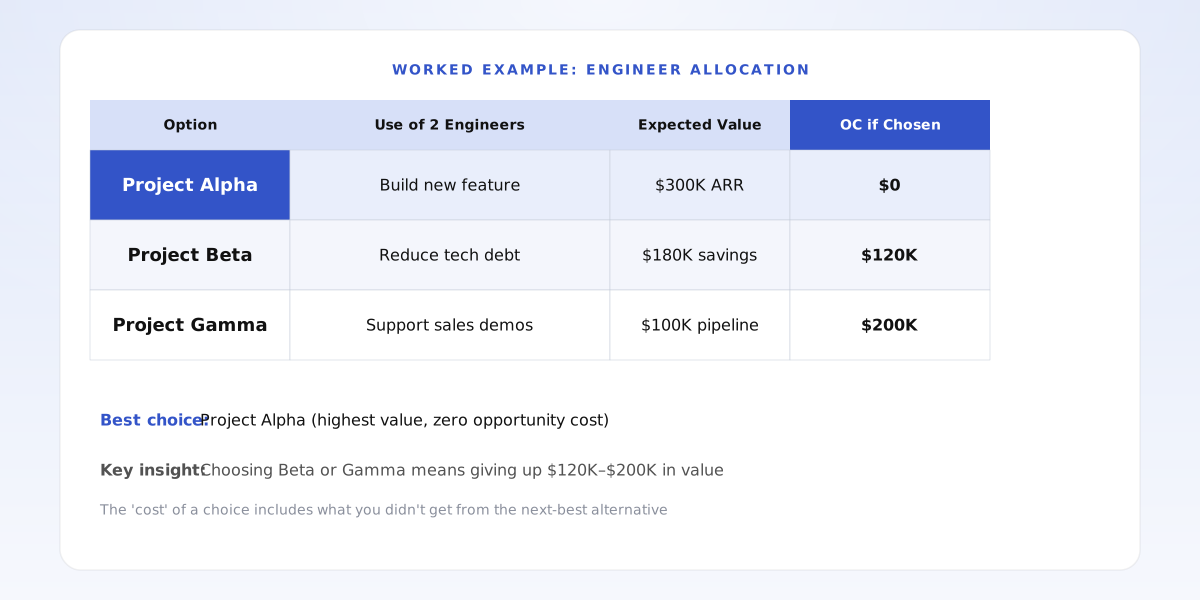
- Alpha ($300K): Best option, zero opportunity cost
- Beta ($180K): Choosing it means forgoing $120K (the gap to Alpha)
- Gamma ($100K): Choosing it means forgoing $200K (the gap to Alpha)
- Opportunity cost makes prioritization concrete—it quantifies what you give up
When Should You Use Opportunity Cost Analysis?
Use opportunity cost analysis whenever you're allocating constrained resources across competing uses. The most common applications: capital allocation (which projects get funded), time management (which tasks get your attention), hiring decisions (which role to fill first), and strategic planning (which market to enter). If resources are unlimited, there's no opportunity cost—but resources are never unlimited.
Opportunity cost is especially important for irreversible decisions. If you can easily switch from Option A to Option B, the opportunity cost of starting with A is low—you'll learn and adapt. But if choosing A locks you in for years (a long-term lease, a major hire, a technology platform), the opportunity cost analysis needs to be rigorous because you're committing the resource for the duration.
It's also valuable when the comparison isn't obvious. If one option is clearly better on every dimension, you don't need a formal analysis. But when options have different strengths (A has higher upside, B has lower risk, C is faster), opportunity cost helps you weigh them. Pair it with second-order thinking to catch downstream effects of your choice.
Finally, use opportunity cost to check your intuition. If you're leaning toward an option but the opportunity cost analysis shows you're giving up significant value, that's a signal to pause. Either find the missing value in your preferred option (strategic fit, learning, relationships) or reconsider the choice.
- Use it when allocating constrained resources: capital, time, talent, attention
- Especially important for irreversible decisions with long commitments
- Helpful when options have different strengths and the comparison isn't obvious
- Use it to check intuition—if OC is high, either find the missing value or reconsider
Common Mistakes in Opportunity Cost Thinking
The most common mistake is ignoring opportunity cost entirely. People compare an option to 'doing nothing' rather than to the best alternative. A project that returns $200K sounds good—until you realize the same resources could return $350K elsewhere. The $200K project isn't profitable; it's a $150K loss disguised as a gain.
The second mistake is comparing to the wrong alternative. Opportunity cost uses the best alternative, not the average or the worst. If you have three options worth $100K, $200K, and $300K, and you choose the $100K option, your opportunity cost is $300K − $100K = $200K, not some average of the two forgone options.
The third mistake is double-counting sunk costs. Opportunity cost is about the future, not the past. If you've already spent $500K on a project, that's gone—it shouldn't factor into the opportunity cost of continuing. The only question is: what's the value of continuing versus the value of the best alternative going forward? See first-principles thinking for how to reason from fundamentals rather than past commitments.
The fourth mistake is ignoring non-financial opportunity costs. Time has opportunity cost. Attention has opportunity cost. If you spend an hour on low-value work, the opportunity cost is the high-value work you didn't do. This is why 80/20 prioritization matters—focusing on the vital few means accepting the opportunity cost of ignoring the trivial many.
- Ignoring opportunity cost: Comparing to 'nothing' instead of the best alternative
- Wrong benchmark: Using average or worst alternatives instead of the best one
- Double-counting sunk costs: Past spending is irrelevant to future opportunity cost
- Ignoring non-financial costs: Time and attention have opportunity costs too
Frequently Asked Questions
What if I can't quantify the value of alternatives? Use your best estimate. A rough number is better than no number. If Project A might be worth $100K–$300K and Project B is worth $150K, you can still reason about the range. Even if you can't pin down exact values, you can often rank options—and that ranking tells you the direction of opportunity cost. When values are truly uncertain, consider which option preserves future flexibility.
How do I handle opportunity cost when time is the constraint? Treat time like money. If you have 10 hours to allocate between two tasks, estimate the value of each hour on each task. If Task A generates $500/hour and Task B generates $200/hour, spending time on B has an opportunity cost of $300/hour. This is why saying 'yes' to low-value requests is expensive—it's not just the time spent; it's the value forgone.
Does opportunity cost apply to personal decisions? Yes. Choosing to work late tonight has an opportunity cost: the rest, exercise, or family time you give up. Pursuing one career path means not pursuing another. Opportunity cost is a universal concept—economics applies it to markets, but it's equally valid for individual choices. The question is always: what am I giving up?
How does opportunity cost relate to decision-making frameworks? Opportunity cost is an input to frameworks like a decision matrix or a build vs buy analysis. It quantifies one dimension of trade-offs: the value you forgo. A complete decision also considers risk, strategic fit, reversibility, and second-order effects. Opportunity cost doesn't make the decision—it makes the trade-off visible.
- Can't quantify alternatives? Use rough estimates or at least rank options by value
- Time-constrained? Estimate value per hour and compare opportunity costs across tasks
- Personal decisions? Opportunity cost applies equally—what are you giving up?
- Frameworks: Opportunity cost is one input, alongside risk, fit, and reversibility
Applying Opportunity Cost to Your Decisions
Start by picking a decision you're currently facing—an allocation of budget, time, or people. List the realistic options. Estimate the value of each option in comparable units. Identify the best alternative to your leading choice. Calculate the opportunity cost. Now ask: is my preferred option still worth it given what I'm giving up?
The discipline of calculating opportunity cost changes how you think about decisions. Instead of asking 'Is this option good?' you ask 'Is this option better than the best alternative?' That's a higher bar—and it leads to better resource allocation. Most underperforming teams don't lack good options; they fail to choose the best among good options.
Razn is an AI workspace that helps you structure decisions like opportunity cost analysis into issue trees, compare options with a decision matrix, and write answer-first recommendations. When you need to map the trade-offs across multiple options—calculating values, identifying the best alternative, quantifying what you're giving up—Razn structures that thinking so your decision is backed by rigorous analysis. Razn is free during beta.
- Practice: Calculate opportunity cost for a decision you're currently facing
- Shift your question from 'Is this good?' to 'Is this better than the best alternative?'
- Use Razn to structure decisions, compare options, and document the opportunity cost analysis