MethodNovember 26, 20267 min read
PESTEL Analysis: How to Use It to Make a Market Decision (With a Worked Example)
A PESTEL analysis checks six outside forces, political, economic, social, technological, environmental and legal, before you commit to a market. Here's how to do one step by step, how to score each factor by impact and likelihood, and a worked example that turns a country launch into a go/no-go decision.
What Is a PESTEL Analysis?
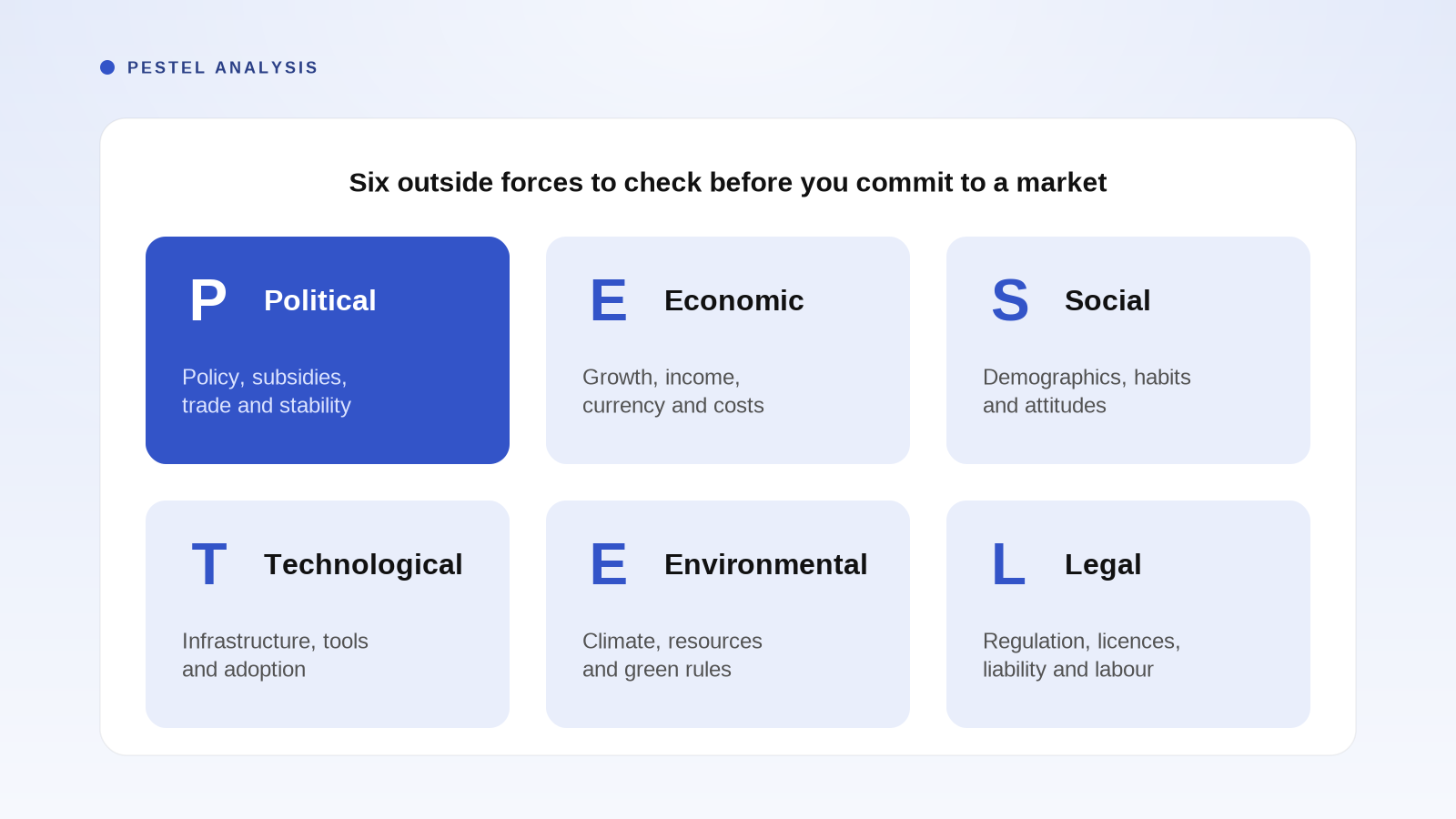
A PESTEL analysis is a checklist of six outside forces that can make or break a decision about a market: political, economic, social, technological, environmental and legal. You list the factors in each category that could change your decision, score each one by impact and likelihood, and add up the result. Done this way, a PESTEL analysis gives you a go/no-go answer rather than a list of observations.
Use it when the decision depends on things you do not control: entering a new country, launching in a new industry, making a long-term investment or deciding whether a market is worth more research. It looks outward only. For your own strengths and weaknesses, use a SWOT analysis; for the profit potential of an industry, use Porter's Five Forces.
What Are the Six PESTEL Factors?
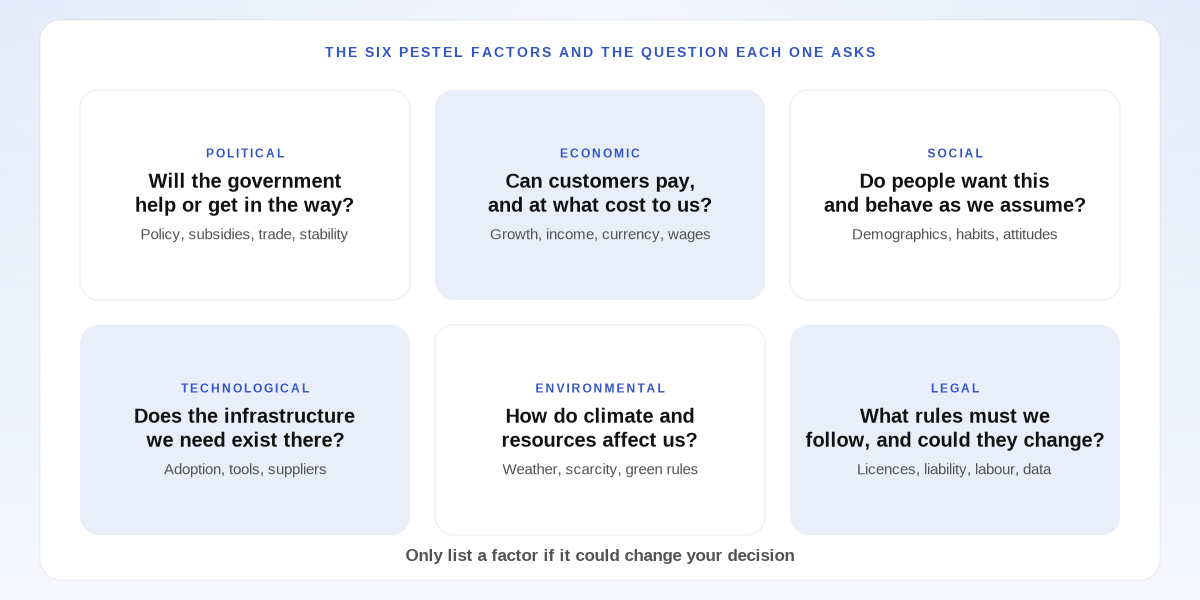
Political: government policy, subsidies, taxes, trade rules and political stability. Will the government help you or get in your way?
Economic: growth, disposable income, inflation, exchange rates, interest rates and wages. Can customers pay, and what will it cost you to serve them?
Social: demographics, habits, attitudes and lifestyle trends. Do people want what you sell, and do they behave the way your plan assumes?
Technological: infrastructure, local suppliers, adoption of digital tools and the pace of change. Does what you need already exist there?
Environmental: climate, weather, resource scarcity and sustainability expectations. How do the physical conditions affect demand and cost?
Legal: licences, product rules, liability, labour law, data protection and consumer law. What must you comply with, and is any of it about to change?
How Do You Do a PESTEL Analysis Step by Step?
1. Write the decision down. "Should we launch in Spain next year?" is a decision; "understand Spain" is not. The decision tells you which factors matter.
2. List the factors. For each of the six categories, write the one to three factors that could change the answer. Skip anything that is true but irrelevant.
3. Score impact. Rate each factor from −3 (serious threat) to +3 (strong opportunity) for this decision.
4. Estimate likelihood. Give each factor a probability of happening, or holding, over your planning horizon, usually three years.
5. Multiply and add up. Impact × likelihood gives each factor's score; the sum is the net score. Set the bar before you add up, for example "go if the net score is +1.0 or more".
6. Sort the factors and decide. Put each factor on an impact × likelihood grid, act on the high-impact, likely ones, set triggers for the high-impact, unlikely ones, then make the call, or change the plan and score it again.
PESTEL Analysis Example: Should an E-Bike Subscription Business Enter Spain?
An e-bike subscription business operating in the Netherlands is deciding whether to launch in Madrid and Barcelona. The two-city launch would cost €2.4M over 18 months. The team sets the bar in advance: go only if the net PESTEL score is +1.0 or more.
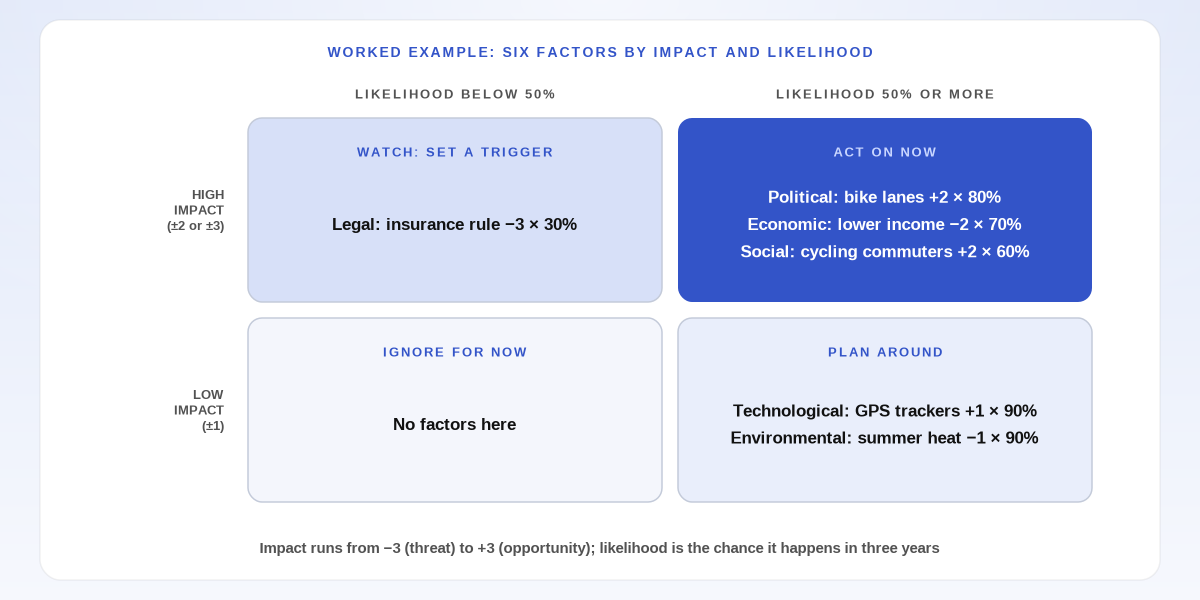
Political: both cities are expanding bike lanes and low-emission zones. Impact +2, likelihood 80%, score +1.6.
Economic: disposable income is lower than at home, so the plan would need prices around 15% lower to win subscribers. Impact −2, likelihood 70%, score −1.4.
Social: the number of people cycling to work is growing. Impact +2, likelihood 60%, score +1.2.
Technological: GPS anti-theft trackers and local battery suppliers are readily available. Impact +1, likelihood 90%, score +0.9.
Environmental: summer heat cuts ridership for about three months a year. Impact −1, likelihood 90%, score −0.9.
Legal: a proposed rule could require compulsory insurance for e-bike riders, adding cost to every subscription. Impact −3, likelihood 30%, score −0.9.
How Do You Turn a PESTEL Analysis Into a Go/No-Go Decision?
Add up the six scores: +1.6 − 1.4 + 1.2 + 0.9 − 0.9 − 0.9 = +0.5. That is below the +1.0 bar, so the two-city launch is a no-go. The grid shows why: the economic factor is a likely, high-impact threat, and it cancels most of the political tailwind.
Instead of dropping the market, the team changes the plan to deal with that threat: a pilot in Madrid only, with prices 15% lower and a €600K budget. With a cheaper plan built for local incomes, the economic impact falls from −2 to −1, so its score becomes −0.7. The new net score is +1.6 − 0.7 + 1.2 + 0.9 − 0.9 − 0.9 = +1.2, which clears the bar. The pilot is a go.
Two rules complete the decision. A kill criterion: if the pilot has fewer than 400 paying subscribers by month six, stop. A trigger for the legal risk: if the insurance rule passes, re-run the numbers before expanding to Barcelona. To stress-test the likelihoods themselves, run a sensitivity analysis on the two biggest scores, or build two or three futures with scenario planning.
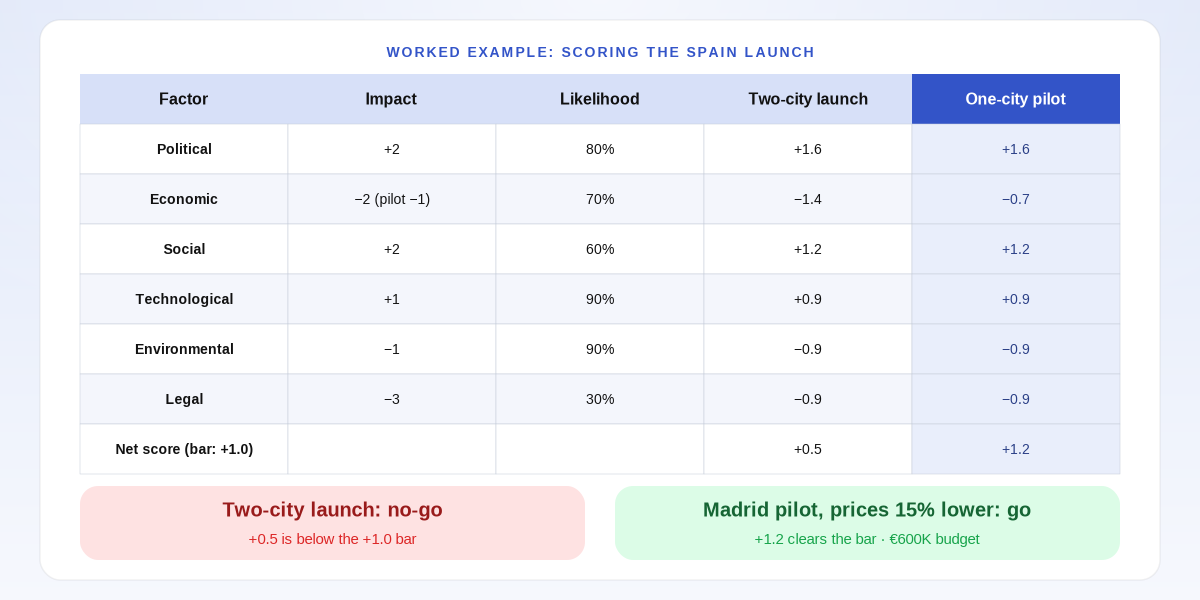
- Factor score = impact (−3 to +3) × likelihood
- Two-city launch: net +0.5, below the +1.0 bar, no-go
- Madrid pilot at 15% lower prices: net +1.2, go, with a stop rule at 400 subscribers by month six
What Are the Most Common PESTEL Mistakes?
Listing everything. A PESTEL with 40 factors is a research report, not an analysis. Keep only the factors that could change the decision.
Skipping the scores. Without impact and likelihood, every factor looks equally important and the analysis ends with "it depends".
Setting the bar after the math. Decide what net score means go before you add up, or you will move the bar to fit the answer you wanted.
Treating it as a one-off. Outside forces change. Revisit the scores when a trigger fires or every six to twelve months.
Stopping at PESTEL. It tells you whether the environment is favourable, not whether you can win. Pair it with a market-entry choice from the Ansoff Matrix, and test the money with a cost-benefit analysis.
Frequently Asked Questions
What is the difference between PEST and PESTEL? PEST covers political, economic, social and technological factors. PESTEL adds environmental and legal, which matter more and more for products with physical operations or strict regulation.
What is the difference between PESTEL and SWOT? PESTEL looks only at the outside environment. SWOT covers both your internal strengths and weaknesses and your external opportunities and threats. A PESTEL analysis is a good way to fill in the opportunities and threats of a SWOT.
How long should a PESTEL analysis take? For one decision, a few hours to a couple of days. Spend the time on the few factors with the highest scores, not on filling every box.
Where do you find the data? Government statistics, central bank reports, industry associations, regulator websites and conversations with local customers or partners. When you cannot find a number, write down your estimate and the reasoning behind it.
How Does Razn Help You Make Market Decisions?
Razn is an AI workspace that helps you structure problems, build issue trees and reach answer-first recommendations. Use it when you have to decide whether to enter a market and the outside factors are hard to weigh: Razn helps you frame the decision, list the factors that matter, test the assumptions behind each impact and likelihood score and write up the go/no-go with the reasoning attached. It is free during beta.
- Six factors: political, economic, social, technological, environmental, legal
- Score each factor: impact (−3 to +3) × likelihood
- Set the go/no-go bar before you add up the scores
- Change the plan to address the biggest threat, then score it again