FrameworksOctober 30, 20267 min read
SWOT Analysis: How to Turn Internal and External Factors Into a Decision (With Worked Example)
A SWOT analysis identifies strengths, weaknesses, opportunities, and threats—but listing them isn't deciding. Here's how to do a SWOT analysis that ends with prioritized actions, not just a four-box diagram.
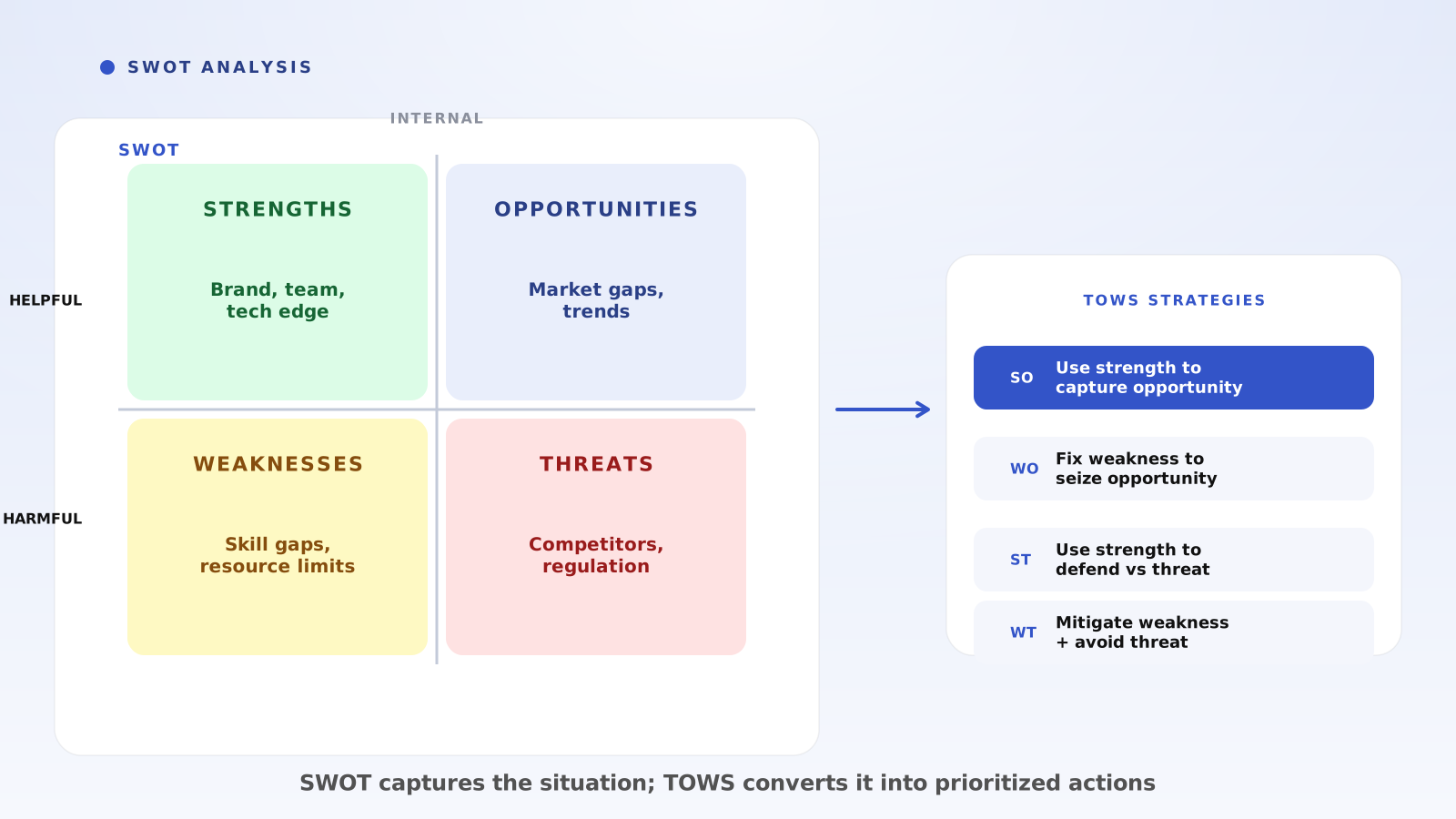
What Is a SWOT Analysis?
A SWOT analysis is a strategic planning tool that organizes factors affecting a decision into four categories: Strengths (internal advantages), Weaknesses (internal limitations), Opportunities (external advantages), and Threats (external risks). By mapping these factors on a 2×2 grid, you create a snapshot of your strategic position—what's working, what's not, and what the environment offers or threatens.
The framework has been used since the 1960s because it's simple and adaptable. Product launches, market entries, competitive responses, and resource allocation all benefit from a SWOT lens. But most SWOT analyses stop at the list: four boxes filled with bullet points, then filed away. The real value comes from converting those factors into prioritized actions—which requires one more step.
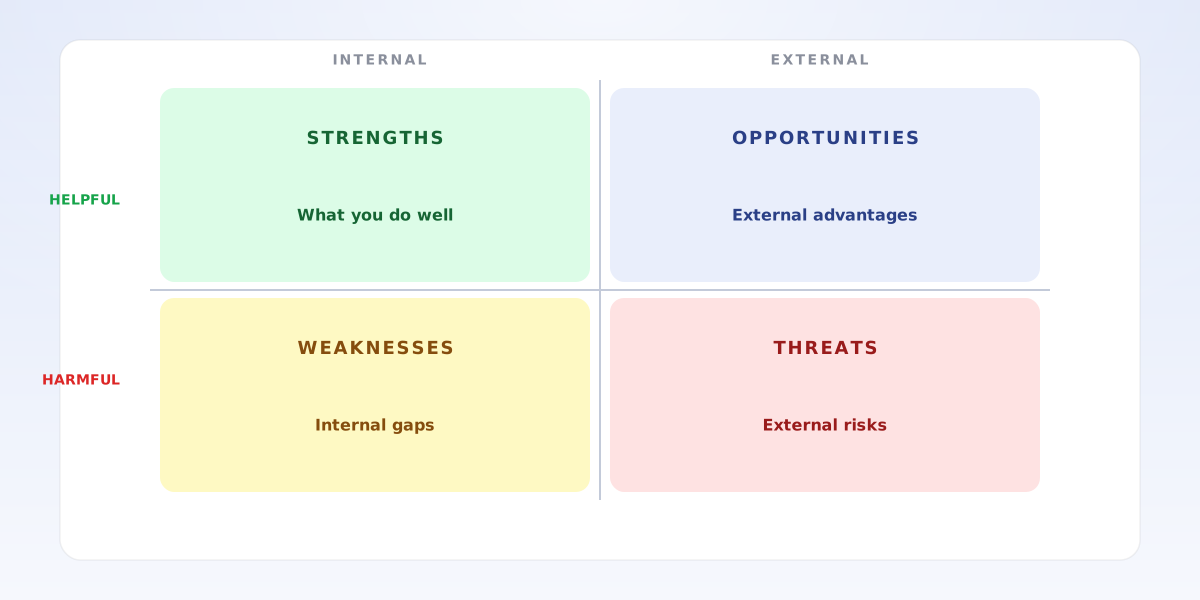
- Strengths: internal capabilities that give you an advantage
- Weaknesses: internal gaps that put you at a disadvantage
- Opportunities: external trends or conditions you could exploit
- Threats: external factors that could cause problems
How Do You Conduct a SWOT Analysis Step by Step?
Step 1: Define the decision or objective. A SWOT without a focal question becomes a vague brainstorm. 'Should we launch a mobile app?' or 'Should we enter the European market?' focuses your analysis. Every factor you list should be relevant to that specific question.
Step 2: List internal factors (Strengths and Weaknesses). Look at your resources, capabilities, and track record. Strengths might include a strong engineering team, recognized brand, or proprietary technology. Weaknesses might include limited capital, skill gaps, or slow decision-making. Be honest—listing only strengths produces a useless analysis.
Step 3: List external factors (Opportunities and Threats). Scan the market, competitors, regulations, and trends. Opportunities might include growing demand, competitor stumbles, or regulatory changes that favor you. Threats might include new entrants, shifting customer preferences, or economic downturns. Use data where possible: '60% of users request mobile' is stronger than 'users might want mobile.'
Step 4: Score and prioritize factors. Not all factors matter equally. Rate each by impact (how much it affects the decision) on a 1–3 scale. A high-impact strength (+3) outweighs a low-impact one (+1). Sum the scores across categories to see whether the balance favors action. This turns a qualitative list into a decision signal.
- Step 1: Define the specific decision or objective
- Step 2: List internal factors—be honest about weaknesses
- Step 3: List external factors—use data where available
- Step 4: Score factors by impact to see the net balance
How Do You Turn SWOT Into Action?
The TOWS matrix is the tool that converts a SWOT list into strategies. It pairs each internal factor with each external factor to generate four types of actions: SO (use strengths to capture opportunities), WO (fix weaknesses to exploit opportunities), ST (use strengths to defend against threats), and WT (minimize weaknesses and avoid threats).
SO strategies are your priority: they leverage what you do well to seize external advantages. A company with a strong dev team (S) and growing mobile demand (O) should launch a mobile app. WO strategies require investment: hiring to fill skill gaps, for example, so you can pursue an opportunity you'd otherwise miss. ST strategies are defensive: using brand strength to hold off a new competitor. WT strategies are about survival—cutting losses, exiting markets, or delaying until conditions improve.
The TOWS output is a ranked list of actions, not just categories. 'Launch mobile app (SO, priority 1)' beats 'consider mobile at some point.' Link your SWOT to an issue tree if the decision is complex, or to a decision matrix if you have multiple options to compare.
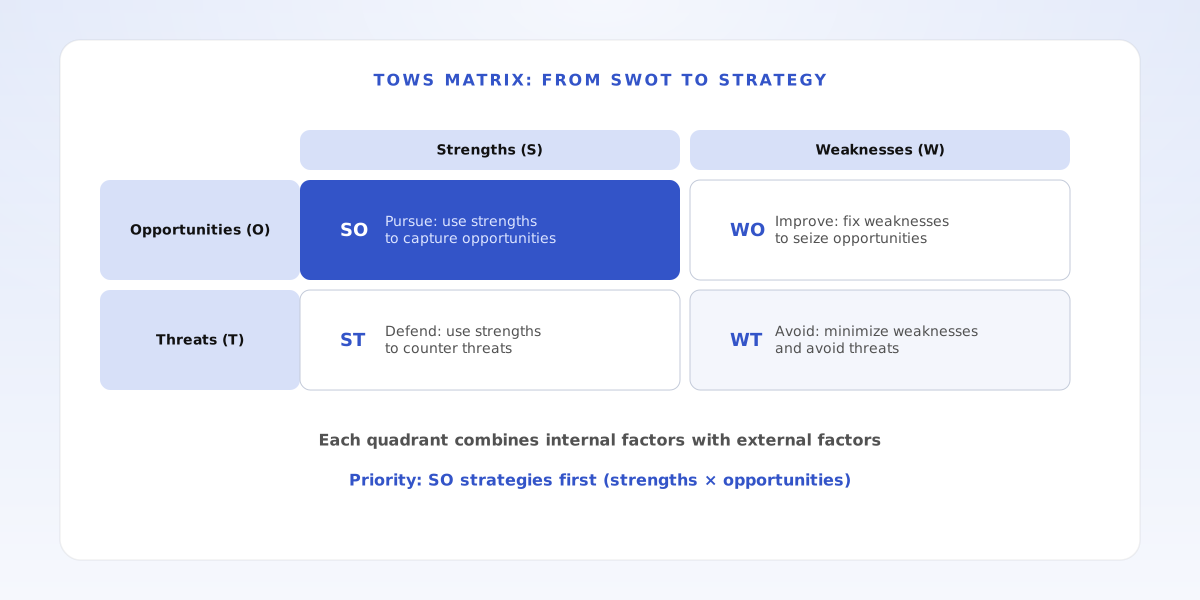
- SO strategies: use strengths to capture opportunities—do first
- WO strategies: fix weaknesses to exploit opportunities—invest here
- ST strategies: use strengths to counter threats—defend position
- WT strategies: minimize weaknesses, avoid threats—last resort
Worked Example: Should We Launch a Mobile App?
A B2B SaaS company is deciding whether to build a mobile app. The product team runs a SWOT analysis with the focal question: 'Should we launch a mobile app in Q1?'
Strengths: strong engineering team (10 developers), modern tech stack, existing API infrastructure. Weaknesses: no mobile development experience, limited design resources. Opportunities: 60% of users have requested mobile access, competitor's mobile app has poor reviews. Threats: main competitor plans to launch an improved mobile app in Q2, mobile development costs could exceed budget.
Scoring: strong dev team (+3, high impact), no mobile experience (−2, medium impact), user demand (+3, high impact), competitor timing (−2, high impact). Net score: +2. The balance favors action. TOWS strategy: use the dev team (S) to capture mobile demand (O) by launching in Q1 before the competitor (T). WO action: hire one senior mobile developer or contract with a mobile-specialized agency to cover the experience gap.
Decision: Launch in Q1 with a hybrid approach—existing team plus one mobile specialist. This is an SO-led strategy with a WO supplement. The impact effort matrix confirms mobile launch as a high-impact, medium-effort initiative that belongs in the 'Major Projects' quadrant.
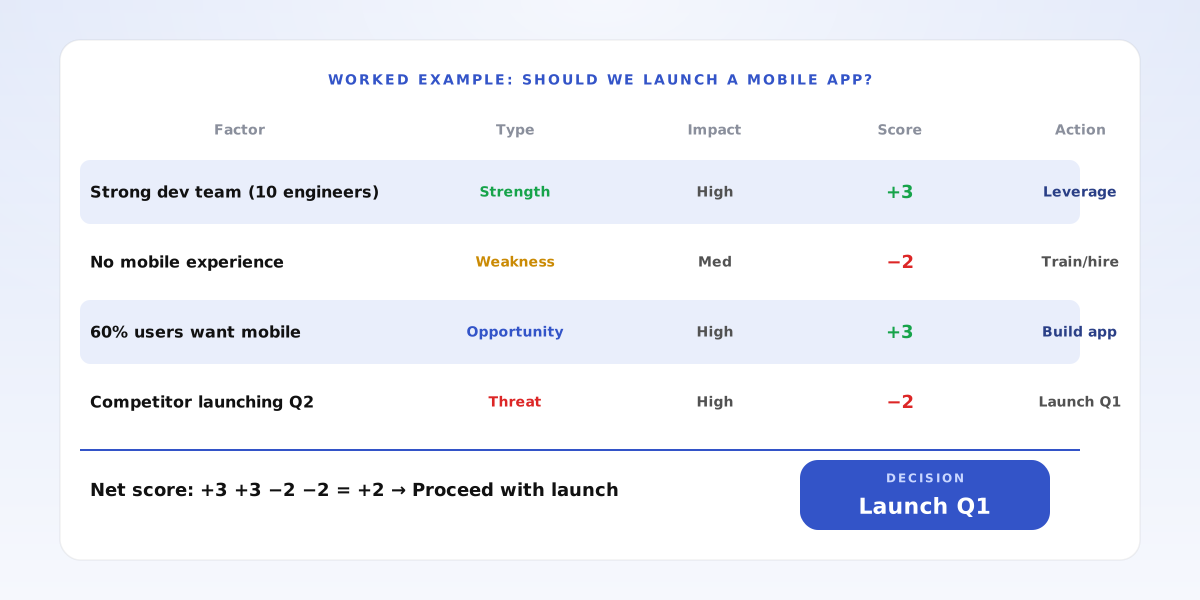
- Focal question: Should we launch a mobile app in Q1?
- Net score: +2 (strengths and opportunities outweigh weaknesses and threats)
- TOWS strategy: SO (use dev team to capture mobile demand) + WO (hire mobile expertise)
- Decision: Launch Q1 with hybrid team
Common Mistakes to Avoid
The first mistake is confusing internal and external factors. 'The market is growing' is an opportunity (external), not a strength. 'We have a loyal customer base' is a strength (internal), not an opportunity. Misclassification muddies the TOWS pairing.
The second mistake is listing factors without evidence. 'Great company culture' is vague. 'Employee NPS of 72, top quartile in industry' is actionable. Unsupported factors invite wishful thinking.
The third mistake is stopping at the list. A SWOT without TOWS is just categorization. The value is in the strategies: what do you do because of these factors? If you can't name an action, the analysis isn't finished. See hypothesis-driven problem-solving for how to turn factors into testable hypotheses.
- Don't confuse internal (S/W) with external (O/T)—misclassification breaks TOWS
- Back factors with evidence—vague assertions invite wishful thinking
- Don't stop at the list—SWOT without strategies is incomplete
Frequently Asked Questions
How many factors should I list? Aim for 3–5 per quadrant. Too few and you miss important considerations; too many and prioritization becomes impossible. If you have 15 threats, group them or pick the top five by impact.
Can a factor be both a strength and a weakness? Sometimes context matters. A large team is a strength (capacity) but may also be a weakness (coordination costs). List it where the impact is greater, or split into two distinct factors.
How often should I update a SWOT? Revisit it when the market shifts, a competitor moves, or you complete a major initiative. A quarterly review keeps the analysis current. A stale SWOT is worse than none—it creates false confidence.
What's the difference between SWOT and a decision matrix? SWOT identifies factors; a decision matrix compares options against criteria. Use SWOT to understand your position, then a decision matrix to choose among alternatives. They complement each other.
- List 3–5 factors per quadrant—enough to matter, few enough to prioritize
- If a factor could go either way, split it or list where impact is greater
- Update quarterly or when conditions change—stale SWOT creates false confidence
- SWOT identifies factors; decision matrix compares options—use both
Putting SWOT Analysis Into Practice
Pick a decision you're facing. Draw the 2×2 grid and fill in 3–5 factors per quadrant. Score each factor by impact. Build the TOWS matrix to generate strategies. Rank the strategies and commit to the top one. Document your reasoning so others can challenge the assumptions.
Razn is an AI workspace that helps you structure business problems into issue trees, hypotheses, and answer-first documents. When you need to run a SWOT analysis—listing factors, scoring them, generating TOWS strategies—Razn helps you organize the thinking and present a clear recommendation. Razn is free during beta. Use it when the decision matters enough to document.
- Define the decision, fill the four quadrants, score by impact
- Build the TOWS matrix—SO strategies first, WT strategies last
- Document assumptions so stakeholders can challenge and refine


