MethodNovember 1, 20267 min read
Scenario Planning: How to Make Decisions When the Future Is Uncertain (With Worked Example)
Scenario planning builds multiple plausible futures so you can make decisions that hold up across uncertainty—not just in your best-case forecast. Here's how to do it step by step.
What Is Scenario Planning?
Scenario planning is a strategic method for making decisions under uncertainty by constructing multiple plausible futures—not predicting which one will happen, but testing whether your decision holds across all of them. Instead of relying on a single forecast, you identify the key uncertainties that could unfold in different directions, then build 2–4 coherent stories about how those uncertainties might combine.
The power of scenario planning isn't prophecy; it's stress-testing. A decision that works only if demand grows 20% and input costs stay flat is fragile. A decision that works across high demand/low demand and high cost/low cost combinations is robust. Scenario planning surfaces that fragility before you commit.
The method originated in military planning and was popularized by Royal Dutch Shell in the 1970s. Shell famously prepared scenarios for a world where oil prices collapsed—which seemed absurd until it happened. Companies that ran scenarios adapted faster when uncertainty resolved; those that built plans around a single forecast were caught flat-footed.
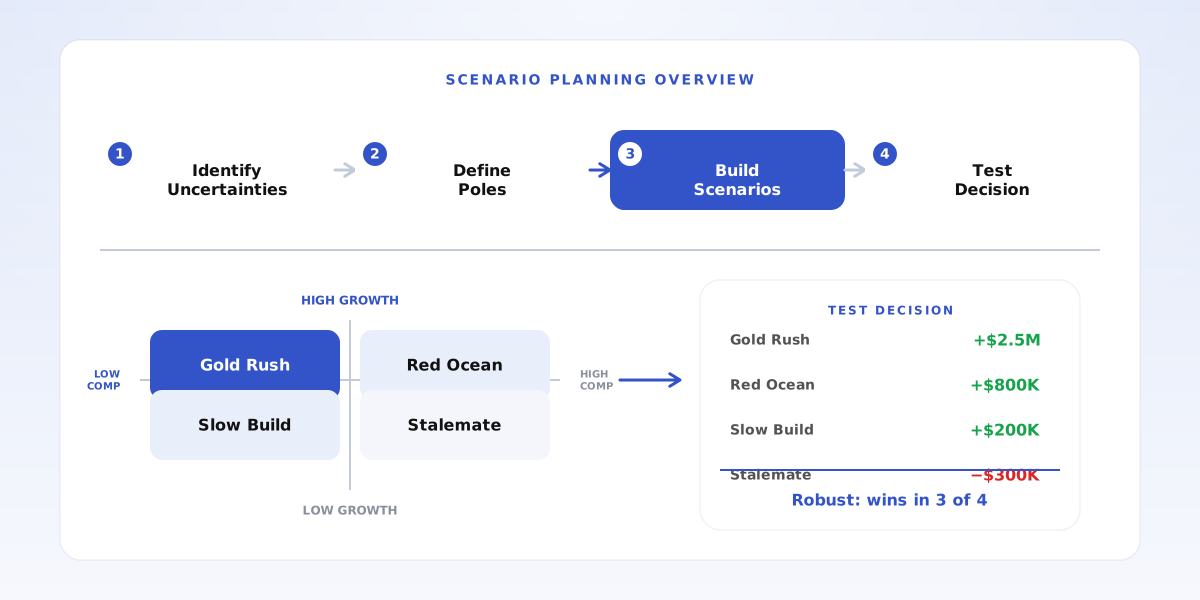
- Scenario planning: building multiple plausible futures to stress-test decisions
- Not forecasting: you're not predicting which future is most likely
- The goal: find decisions that are robust across uncertainty, not optimal for one guess
How Do You Identify Key Uncertainties?
Start by listing the factors that could significantly affect your decision's outcome. For a market entry, this might include market growth rate, competitor response, regulatory changes, and technology evolution. For a product launch, it might be customer adoption speed, manufacturing costs, and channel partnerships.
Then filter to the uncertainties that are both high-impact and genuinely uncertain. Some factors matter a lot but are predictable (demographic trends shift slowly); others are unpredictable but low-impact (a supplier's logo redesign). You want factors that are both uncertain enough to produce meaningfully different futures and important enough that those differences matter to your decision.
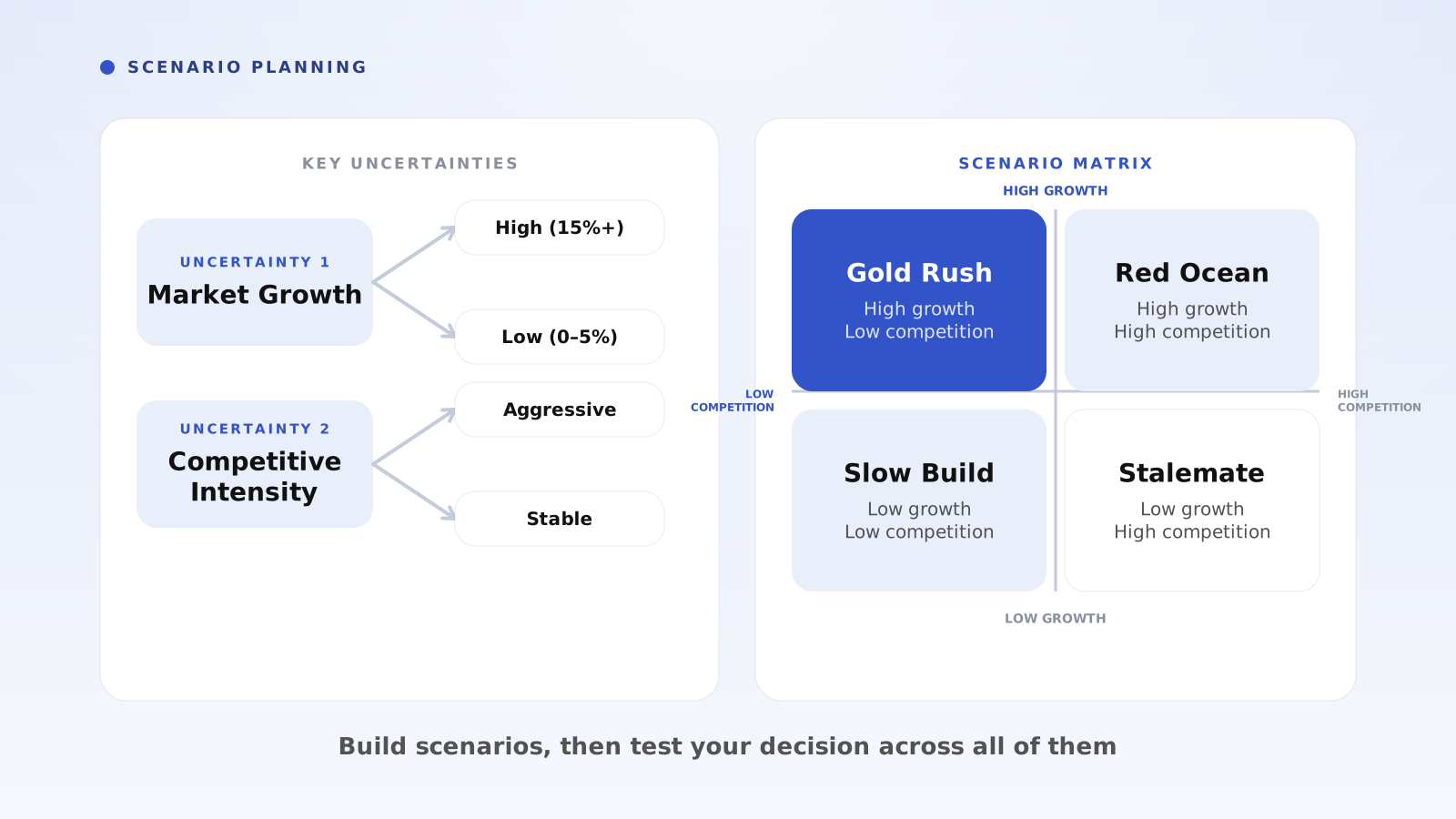
Limit yourself to 2–3 key uncertainties. With two uncertainties, you get a 2×2 matrix of four scenarios—manageable and memorable. Three uncertainties give eight combinations, which is often too many to think through clearly. Pick the ones that keep you up at night.
- List all factors that could affect your decision's outcome
- Filter to high-impact AND genuinely uncertain (not just one or the other)
- Limit to 2–3 uncertainties—more than that creates unmanageable complexity
How Do You Build Scenarios?
Step 1: Define the poles for each uncertainty. If your key uncertainty is 'market growth,' the poles might be 'rapid growth (15%+ annually)' and 'stagnant market (0–2%).' Make the poles distinct enough that they'd require different responses, but not so extreme they feel impossible.
Step 2: Combine the poles into scenarios. With two uncertainties, you get four quadrants. Give each scenario a memorable name—not 'High Growth / High Competition' but something evocative like 'Gold Rush' or 'Red Ocean.' Names help stakeholders remember and reference the scenarios.
Step 3: Flesh out each scenario with a coherent narrative. What does the world look like in this scenario? What happened to get there? What are customers doing? What are competitors doing? The story should be internally consistent—if the market is stagnant, why would a major competitor enter? Work through the logic.
Step 4: Assign rough probability weights if useful, but don't obsess over precision. The point isn't to predict which scenario is most likely; it's to ensure you've thought through meaningfully different futures. If one scenario feels 5% likely, it still might reveal a decision-breaking risk.
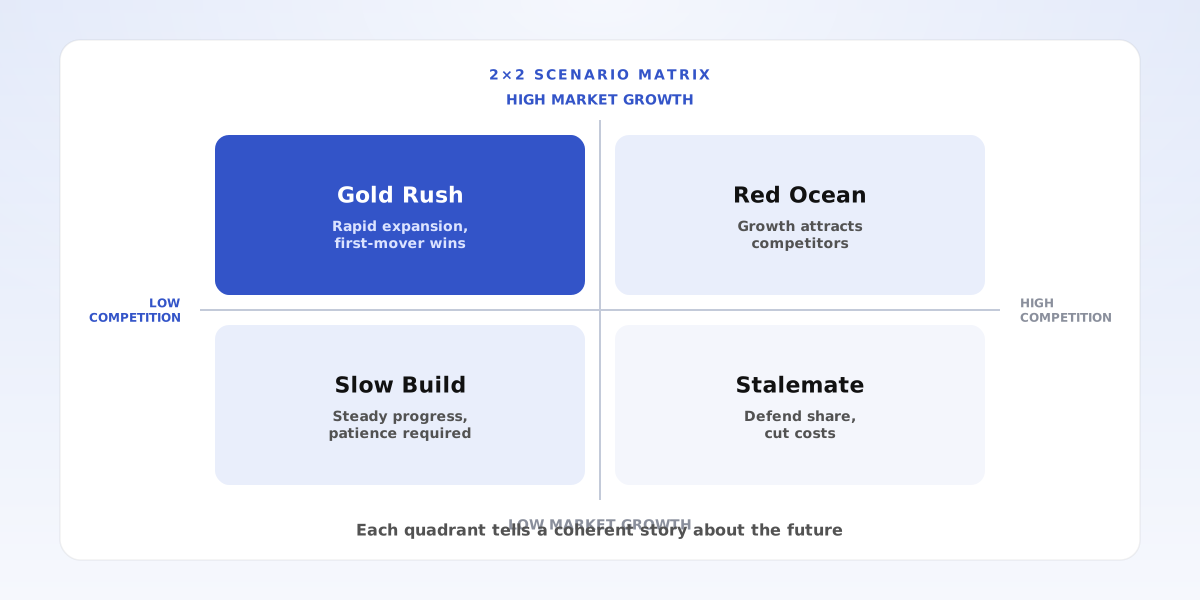
- Define distinct poles for each uncertainty (not just high/low—make them concrete)
- Combine into 2–4 scenarios; give each a memorable name
- Write a coherent narrative for each: what happened, what customers do, what competitors do
- Probability weights are optional—don't let them distract from the stress test
Worked Example: Should We Expand to a New Region?
A SaaS company is deciding whether to expand from the US to Europe. Fixed costs for the expansion are $2M (legal, localization, initial team). The company identifies two key uncertainties: (1) market reception—will European customers adopt as fast as US customers did? (2) regulatory complexity—will GDPR and local data laws create ongoing compliance costs?
They define poles: Market reception could be 'strong' (50% of US adoption rate) or 'weak' (20% of US adoption rate). Regulatory costs could be 'manageable' ($200K/year ongoing) or 'heavy' ($600K/year ongoing). This creates four scenarios.
Scenario A: 'Fast Track' (strong reception, manageable regulation). Revenue Year 1: $3M. Costs: $2M fixed + $200K regulatory = $2.2M. Net: +$800K. Scenario B: 'Compliance Drag' (strong reception, heavy regulation). Revenue: $3M. Costs: $2M + $600K = $2.6M. Net: +$400K. Scenario C: 'Slow Start' (weak reception, manageable regulation). Revenue: $1.2M. Costs: $2.2M. Net: −$1M. Scenario D: 'Worst Case' (weak reception, heavy regulation). Revenue: $1.2M. Costs: $2.6M. Net: −$1.4M.
The decision test: Does expansion make sense across scenarios? In two scenarios (A and B), it's profitable. In two (C and D), it loses money. The deciding factor is market reception, not regulation—even with heavy compliance costs, strong reception makes it work. The team decides to invest in market validation before committing: run a pilot, test actual European demand, then decide. Scenario planning surfaced that reception is the load-bearing assumption.
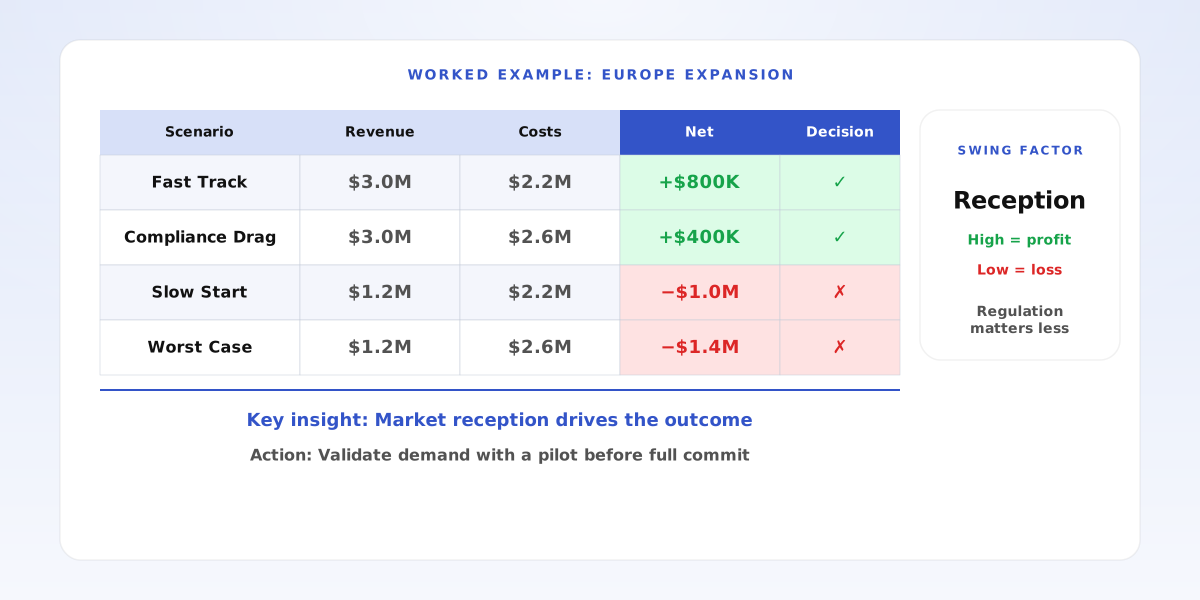
- Key uncertainties: market reception and regulatory costs
- Four scenarios with concrete numbers: Fast Track (+$800K), Compliance Drag (+$400K), Slow Start (−$1M), Worst Case (−$1.4M)
- Decision insight: reception is the load-bearing assumption—validate it before committing
- Action: run a pilot to test actual demand before full expansion
How Do You Test a Decision Across Scenarios?
For each scenario, model the decision's outcome. What's the expected revenue? What are the costs? What's the net result? Use rough numbers—scenario planning is about direction, not decimal precision. A cost-benefit analysis or break-even analysis can structure the math.
Look for decisions that are robust: positive outcomes across most or all scenarios. If a decision wins big in one scenario but loses badly in others, it's fragile. If it wins modestly in all scenarios, it's robust. Sometimes the robust decision has lower upside, but it also has lower downside—which matters when you can't predict which future will arrive.
Identify the swing factors: which uncertainties most affect whether the decision works? In the expansion example, market reception mattered more than regulatory costs. That tells you where to focus: gather better information on reception before committing. This connects to first-principles thinking—dig into the assumptions that drive the outcome.
- Model each scenario: revenue, costs, net outcome (rough numbers are fine)
- Look for robust decisions: work across most/all scenarios, not just the optimistic one
- Identify swing factors: which uncertainty most affects whether the decision works?
What Are Common Mistakes in Scenario Planning?
The first mistake is building scenarios that are too similar. If your 'best case' and 'worst case' differ only in degree—15% growth vs. 10% growth—you haven't explored the uncertainty space. Push the poles farther apart. What if growth is 30%? What if it's negative? Scenarios should feel uncomfortable.
The second mistake is treating scenarios as forecasts and picking the 'most likely' one as your plan. That defeats the purpose. Scenario planning isn't about predicting; it's about preparing. If you collapse back to a single forecast, you've wasted the exercise. Use all scenarios to stress-test your decision.
The third mistake is analysis paralysis—building so many scenarios or so much detail that you never decide. Three to four scenarios with rough numbers is enough. The goal is insight, not precision. If you're spending weeks building elaborate models, you've overengineered it. See decision memos for how to move from analysis to action.
The fourth mistake is ignoring scenarios once you've built them. Scenario planning creates early warning indicators—signals that tell you which future is emerging. Define those indicators ('if European pilot conversion exceeds 5%, we're in Fast Track territory') and monitor them. Update your decision as uncertainty resolves.
- Don't make scenarios too similar—push the poles apart, make them uncomfortable
- Don't collapse to 'most likely'—use all scenarios to stress-test the decision
- Don't overengineer—3–4 scenarios with rough numbers is enough
- Don't ignore scenarios after building them—define indicators and monitor which future emerges
Frequently Asked Questions
How is scenario planning different from sensitivity analysis? Sensitivity analysis changes one variable at a time to see how results shift. Scenario planning changes multiple variables together to build coherent stories. Sensitivity tells you which inputs matter; scenarios tell you what combinations of changes are plausible and how they interact. Use both: sensitivity to find leverage points, scenarios to stress-test full pictures.
When should I use scenario planning? Use it when you face a major, hard-to-reverse decision with significant uncertainty. Product launches, market entries, acquisitions, strategic pivots. Don't use it for routine decisions where the stakes are low or the uncertainty is manageable. A decision tree may be simpler when probabilities are estimable and outcomes are well-defined.
How many scenarios should I build? Three to four is the sweet spot. Two scenarios (best/worst) misses the nuance; more than four becomes hard to hold in your head. A 2×2 matrix from two key uncertainties naturally gives four—memorable, manageable, and covers the space.
Can I assign probabilities to scenarios? You can, but don't let it become the focus. Rough probabilities (30%, 40%, 20%, 10%) can help weight expected outcomes, but the precision is false—you're assigning numbers to fundamentally uncertain futures. The value is in the stress test, not the probability math.
- Scenario planning vs. sensitivity analysis: scenarios combine multiple variables into coherent stories; sensitivity tests one at a time
- When to use it: major, hard-to-reverse decisions with significant uncertainty
- How many: 3–4 scenarios (2×2 from two key uncertainties is ideal)
- Probabilities: optional and rough—don't obsess over precision
Putting Scenario Planning Into Practice
Pick a decision you're facing that involves significant uncertainty. List the factors that could affect the outcome. Filter to the 2–3 that are both high-impact and genuinely unknown. Define poles for each. Combine into a 2×2 (or 2×2×2) matrix. Name each scenario. Write a one-paragraph narrative for each. Model the decision's outcome in each scenario. Look for robust choices and identify the swing factors.
Razn helps you structure a problem into an issue tree, form hypotheses, and write an answer-first recommendation. When you're running scenario planning—identifying uncertainties, building scenarios, testing decisions—Razn helps organize the thinking and present a clear recommendation that acknowledges the uncertainty. Razn is free during beta.
- Identify 2–3 key uncertainties that are high-impact and genuinely unknown
- Build 3–4 scenarios with distinct names and coherent narratives
- Model the decision in each scenario; look for robust choices
- Define indicators to monitor which future is emerging