FrameworksNovember 11, 20267 min read
Porter's Five Forces: How to Use It to Make a Market Decision (Worked Example)
Porter's Five Forces scores how much profit a market leaves for you: rivalry, new entrants, buyer power, supplier power and substitutes. Here's how to score each force and turn the scores into a go or no-go, with a worked example of two markets.
What Are Porter's Five Forces?
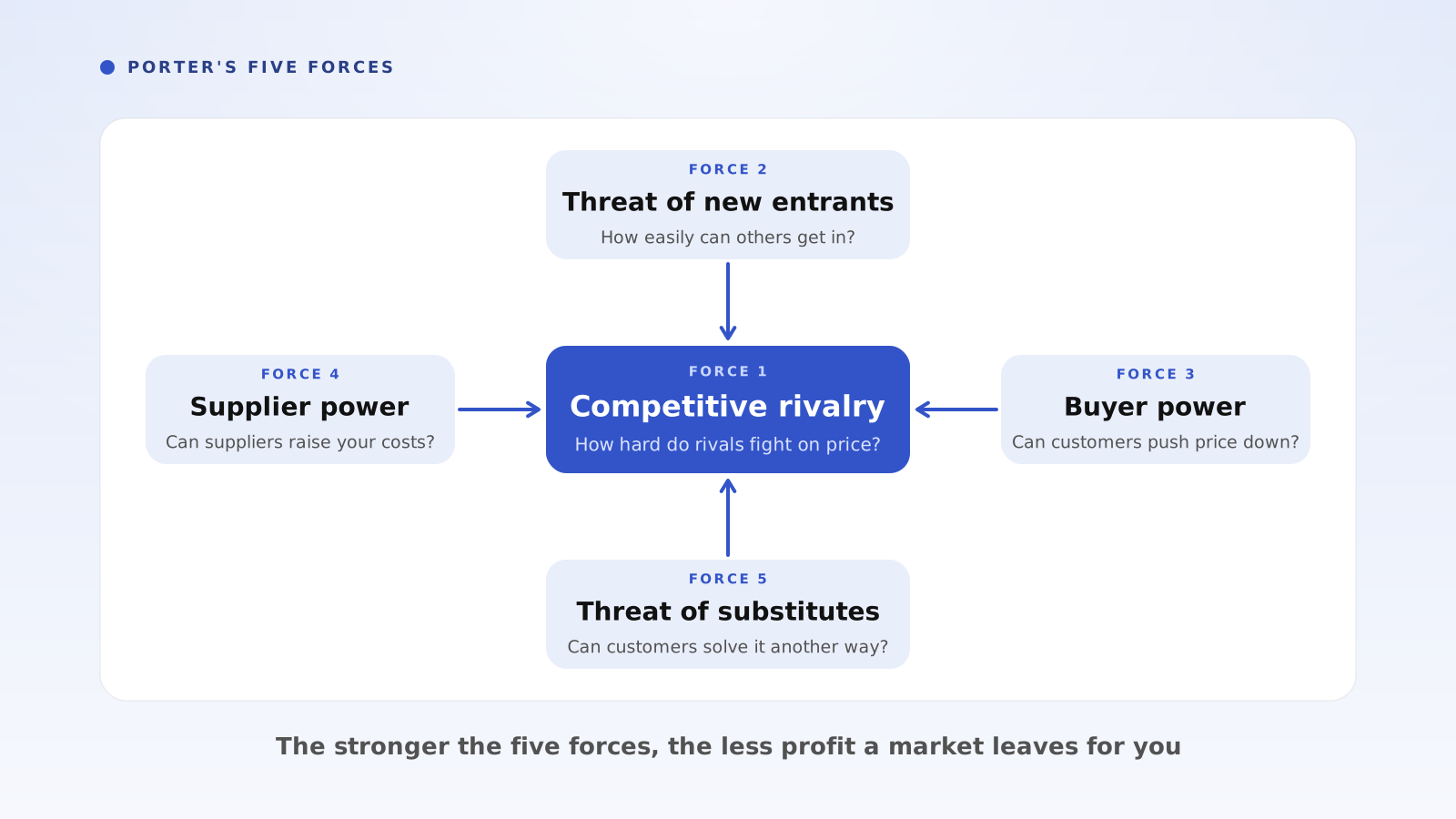
Porter's Five Forces is a framework for judging how much profit a market leaves for the companies in it. It looks at five pressures: rivalry among existing competitors, the threat of new entrants, the bargaining power of buyers, the bargaining power of suppliers and the threat of substitutes. The stronger the forces, the lower the prices and margins you can expect, so it is most useful before you decide where to compete.
Michael Porter introduced the framework in a 1979 Harvard Business Review article. Use it to decide whether a market is worth entering or defending, and pair it with a SWOT analysis when you also need to judge whether your company can win there.
What Does Each of the Five Forces Mean?
Each force is a different way that profit leaks out of a market. A force is strong when it pushes prices down or costs up.
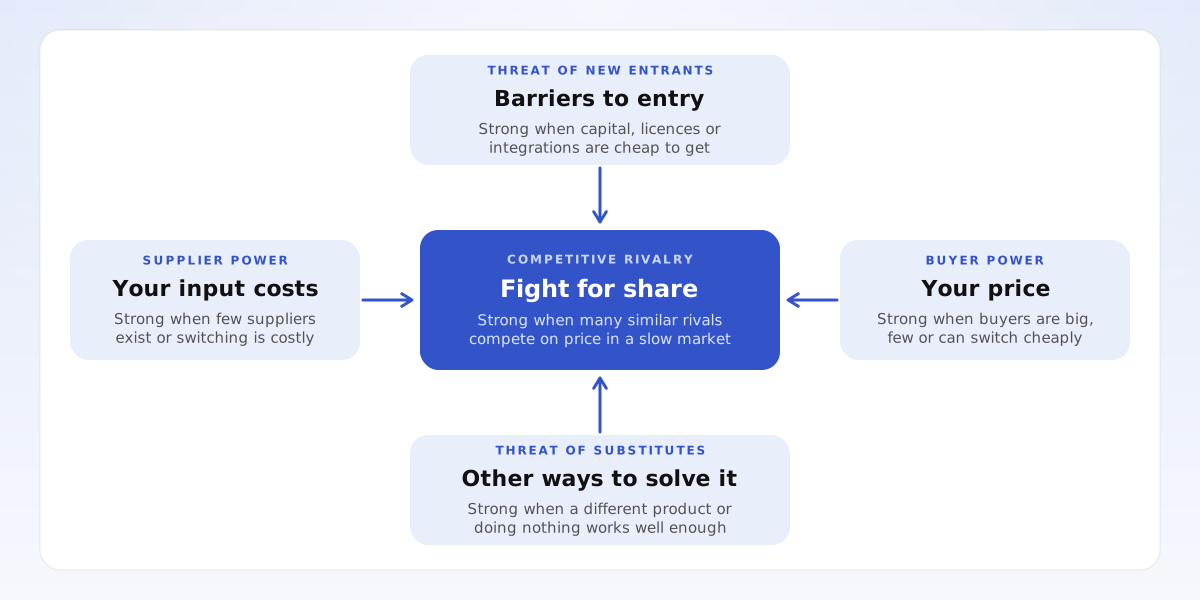
- Competitive rivalry: how hard existing competitors fight for share. It is strong when there are many similar rivals, slow growth and frequent price cuts.
- Threat of new entrants: how easily new companies can get in. It is strong when capital needs, regulation, brand loyalty and switching costs are low.
- Buyer power: how much customers can push your price down. It is strong when buyers are few or large, buy in volume or can switch at little cost.
- Supplier power: how much your suppliers can raise your costs. It is strong when there are few suppliers or switching away from them is expensive.
- Threat of substitutes: how easily customers can meet the same need another way, including doing nothing. It is strong when a cheaper alternative works well enough.
How Do You Do a Five Forces Analysis Step by Step?
1. Define the market. Name the product, the customer and the geography, such as scheduling software for veterinary clinics in the US. A vague market produces vague scores.
2. Collect evidence for each force. Count competitors and their prices, find who controls most of the buying, list your key suppliers and note how customers solve the problem today.
3. Score each force from 1 to 5. Use 1 for a weak force and 5 for a strong one, and write one line of evidence next to every score. A score without evidence is an opinion.
4. Find the force that limits profit. One force at 5 can take most of the margin even if the other four are weak, so look at the highest score as well as the total.
5. Translate the scores into numbers. Ask what each strong force does to your expected price, acquisition cost and margin. This is where the analysis becomes a decision.
6. Decide and set a review trigger. Make the go or no-go call, and name the change that would make you revisit it, such as a competitor raising prices.
Worked Example: Should a Software Company Enter the Dental or Veterinary Market?
A scheduling software company with $6 million in annual revenue sells to physiotherapy clinics. It has budget to enter one new market next year and is choosing between dental clinics and veterinary clinics. It scores each market with Porter's Five Forces.
Dental scores 17 out of 25. Rivalry is 5: eight established vendors, and two of them offer 30% discounts to win customers from competitors. Buyer power is 4, because dental groups own about 30% of clinics and negotiate discounts across many sites. New entrants and substitutes both score 3, and supplier power scores 2.
Veterinary scores 13 out of 25. Rivalry is only 2: three vendors, two of them still selling on-premise software. Buyer power is 3, with corporate groups owning about 25% of clinics. New entrants score 3, substitutes 3 (many clinics still use phone and paper diaries) and supplier power 2, since hosting and text-message providers are easy to switch.
Next, the company turns the scores into money. Its list price is $170 a month and it costs $30 a month to serve a clinic. In dental, matching the 30% discounts brings the real price to about $120, so the margin is $90 a month. Strong rivalry also raises the customer acquisition cost (CAC) to $2,700, so payback is $2,700 ÷ $90 = 30 months. In veterinary, the list price holds, the margin is $140 a month and CAC is $1,680, so payback is 12 months.
The decision is to enter veterinary and pass on dental for now. A $400,000 acquisition budget wins about 238 veterinary clinics, which bring in about $400,000 of contribution margin a year, so the budget pays back in its first year. The unit economics behind these numbers decide the case, and the Five Forces explain why they differ.
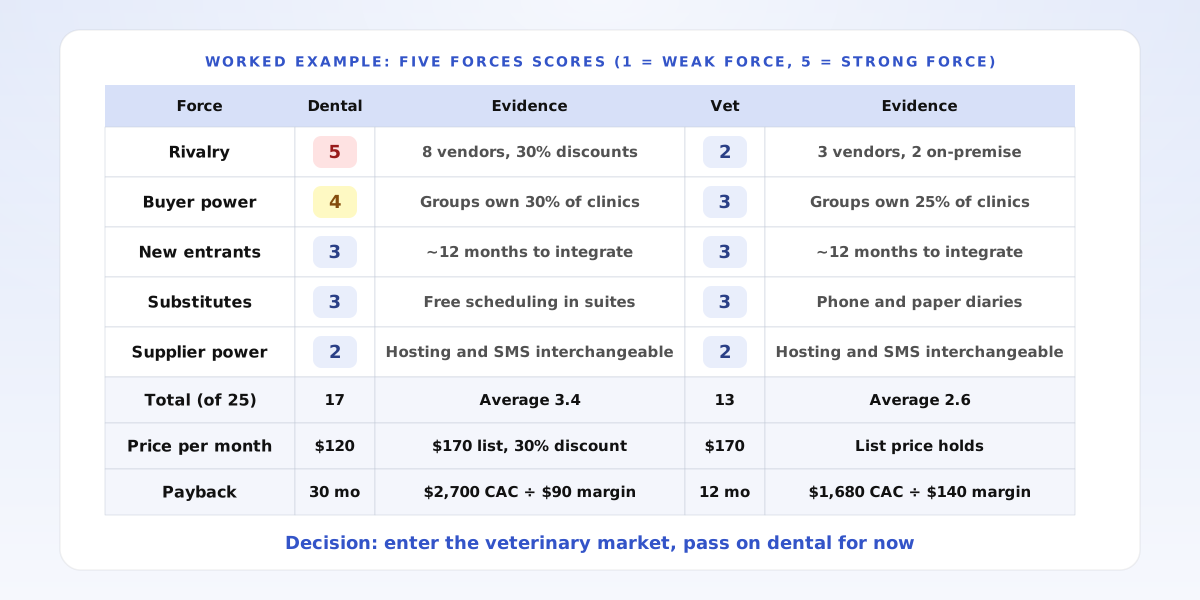
- Dental: 17 of 25, rivalry at 5, $120 real price, $90 monthly margin, 30-month payback
- Veterinary: 13 of 25, highest force at 3, $170 price, $140 monthly margin, 12-month payback
- Decision: enter veterinary with a $400,000 acquisition budget
- Review trigger: revisit dental if discounting stops or a major vendor exits
How Do You Turn Five Forces Scores Into a Go or No-Go?
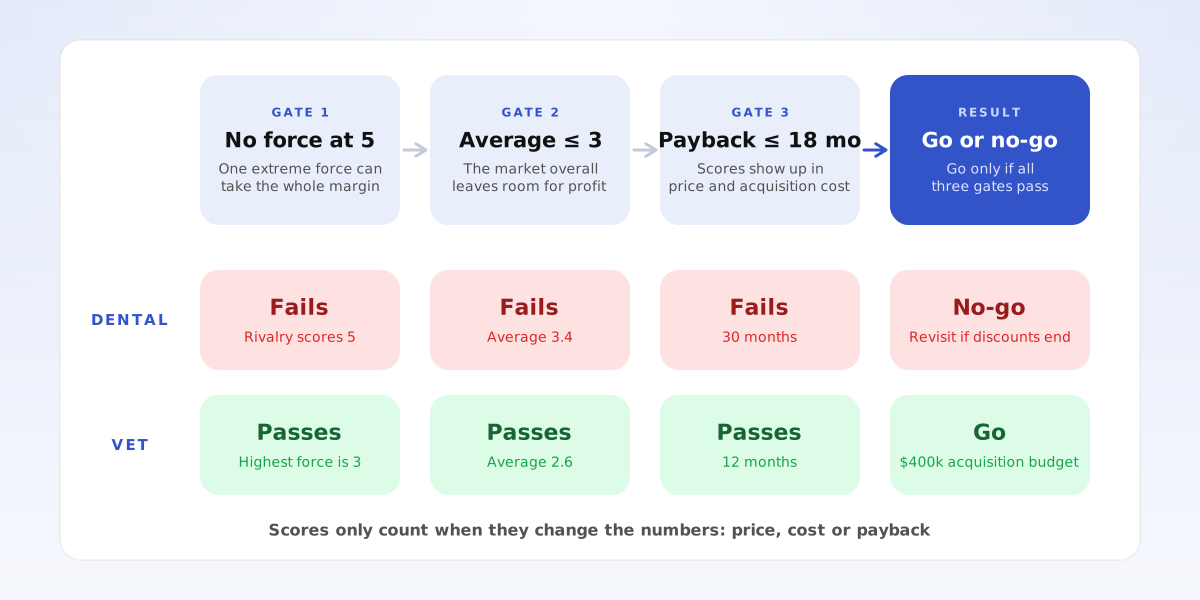
Set the rules before you score, so the answer cannot be bent to fit what you hoped. A simple version uses three gates: no force at 5, an average of 3 or lower, and payback within 18 months. A market has to pass all three to be a go.
In the example, dental fails all three gates and veterinary passes all three. The force to watch in veterinary is buyer power. If corporate groups grew from 25% to 40% of clinics, prices would come under pressure, and scenario planning shows how much margin that would cost. To set the price you open with, see how to price a product.
What Are Common Five Forces Mistakes?
Defining the market too broadly. Healthcare software and veterinary scheduling software have different rivals, buyers and substitutes. Score the market you would actually sell into.
Scoring without evidence. A 4 because it feels competitive tells you nothing. Write down the competitor count, the price gap or the buyer share that justifies the score.
Stopping at the scores. A total of 17 is not a decision. Convert the strong forces into price, cost and payback, as in the example.
Treating the analysis as permanent. Forces shift when competitors merge, regulation changes or buyers consolidate. Re-score at least once a year.
Using it to compare very different options. If you are choosing between entering a market and something else entirely, list the options in a decision matrix and use the Five Forces as one input.
Frequently Asked Questions
What are the five forces in Porter's model? Competitive rivalry, threat of new entrants, bargaining power of buyers, bargaining power of suppliers and threat of substitutes.
Is Porter's Five Forces still relevant? Yes. The question it asks, where profit goes in a market, does not go out of date. Score the forces with current evidence.
What is the difference between Five Forces and SWOT? Five Forces judges the market. SWOT judges your company's position in it. Use Five Forces to choose where to compete and SWOT to check whether you can win there.
Can a small business use Porter's Five Forces? Yes. Define a narrow local or niche market and score it the same way.
How Does Razn Help With Market Decisions?
Razn is an AI workspace that turns a messy business problem into a structured issue tree, testable hypotheses and an answer-first document. Use it when a question like "which market should we enter next?" is too broad to score yet: break it into its drivers in Razn, test the hypotheses behind each force and write up the recommendation. To learn the structure first, see issue trees. Razn is free during beta.
- Define the market narrowly: product, customer and geography
- Score each force from 1 to 5 with one line of evidence
- Translate the strongest forces into price, CAC and payback
- Decide with gates set in advance, and name a review trigger
Related: should we do it template


