FrameworksNovember 9, 20266 min read
Eisenhower Matrix: How to Prioritize Urgent vs. Important Work (Worked Example)
The Eisenhower matrix sorts tasks by urgency and importance into four quadrants: Do, Schedule, Delegate and Eliminate. Here's how to score each task, with a worked example of a 10-item week.
What Is the Eisenhower Matrix?
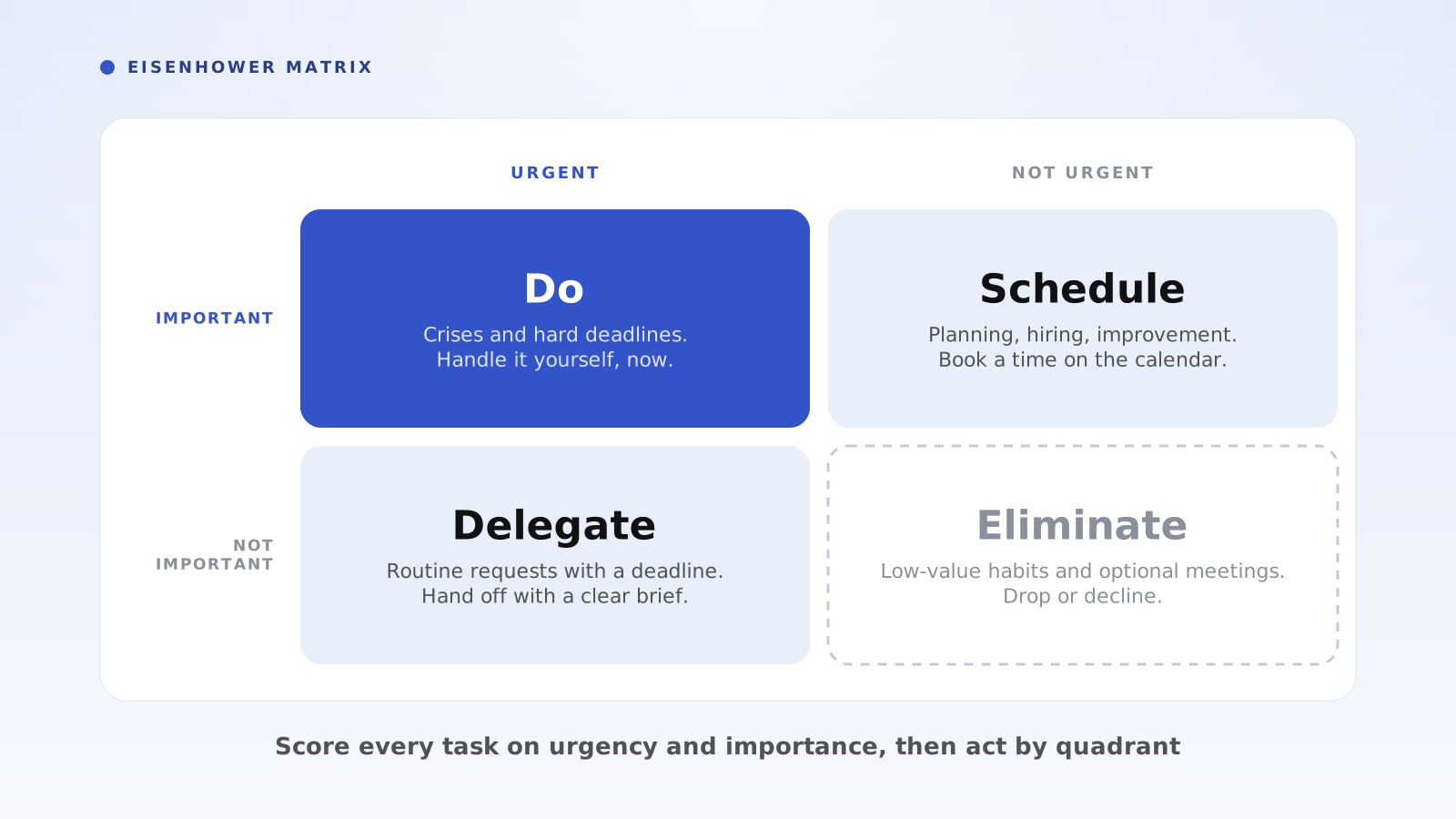
The Eisenhower matrix is a prioritization tool that sorts tasks by two questions: is it urgent, and is it important? The answers place each task in one of four quadrants, and each quadrant comes with an action: do it now, schedule it, delegate it or eliminate it. It is most useful when a full week of requests leaves no time for the work that actually matters.
The matrix is named after Dwight D. Eisenhower, who is credited with saying that what is important is seldom urgent and what is urgent is seldom important. Stephen Covey turned the idea into the four-box grid in The 7 Habits of Highly Effective People. Today it is used by executives, operators and individual contributors to decide what deserves their time this week.
Two definitions matter. Urgent means the task has a near deadline or a visible consequence if it waits. Important means the task moves a goal you are accountable for. The two are independent, and the matrix exists because people tend to treat urgent work as important by default.
What Do the Four Quadrants Mean?
Each quadrant combines one answer to each question and tells you what to do with the task.
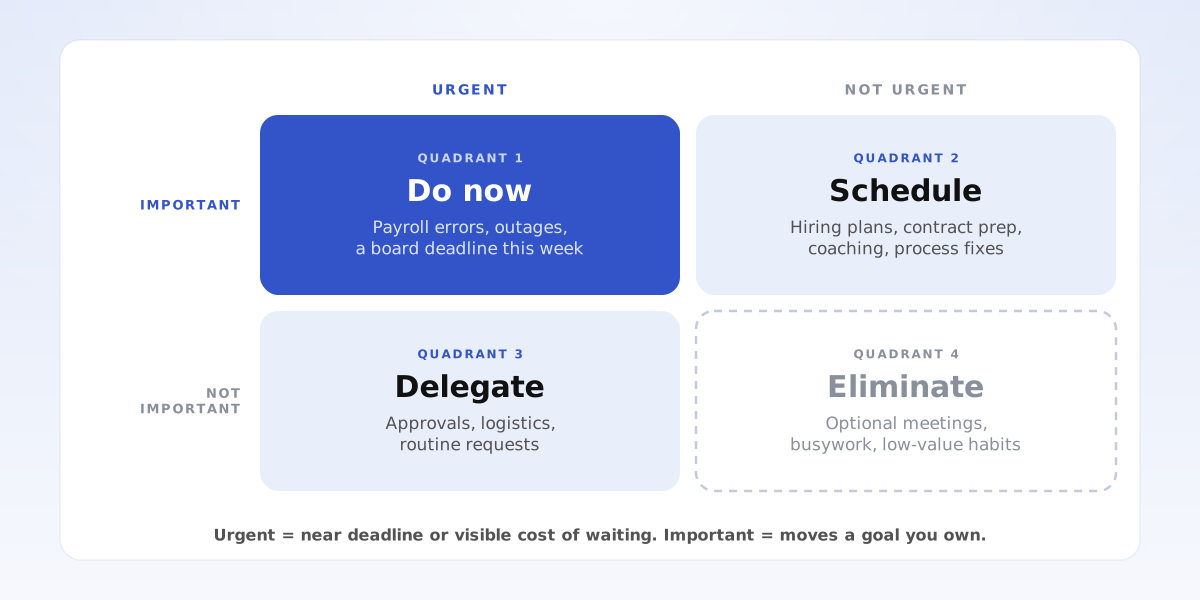
- Do (urgent and important): crises, hard deadlines and problems that hurt if they wait. Handle them yourself, now.
- Schedule (important, not urgent): planning, hiring, relationships and improvement work. Put a specific time on the calendar.
- Delegate (urgent, not important): routine requests and interruptions with a deadline. Hand them to someone else with a clear brief.
- Eliminate (neither): low-value habits and optional meetings. Drop them, or decline them politely.
How Do You Use the Eisenhower Matrix Step by Step?
1. List every task for the period. Include meetings, requests and recurring work, not just projects. A week is a good window for most people.
2. Name your goals first. Importance only means something relative to a goal, so write down the two or three outcomes you are accountable for this quarter.
3. Score urgency from 1 to 5. Base it on the real deadline and the cost of waiting a week, not on how loudly someone asked.
4. Score importance from 1 to 5. Ask how much the task moves one of your goals. If it moves none of them, it scores 1 or 2.
5. Place each task in a quadrant. Treat 3 or higher as urgent or important. A fixed cutoff stops you from shifting the line to fit your preferences.
6. Act by quadrant and check your hours. Do the first quadrant, book time for the second, delegate the third and remove the fourth. Then compare the hours left in Do and Schedule with the time you actually have.
Worked Example: How Should an Operations Lead Plan a 10-Task Week?
An operations lead has 25 hours of focused time this week and 10 tasks that need 34 hours. The goals this quarter are reliable service and lower operating costs. Each task gets an urgency score (U) and an importance score (I) from 1 to 5.
Three tasks land in Do: fix a payroll error affecting 40 employees (U5, I5, 3 hours), finish a board update due Thursday (U5, I4, 4 hours) and resolve a customer outage escalation (U4, I5, 2 hours). That is 9 hours.
Three land in Schedule: draft the next quarter's hiring plan (U2, I5, 6 hours), prepare the renegotiation of a $120,000 vendor contract that renews in six weeks (U2, I5, 5 hours) and hold coaching one-on-ones (U1, I4, 3 hours). That is 14 hours.
Two land in Delegate: expense report approvals (U4, I2, 2 hours) and offsite logistics (U4, I2, 3 hours). Two land in Eliminate: reorganizing the shared drive (U1, I2, 4 hours) and an optional vendor webinar (U2, I1, 2 hours).
Do and Schedule need 9 + 14 = 23 hours, which fits in 25 with 2 hours of buffer. Delegating saves 5 hours and eliminating saves 6, which closes the 9-hour gap between the original list and the time available.
The vendor contract is the task the matrix protects. It is not urgent this week, so it would normally lose to the expense approvals. But a 5% better rate is worth $6,000 a year, far more than anything in the Delegate box. If you want to know how much the rate assumption matters, run a quick sensitivity analysis on it before the negotiation.
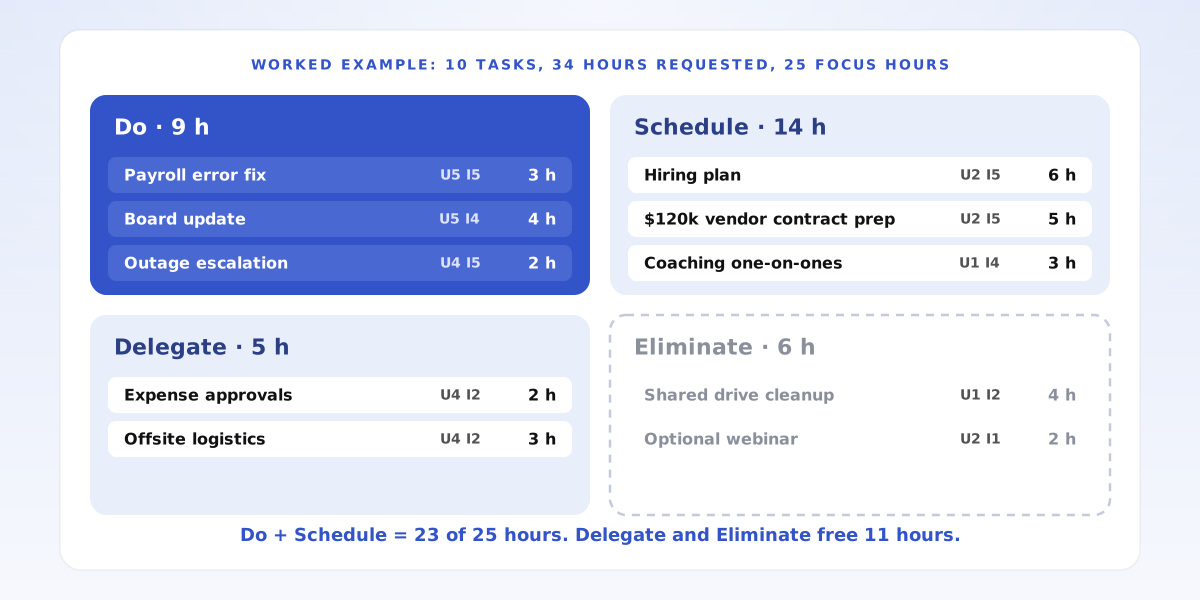
- Do: 3 tasks, 9 hours
- Schedule: 3 tasks, 14 hours, booked on the calendar
- Delegate: 2 tasks, 5 hours handed off
- Eliminate: 2 tasks, 6 hours removed
Eisenhower Matrix vs. Impact Effort Matrix and RICE: What's the Difference?
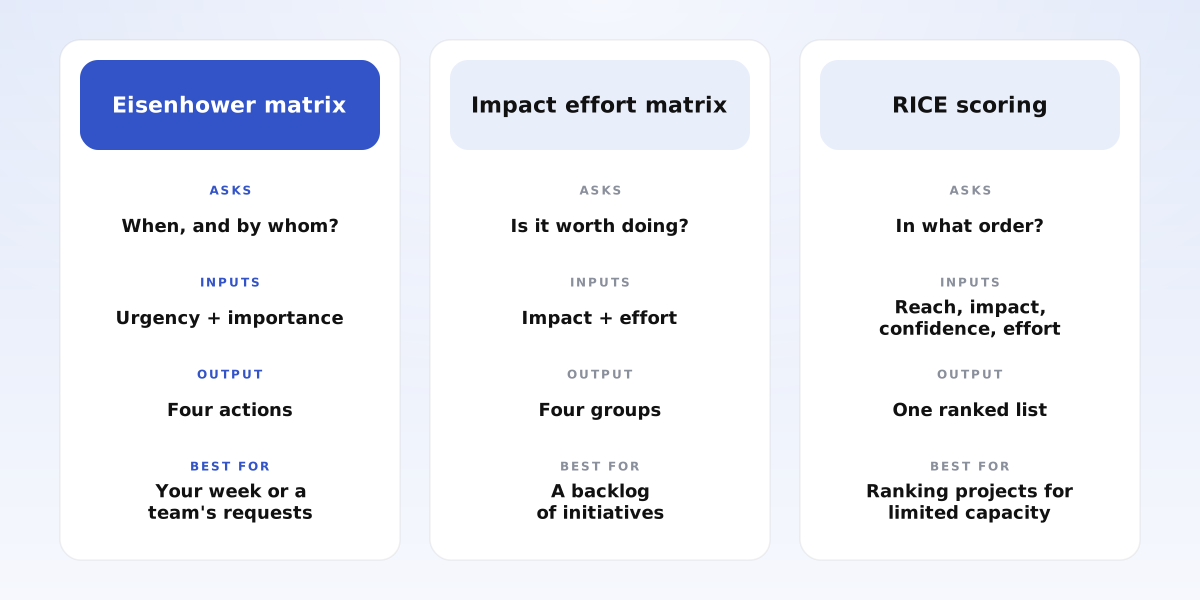
The Eisenhower matrix decides when and by whom work gets done, based on deadlines and goals. An impact effort matrix decides which work is worth doing, based on payoff and cost. RICE scoring ranks a list of projects in order with one number.
Use the Eisenhower matrix for your own week or a team's incoming requests. Use the impact effort matrix for a backlog of initiatives, and RICE when you must choose between several good projects with limited capacity. For a single choice across several criteria, such as choosing a supplier, use a decision matrix.
What Are Common Eisenhower Matrix Mistakes?
Treating urgent as important. A request with a deadline feels important because it is loud. Score importance against your written goals, not against the pressure in the room.
Never doing the Schedule quadrant. Important work that is not urgent only happens if it has a time slot. If it stays on a list, next week's urgent tasks will push it out again.
Delegating without a brief. A handoff with no owner, deadline or definition of done comes back as rework. Give the person the outcome, the deadline and what good looks like.
Keeping everything in Do. If more than a third of your hours sit in Do every week, the problem is upstream: missing processes, late planning or unclear ownership. Find the few causes that create most of the fires with an 80/20 pass.
Ignoring capacity. The matrix sorts tasks but does not add up hours. Always total Do and Schedule and compare them with the time you really have.
Frequently Asked Questions
What are the four quadrants of the Eisenhower matrix? Do (urgent and important), Schedule (important, not urgent), Delegate (urgent, not important) and Eliminate (neither urgent nor important).
Can teams use the Eisenhower matrix? Yes. Score incoming requests together against the team's goals, and use Delegate to route work to the right owner rather than to push it down.
What if I have no one to delegate to? Automate the task, batch it into one short block, or renegotiate its deadline. The point is to stop it from taking time away from the Schedule quadrant.
How often should I update the matrix? Build it once a week and review it briefly each morning. New urgent tasks will appear, so place them as they arrive instead of reacting to each one.
How Does Razn Help With Prioritization?
The Eisenhower matrix only works if you know which goals define important. Razn builds issue trees that break a goal into its drivers and the moves that would change them. Use it when your goal is clear but the work behind it is not: structure the goal in Razn, turn the strongest branches into tasks, then sort them with the Eisenhower matrix. Razn is free during beta.
- Write down the goals that define important
- Score every task for urgency and importance from 1 to 5
- Do, schedule, delegate or eliminate by quadrant
- Total the hours in Do and Schedule and compare with your capacity


