FrameworksNovember 17, 20267 min read
How to Write a Business Case: Template, Steps and Worked Example
A business case shows decision-makers why a project is worth funding: the problem, the options, the costs and benefits, the risks and a clear recommendation. Here's how to write a business case step by step, a template you can copy, and a worked example with payback, NPV and ROI math.
What Is a Business Case?
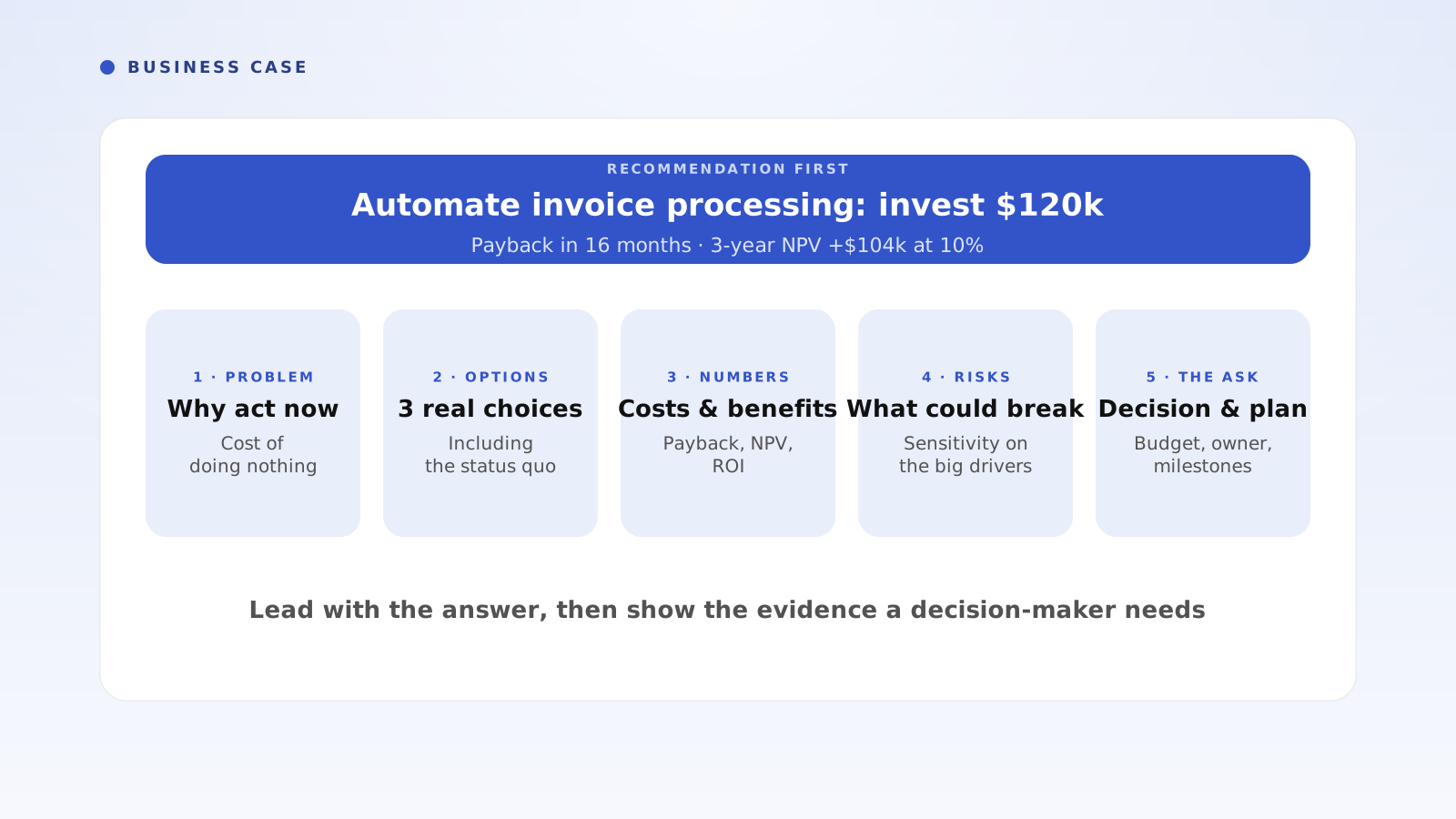
To write a business case, state the problem and what it costs, compare two to four real options including doing nothing, quantify each option's costs, benefits and risks, and lead with a clear recommendation and a specific ask. Learning how to write a business case comes down to one goal: give the person approving the money everything they need to say yes or no in a single read.
A business case is a document that justifies a decision to spend money, time or people on a project. It answers three questions: why act, why this option, and why now. It is not a sales pitch for an idea you have already chosen. A good business case shows the alternatives honestly, so the reader can see the recommended option wins on the numbers.
You need one whenever a decision is big enough that someone else has to approve it: buying new software, hiring a team, opening a location, replacing equipment or launching a product.
What Should a Business Case Include?
Most business case templates share the same eight parts. Put them in this order, because the reader wants the answer before the evidence.
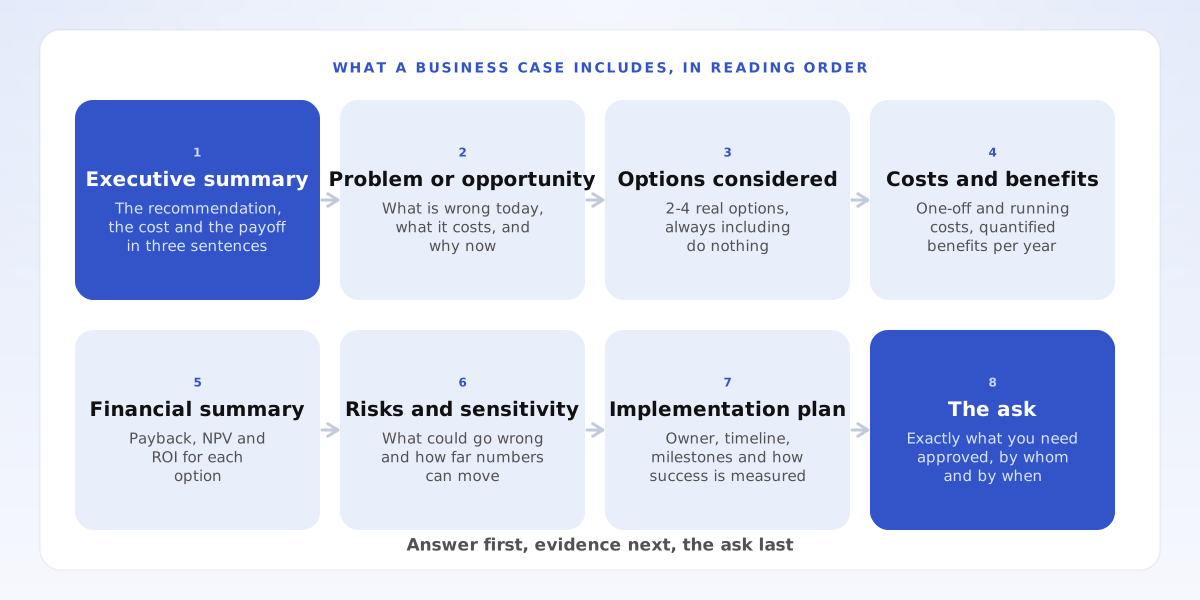
- Executive summary: the recommendation, the cost and the expected return in three sentences. Many readers stop here.
- Problem or opportunity: what is wrong today, what it costs per year and why it has to be solved now. A sharp problem statement makes the rest of the document easier to write.
- Options considered: two to four realistic options, always including doing nothing.
- Costs and benefits: one-off costs, running costs and benefits per year, each with its source or assumption.
- Financial summary: payback period, net present value (NPV) and return on investment (ROI) for each option.
- Risks and sensitivity: what could go wrong and how far the key numbers can move before the answer changes.
- Implementation plan: owner, timeline, milestones and how you will measure success.
- The ask: exactly what you need approved, by whom and by when.
How Do You Write a Business Case Step by Step?
1. Define the decision. Write one sentence naming who decides, what they are deciding and by when, such as "the CFO approves or rejects a $120,000 automation budget at the March review."
2. Quantify the problem. Put a number on the cost of the status quo: hours lost, errors, revenue missed or fees paid. If doing nothing costs nothing, you do not have a business case.
3. List the options. Include doing nothing, the obvious fix and at least one alternative. Readers trust a business case more when it shows the options that lost.
4. Estimate costs and benefits for each option. Separate one-off costs from running costs, and count benefits per year. A cost-benefit analysis gives you the method; write down every assumption next to its number.
5. Run the financials. Calculate payback (upfront cost divided by net annual benefit), NPV (benefits and costs discounted to today) and ROI (net gain divided by total cost). Use the same time horizon for every option.
6. Stress-test the numbers. Use sensitivity analysis to find which assumption matters most and how far it can fall before the answer flips. A break-even analysis tells you the minimum result the project needs to pay for itself.
7. Write it answer-first. Put the recommendation and the ask at the top, then the evidence. If the decision-maker prefers a short format, the same content fits in a one-page decision memo.
Related: should we do it template
Business Case Example: Should a Mid-Size Company Automate Invoice Processing?
A 400-person distributor processes 36,000 supplier invoices a year by hand. Its four-person accounts payable team is at capacity, and invoice volume is expected to grow 15% next year. The finance lead writes a business case for an invoice automation tool.
One-off costs total $120,000: $70,000 for setup, $35,000 to integrate with the accounting system and $15,000 for training. The running cost is a $48,000 annual subscription.
Annual benefits total $138,000. Automation saves about 4 minutes per invoice, or 2,400 hours a year, worth $96,000 at a loaded cost of $40 an hour. Paying on time captures $30,000 of 2% early-payment discounts on $1.5 million of eligible invoices. Avoided late-payment fees add $12,000.
The net annual benefit is $138,000 minus $48,000, or $90,000. Payback is $120,000 divided by $90,000, which is 1.33 years, or 16 months. Over three years, total benefits are $414,000 and total costs are $264,000 ($120,000 plus three years of $48,000), so the net gain is $150,000 and ROI is 57%.
At a 10% discount rate, the three years of $90,000 net benefit are worth $81,800, $74,400 and $67,600 today, for a total of $223,800. Subtracting the $120,000 upfront cost gives an NPV of about +$104,000.
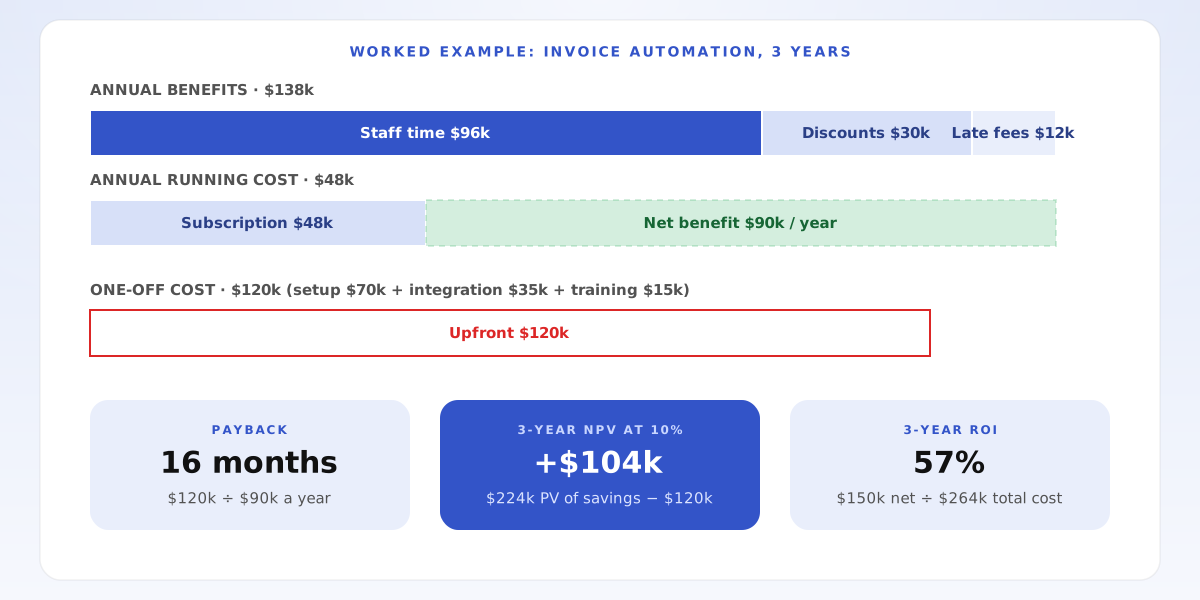
- Upfront cost: $120,000. Running cost: $48,000 a year
- Benefits: $138,000 a year. Net benefit: $90,000 a year
- Payback: 16 months. 3-year ROI: 57%
- 3-year NPV at 10%: about +$104,000
How Do You Compare the Options in a Business Case?
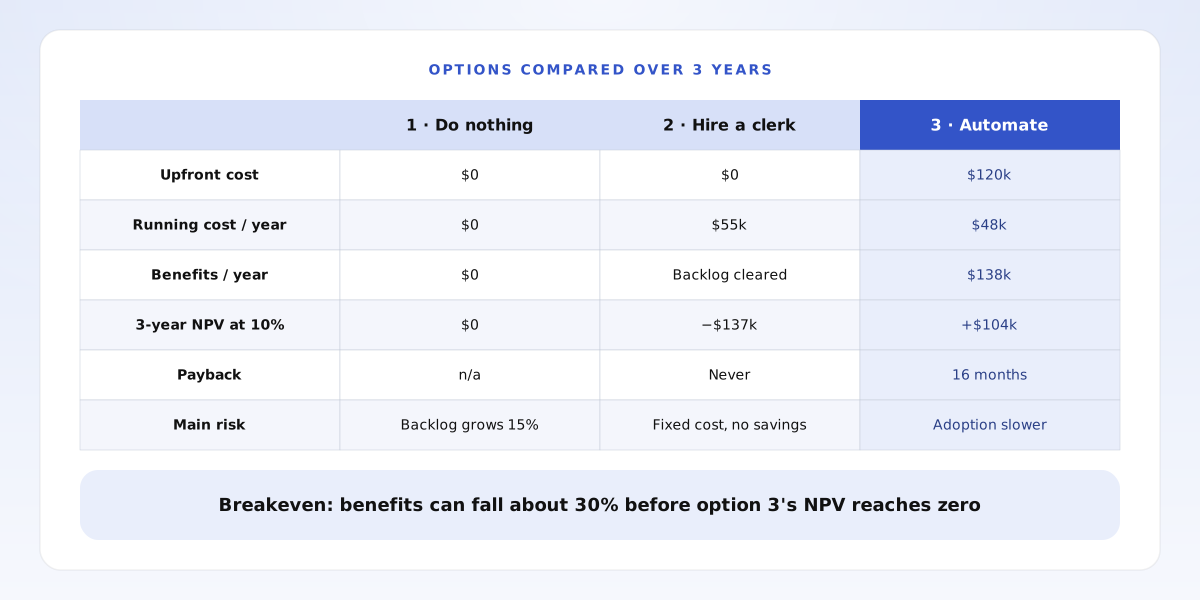
Put every option in one table using the same horizon and discount rate. In the example, doing nothing costs nothing upfront, but the backlog grows with the 15% volume increase. Hiring one more clerk at $55,000 a year clears the backlog but creates no savings, so its three-year NPV is about -$137,000. Automation is the only option with a positive NPV.
Then test the riskiest assumption. Benefits can fall about 30%, to roughly $96,000 a year, before automation's NPV reaches zero. If the team believes the tool will deliver at least 70% of the estimated savings, the case holds. For options that differ on more than money, such as vendor lock-in or team morale, add a decision matrix alongside the numbers.
What Are Common Business Case Mistakes?
Leaving out doing nothing. Without the status quo as a baseline, the reader cannot tell whether any option is worth it.
Counting benefits nobody will bank. Saved hours only become savings if the time is redeployed or a hire is avoided. Say which.
Mixing time horizons. Comparing three years of benefits for one option with five years for another makes the numbers meaningless.
Burying the ask. If the reader reaches the end without knowing what to approve, the business case has failed, however good the analysis.
Frequently Asked Questions
How long should a business case be? As short as the decision allows. A one-page summary with an appendix of numbers works for most decisions; large capital projects may need 10 to 20 pages.
What is the difference between a business case and a business plan? A business case justifies one decision or project. A business plan describes how a whole business will operate and grow.
Which financial metric should a business case use? Show payback for simplicity, NPV for value and ROI for comparison. If they disagree, NPV is the most reliable because it accounts for timing.
Who writes the business case? Usually the person who will own the project, with input from finance on costs and from the teams affected on benefits.
How Does Razn Help You Write a Business Case?
Razn is a workspace that helps you structure a business problem into an issue tree, test the hypotheses behind it and turn the result into an answer-first document that is ready for a decision. Use it before you write the business case, when the problem is still messy: break down what the status quo really costs, lay out the options and their drivers, and draft the recommendation with the reasoning attached. To learn the structure first, see answer-first writing.
- Lead with the recommendation and the ask
- Always compare against doing nothing
- Show payback, NPV and ROI on the same horizon
- Test the assumption that matters most before you send it


